
- Let’s boot up our mushrooms and log into the fungal network.
If you like Asian food, you’re familiar with the shiitake mushroom. These vaguely baby bella-looking fungi are absolutely delicious, whether you grill them, fry them, or use them to infuse mouthwatering umami flavor into broths.
In the future, they might also help power your computer.
A research team from the Ohio State University (OSU) has demonstrated that shiitake mushrooms could work as parts of computer memory components. Their mycelium convey electric signals just like conventional electronics, so in a way, this discovery makes sense.
The OSU team successfully used shiitake colonies as for data memory storage. Although the mushroom components don’t yet hold a candle to actual PC chips, the tests show that there is potential in the fungus.
We might soon have a real need for fungal computers, too. The rare earth minerals used to produce current computer chips are becoming an ever-scarcer resource, and fungus could jump in to fill the role.
Man, first they teach mushrooms to walk around in robot bodies and now this. Maybe the future is fungal.
How Does It Work?
While the idea of a mushroom-powered computer might seem outlandish, it’s actually nothing new. According to John LaRocco, research scientist in psychiatry at the OSU and lead author of the new study, fungal tech has been tried, but not to the degree that his team did.
“Mycelium as a computing substrate has been explored before in less intuitive setups, but our work tries to push one of these memristive systems to its limits,” LaRocco said in a statement.
Memristors are a type of computer component that processes data and can remember “past electrical states.” For instance, the RAM (basically working memory) in the device you’re using is a memristor.
Fungi are good candidates for building bioelectronics as their mycelium (the mushroom’s “roots”) conduct electricity much like current semiconductors. They’re not a drop-in replacement for modern tech, but there’s potential there.
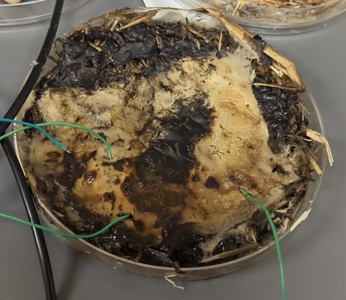
To explore this potential, LaRocco’s team grew colonies of both shiitake and button mushrooms. Once the fungi were mature, they were dehydrated to keep them from decomposing and to prevent excess moisture interfering with computer systems.
Then, the researchers plugged the fungi plates into custom-made computer circuits and started shocking them with electricity.
“We would connect electrical wires and probes at different points on the mushrooms because distinct parts of it have different electrical properties,” LaRocco explained.
What Were the Results?
Initially, the team had to find out how to most effectively use the mushrooms in computing. Fungi aren’t as uniform as factory-built electronics, after all, and they sometimes worked better than other times.
“Depending on the voltage and connectivity, we were seeing different performances,” said LaRocco
After two months of electrocuting mushrooms, LaRocco’s team started getting results. They were able to use the shiitake memristor as RAM. The fungal component operated at 5,850Hz with a roughly 90% accuracy.
Now, that’s not particularly powerful. For reference, modern RAM run at clock speeds anywhere between 400 and 1,067MHz.
Additionally, LaRocco’s team found that the shiitake RAM’s performance crashed as the electrical voltage increased, indicating that they were pumping more power into the mushroom than it could handle. Still, they believe this issue could be circumvented simply by using more mushroom.
Why Did They Do It?
But why would they want to build a fungal computer? Well, one of the more burning reasons is that we may soon need them.
Producing modern computer components requires large amounts of energy and rare earth minerals. If you’ve been reading the news, the latter are becoming so rare — even for things with “rare” right in the name — that they’re starting to cause geopolitical tension.
Mushroom, on the other hand, are quick and easy to grow.
“Everything you’d need to start exploring fungi and computing could be as small as a compost heap and some homemade electronics, or as big as a culturing factory with pre-made templates. All of them are viable with the resources we have in front of us now,” said LaRocco.
Additionally, mushroom-based electronics are a lot more environmentally friendly than current ones. Modern gadgets aren’t exactly biodegradable and contain chemicals that can be very harmful if they get to flow freely into the soil.
Finally, the fungal computer could use less power than semiconductor-based systems.
“Being able to develop microchips that mimic actual neural activity means you don’t need a lot of power for standby or when the machine isn’t being used,” mused LaRocco.
If you’d like to read more about unusual (and a bit creepy) computer developments, check out our story about the computer powered by a human brain.