
- Talk about a smart device.
If you have a computer powered by disembodied human brain, is it a man or machine? That’s a question that comes up in many science fiction stories where combining human biology with computers is possible.
Soon, we may have to start asking that question in real life as well.
An Australian biotech company Cortical Labs has released something that seems like a breakthrough. The firm has launched the first commercial computer that combines a silicon processor with human brain cells.
That’s right — the CL1 computes using the same neurons that fire inside your skull.
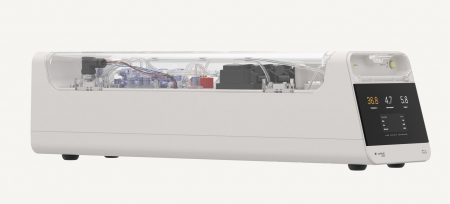
Floating inside a life support system, the human neurons integrate with the more traditional computer processors. The user can feed them information through various input methods, such as cameras, and the neurons respond as a human brain would.
Cortical Labs believes the computer could break new ground in, for example, medical tests, where scientists would no longer have to rely on animal experimentation. Additionally, the manufacturer says the CL1 is poised to blaze a trail in machine learning.
But is it “machine learning” anymore if its human brain cells doing the learning?
A Brain for Sale
Cortical Labs is a biotechnology company based in Australia. They’re not newcomers to human brain computing.
The company’s engineers have been blending brains and silicon for years. However, so far their efforts have been restricted to university laboratories.
Not anymore. In early March, Cortical Labs released the CL1.
This machine is the world’s first commercially available “code-deployable biological computer.” That means it’s a computer you can program like a regular silicon-based one, but this one has a brain.
Literally. And it sells for $35,000.
Inside the CL1 is a silicon chip, on which grows a network of human neurons. They live inside a life support system filled that provides the brain cells everything they need to survive, like nutrients, oxygen, and so forth. According to the manufacturer, users can expect a six-month life span from the neurons before they need replacement.
So, whose brain is inside this thing, anyway? Well, that’s the thing — it’s nobody’s.
The brain cells in the system are grown in a lab. They’ve never been inside a human being, nor are the conscious.
But they still have the capacity to learn.
Natural Intelligence
Sure enough, learning is one of the main purposes of the CL1. Cortical Labs believes that the computer could possibly cause waves in the artificial intelligence and machine learning scenes.
After all, AI is just software that tries to emulate the human brain’s ability to learn. But here we have a naturally learning human brain, in a computer, that you can program and give instructions to.
Case in point, the Cortical Labs team taught one of their early brain-powered computers to play Pong. Or well, they hooked it up to Pong and the brain cells learned to play the game pretty much on their own.
But playing decades-old video games isn’t really what this project it about. In addition to creating learning machines, the CL1 could be used in the medical field as well.
For instance, it could help researchers currently relying on animal testing to no longer test on animals. Instead, they could create a computer program that simulates the effect of a disease, for example, and see how the CL1’s brain cells respond to it.
All that said, the $35,000 price tag is pretty cheap, and not all research labs can afford it. That’s fine — Cortical Labs also says researchers will be able to use the company’s cloud service to buy remote time on the brain-silicon chips to do their computations.
And the CL1 computes cheaply, too. Compared to computers running current AI platforms, the CL1 uses very little power.
It’s a Little Creepy
That’s all well and good, but are you still a little uncomfortable with this whole “brain in a jar” computer? If you are, don’t worry. Others are too.
Although Cortical Labs assures us that the brain cells in the machine are unconscious, they are still human parts. That brings up a lot of ethical and moral questions.
For its part, the company seems to be on the ball when it comes to these concerns. Although the CL1 is out on the open market, Cortical Labs says it requires all buyers to produce all necessary regulatory approvals, based on where they’re located and what they plan to do with the computer.
That’s another question — what will people do with the CL1? We’ve gone through some of the intended end uses, but the thing about computer nerds is that they love to break things down and use them in ways they were originally intended.
“The difficulty I keep hearing … is that we don’t fit into a box,” Cortical Labs chief scientific officer Brett Kagan told New Atlas. “And we don’t – we’re a technology that crosses a number of different boundaries.”
Concerns about this new technology are certainly warranted. But, for the time being, it seems like a breakthrough piece of tech that could change a lot of things.
As long as the brain in the box doesn’t wake up.