
1The First Photograph Ever Taken (1826)
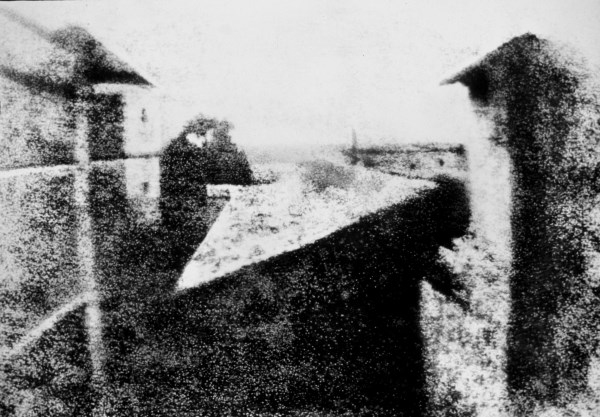
The oldest surviving camera photograph was created by Nicéphore Niépce in 1826 at Saint-Loup-de-Varennes, France. It shows parts of the buildings and surrounding countryside of his estate, Le Gras, as seen from a high window.
Niépce captured the scene with a camera obscura focused onto a 16.2 cm × 20.2 cm (6.4 in × 8.0 in) pewter plate thinly coated with Bitumen of Judea, a naturally occurring asphalt. The bitumen hardened in the brightly lit areas, but in the dimly lit areas it remained soluble and could be washed away with a mixture of oil of lavender and white petroleum. Niépce called this a "heliograph."
Sunlight striking the buildings on opposite sides suggests an exposure that lasted about eight hours, which has become the traditional estimate.
2The First Photo of a Human (1838)
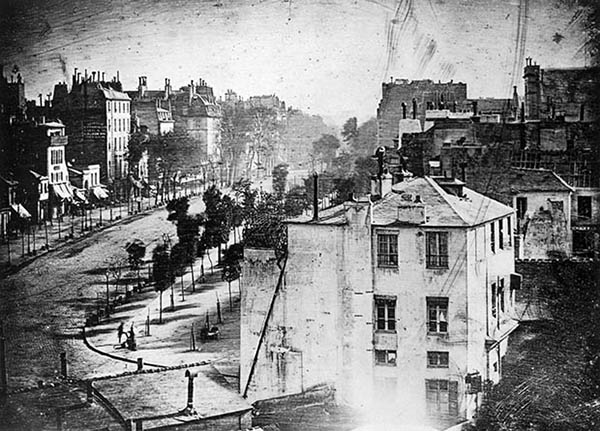
The honor of being the first human ever photographed is bestowed on an anonymous man in the lower left of the corner of the picture above.
The photo dates back to 1838 and was taken by Louis Daguerre (inventor of the daguerreotype process of photography) himself. The scene is from Paris. It's a view of the Boulevard du Temple.
To achieve the image, Daguerre exposed a chemically treated metal plate for ten minutes. There are other people in the photo, but they were walking or riding in carriages down that busy street that day. Because they were in movement, they didn't show up. This guy stood still long enough — maybe to have his boots shined — to leave an image.
3The First Selfie (1839)

The first photographic self-portrait was taken just a year after that of the first human photographed, in 1839.
In October or November 1839, Robert Cornelius, then 30 years old, set up his camera at the back of his father's shop in Philadelphia. He ran into the frame and sat still for five minutes before running back and replacing the lens cap.
Cornelius, the son of a Dutch lamp manufacturer, became a photographer specializing in portraits, but only operated for about two years before returning to his father's lamp business. He managed it for 20 years and held many patents for improved lamp designs. The business became the largest lighting company in America and Cornelius died a wealthy man in 1893.
4The First Portrait Photo of a Woman (1840)
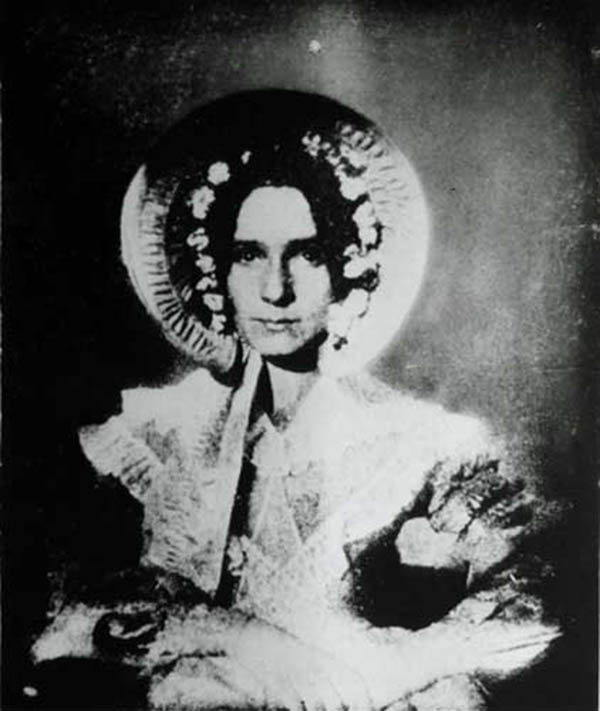
This photo of Dorothy Catherine Draper is the earliest surviving photograph of a woman. John William Draper, professor of chemistry at the University of New York, built his own camera and made this portrait of his sister in early 1840, after a 65-second exposure.
Draper, had her face powdered with flour in an early attempt to accentuate contrasts and was also the first woman to be photographed with her eyes open!
5The First Hoax Photo (1840)
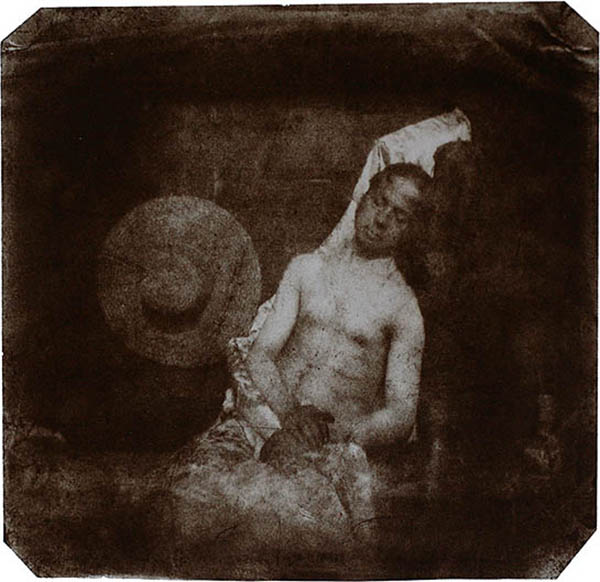
The great, great grandaddy of the Photoshopped photo was taken in 1840 by a French photography pioneer named Hippolyte Bayard.
Bayard was to Daguerre what Tesla was to Edison. There was a rivalry between the two photography pioneers, and although Daguerre became known as one of the “fathers of photography,” Bayard claimed to have actually invented photography first.
Bayard was talked out of announcing his own direct positive printing process to the French Academy of Sciences by François Arago, perpetual secretary of the Academy and a friend of Daguerre's. The delay caused by Arago allowed Daguerre to beat Bayard to the punch – he publicly unveiled the daguerreotype process at the Academy on January 7, 1839.
Bayard did eventually report his own process to the Academy in 1840, but it was too late. Daguerre had gotten the monumental “first." To protest, Bayard made the first hoax photo, titled “Self Portrait as a Drowned Man." It was meant to make people believe that he had committed suicide. On the back of the photo was a statement:
The corpse which you see here is that of M. Bayard, inventor of the process that has just been shown to you. As far as I know this indefatigable experimenter has been occupied for about three years with his discovery. The Government which has been only too generous to Monsieur Daguerre, has said it can do nothing for Monsieur Bayard, and the poor wretch has drowned himself. Oh the vagaries of human life….! … He has been at the morgue for several days, and no-one has recognized or claimed him. Ladies and gentlemen, you'd better pass along for fear of offending your sense of smell, for as you can observe, the face and hands of the gentleman are beginning to decay.
Bayard obviously didn't commit suicide, and contributed a good deal to photography over the remaining 50 years of his life. He helped found the French Society of Photography, and invented what became known as combination printing.
6First Wildlife Photos to Appear In National Geographic (1906)

When National Geographic published its first wildlife photographs in July 1906, two of the National Geographic Society board members “resigned in disgust.“ Why? They were afraid the reputable magazine was turning into a "picture book."
The photos, published in the magazine, were captured by George Shiras, III and marked quite a few “firsts.”
To achieve his shots, Shiras pioneered a number of different photo-making methods. One was to float silently across water in complete darkness. When he heard rustling nearby, he would point his camera system and snap a flash photograph in that direction.
He also created a custom-designed camera trap system (the first of its kind) that used a trip wire to activate a magnesium flash gun. When animals would attempt to take the bait attached to the wires, they would trigger their own photograph (and a flash that was powerful enough to temporarily blind both Shiras and the animal).
As a result of his ingenuity, Shiras succeeded in capturing the first nighttime wildlife photographs ever created.
As for the two board members who resigned in disgust – well, they faded into obscurity. In 1911, half a decade after his photographs appeared in the magazine, Shiras was named to the Board of Managers.
7The Oldest Surviving Aerial Photo (1860)
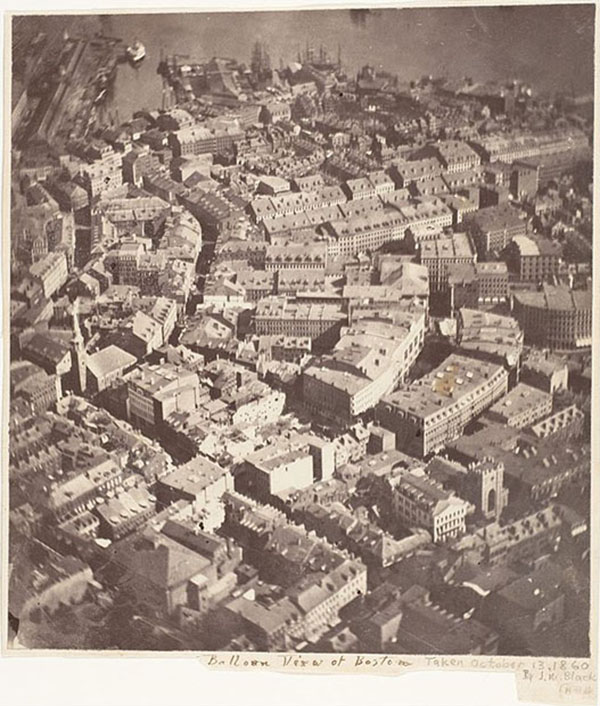
The world's first aerial photo, an 1858 image of Paris, France, captured by Gaspard-Félix Tournachon, is no longer with us. However, this photograph of Boston, captured from 2,000 feet above, is.
“Boston, as the Eagle and the Wild Goose See It” was taken by James Wallace Black in 1860. The photo, taken from a hot air balloon (the Wright Brothers weren't even born yet and wouldn't invent flight for another 43 years), is currently in the caring hands of the New York's Metropolitan Museum of Art.
8The First Color Photo (1861)

On May 17, 1861, James Clerk Maxwell unveiled the first color photo during a lecture at King's College London.
Clerk Maxwell first proposed the concept of combining three separate single-color exposures into one image to create a full-color photograph in 1855. However, it wasn't until 1861 that he was able to put that theory into practice with the help of photographer Thomas Sutton, the inventor of the single lens reflex camera.
The pair took three separate exposures of a tartan ribbon, each through a different color filter — red, green and blue. During the Kings College lecture, the slides were projected through that same color filtered lens, and focused and combined into a single, full-color image.
While the red and green exposures weren't nearly sensitive enough to capture all the color in the tartan ribbon, it was the first full-color image, and the basis of color photography as we know it.
9The First Digital Image (1957)

In 1957, Russell Kirsch, a scientist at what is now the National Institute of Standards and Technology, used a drum scanner connected to the SEAC (Standards Electronic Automatic Computer) to scan an image of his three-month-old son Walden.
The scanner used a very sensitive light-detecting tube called a photomultiplier to translate the parts of the image into black or white square pixels. If light was reflected off a scanned spot on the photo, SEAC registered a 0 (white). If no light signal was received, it'd register a 1 (black).
It should also be noted that the first digital camera wasn't invented until 1975 by the Eastman Kodak Company.
10The First Photo On The Web (1992)

This composite image is a promotional shot for Les Horribles Cernettes, a particle physics parody pop band led by Michele de Gennaro, a 3D graphics artist at CERN in the early 90s.
The photo was taken backstage at the 1992 Hadronic Music Festival by Silvano de Gennaro, Michele's then-husband and an IT developer at CERN. (He later tricked out the image in the very first version of Photoshop.)
Tim Berners Lee, inventor of the world wide web (and a fan of the Cernettes), was working at CERN as software consultant developing software that would enable the web to handle GIF images. As the story goes, he was just bumming around the office, when he asked de Gennaro for a few scanned photos that he could upload and the rest, as they say, is history.
At least that's what's been reported over the years. De Gennaro offers a slightly different version of the story: "One word about the press tornado that is happening right now around us, concerning the alleged 'first photo on the web.' If you read our website, it says that it was, to our knowledge, the 'first photo of a band.' Dozens of media are totally distorting our words for the sake of cheap sensationalism. Nobody knows which was the first photo on the web. But our photo was one of those that changed the web, from a platform for physics documentation, to a media for our lives. It was the portal that opened the Web to music and arts, and to anything fun!"
While it's probably pretty difficult to know which was the very first photo uploaded to the web, it's believed that the image was among the first five pictures published on the web.
And as for the band? They officially disbanded in late July 2012, after performing at the CERN Hardronic Festival. To check out the smooth pop stylings of the Cernettes, watch below!