
- ‘Bird Corpse Wildfire’ would be a pretty badass band name, if not for the real-world implications.
Devastating wildfires have unfortunately become annual (and often year-long) problems almost all over the country. With the way the climate’s going, we sure don’t need anything additional, like gender-reveal parties, to set things on fire.
Oh, look, the undergrowth just caught fire because a flaming bird fell in there.
That sounds like a comedy routine, but it’s a dead serious reality. Incinerated birds are falling off power lines and causing huge wildfires.
It’s shockingly common, too. Just this summer, birds have started three fires in Colorado alone.
As such, experts are now calling on power companies to bird-proof their electrical equipment. Unfortunately, it’s like utterly impossible to make power lines completely impervious to bird-brained idiots.
We wish were referring just to birds.
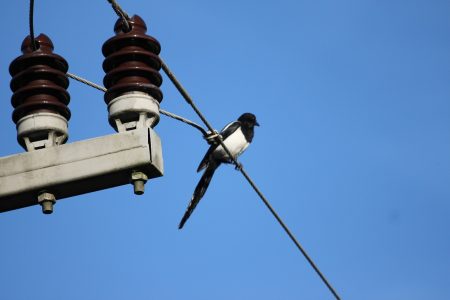
How Birds Catch Fire
“But wait a minute,” you say. “I’ve seen hundreds of birds sit on a power line and they haven’t caught fire! What gives?”
Well, that’s all because of how electricity behaves. A bird can safely perch on a single power line and there’ll be no issues.
That’s because the electricity traveling through the line has nowhere to go. As long as the bird doesn’t touch anything else, the electrical current will play nice and stay within the line.
The problems start when the bird unwittingly comes in contact with something else. In most cases, that “something else” is either a piece of metal equipment in contact with the ground or another power line.
Let’s say a bird is chasing a bug and touches a metal bracket on the power pole. That bracket could be touching another metal bracket and so on, until you can build a metallic pathway to the ground.
Now the electrical current can escape through the bird to the metal structure and travel to the ground. Needless to say, that’s not going to be healthy for the bird.
In the other situation, the bird might place one of its feet on one wire, and the other on another. This forms a circuit, and suddenly there are thousands of volts of electrical current coursing through the poor avian.
In both cases, the bird is a goner. However, that doesn’t necessarily mean it will catch fire.
“Sometimes they just fall dead. Not every bird that is electrocuted will fall to the ground and start a fire,” Taylor Barnes, Biologist and GIS specialist from electric utility consulting company EDM International told 9News.
Occasionally, though, the bird will burst into flames. Once its smoldering carcass hits the dry brush beneath the power line, the real problems start.
Dozens of Blazes
It’d be easy to dismiss bird-caused wildfires as freak accidents, and in the grand scheme of things, they might be that. Still, some things that seem rare can be surprisingly common, and this is one of them.
For instance, a 2022 study that Barnes led discovered that burning birds caused 44 wildfires between January 2014 and December 2018.
Most of the fires were fairly small, but some grew out of control. The largest reviewed wildfire was a 2015 blaze in Indiana, caused by a “raptor,” that burned more than 4,000 hectares of land.
This summer, too, has seen several bird-sparked wildfires. Colorado alone has seen three wildfire incidents caused by birds this year between July and August.
Fortunately, no one has died in the fires, but that doesn’t mean they weren’t serious. For instance, a fire in Colorado’s Arapahoe County, sparked by a bird on July 13, burned 1,100 acres, a home, and a dozen outbuildings.
Protected but Not Bird Brain-Proof
As large-scale wildfires are getting more and more common, it’s crucial that we do our best to prevent any blazes that can be prevented. As such, experts like Barnes are now calling on power companies to try and bird-proof their equipment.
Various types of coatings applied to power lines and connected equipment are the most common and effective way to stop birds from catching aflame.
“Things like equipment that goes over the energized pieces on a pole, rubber coverings, cages, all types of things to try to keep wildlife and specifically birds out of the equipment,” Amber King, communications manager of Core Electric, told 9News.
These coatings are thick enough that even if a bird were to spend some time pecking them, they can’t break through to the inevitable doom contained within.
Unfortunately, even these measures can’t cover power equipment completely. And as we all know, life always finds a way — and so will a bird, if it’s stupid or determined enough.
“There’s also elements of it that can’t always be 100% covered, or if they are, these little, tiny birds can sometimes get through that,” lamented King.