
- But what did the necklace cheese taste like?
Cheese is delicious. You can’t beat a nice chunk of brie or gorgonzola on a cracker, and melty mozzarella makes pizza worth eating.
Humanity’s love affair with cheese has ancient origins. But it’s unclear how long exactly we’ve been making cheese.
That said, a recent discovery has shed some light on our cheesy history. Archeologists have unearthed the oldest known pieces of cheese.
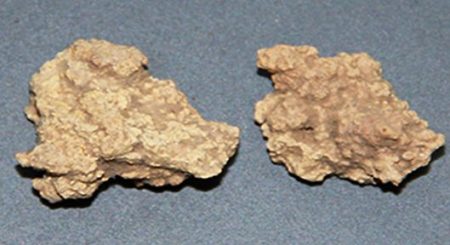
The well-aged cheese was found in a group of graves in an area that is today part of northern China. According to tests, the chunks are more than 3,000 years old.
That’s fascinating on its own. But the most mind-boggling thing is that the cheese wasn’t found on some fossilized snack plate.
Instead, it was part of a necklace worn by an ancient mummy.
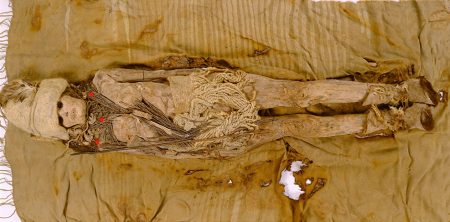
A Window to History
The discovery of the ancient cheese was detailed in a recent study published in the journal Cell. A team of archeologists found it in a group of graves in China’s northwestern Xinjiang region almost two decades ago.
In 2014, a protein analysis was carried out on the pieces, which confirmed that they indeed contained dairy proteins. The most recent research, however, has given us more detailed information about the cheese, its age, and the people who made it.
The cheese was prepared some 3,500 years ago by a Bronze Age people known to us Xiaohe. This makes it the oldest surviving piece of cheese archeologists have ever found.
That said, there is evidence of dairy being stored in containers that are even older. However, it’s impossible to say whether that dairy was cheese or simply milk, so the Xiaohe cheese takes the cake.
According to the study, the cheese is a type of kefir cheese, containing bacteria, yeast, and fungus still used in cheesemaking today. Although most kefir is drinkable these days, it seems the Xiaohe preferred theirs in a more solid form.
Additionally, DNA evidence shows the Xiaohe people were related to populations living in the steppes of today’s Mongolia and Russia. The discovery could indicate that (at least Asian) cheesemaking originated among the peoples of those regions.
Another factor supporting this theory is the milk the cheese was made from. That’s right, they were able to tell what animal produced the milk.
There were two types of cheese in the graves, one of cow and one of goat milk. The DNA extracted form the goat milk indicates the goats are related to those that originated in Eastern Europe.
As such, they would’ve had to cross the Central Asian steppes to get to China.
But Why a Necklace?
However, perhaps the most remarkable (and weird) thing about the cheese is how it was buried with the bodies. The Xiaohe didn’t place the cheese on a platter with some crackers and fruit.
Instead, they had made necklaces with the cheese and draped them on the bodies.
Now, burying food with the dead isn’t anything weird as far as human funerary practices go. For instance, the ancient Egyptians placed plenty of food in the pyramids for the Pharaohs to snack on in the afterlife.
In fact, some cultures bury food offering to this day.
However, in most cases where the food is meant to be “eaten” by the deceased, it’s typically presented as such. To return to the Egyptian example, the foodstuffs found in pyramids were placed in vessels and containers that would’ve stored living peoples’ food as well.
So, why did the Xiaohe put the cheese on a necklace? Well, that’s where we have to look at the second common type of grave goods.
Another common feature of ancient burials is various kinds of valuable objects. The dead could be buried with weapons, jewels, gold, entire chariots — or necklaces.
As such, its possible cheese was somehow incredibly precious to the Xiaohe. In a way, it makes sense.
If you’ve ever forgotten your milk carton on the kitchen counter, you know dairy products spoil very quickly. Turning milk into cheese used to be one of the only ways to preserve its precious proteins for any length of time.
So, it could be that the extra shelf life just made cheese that valuable to the Xiaohe. Or maybe they just liked wearing cheese necklaces in case they got peckish and wanted a little snack.