
- Meet the superheated space lemon with an impossible atmosphere and a core of diamond.
Space is strange. There are all kinds of bizarre things floating about in there, from planets where razor glass rains sideways to incomprehensibly huge voids where there’s nothing at all.
Yet, we know so little about the universe that astronomers discover new surprises all the time. Recently, they found a planet that defies most things we know about planets.
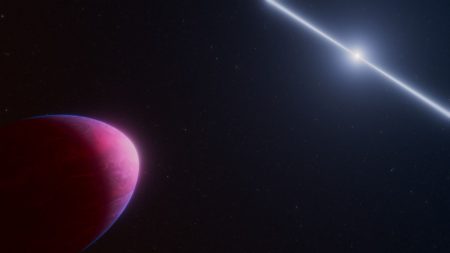
This planet is PSR J2322-2650b. Its most striking feature is that it’s shaped like a red lemon.
Yet, that is far from the only oddity about the planet. In addition, it’s ridiculously hot, has wind that blows in the exact opposite direction than it should, and it has an atmosphere consisting of carbon — which isn’t something that should be.
Part of the reason behind the planet’s weirdness is its host star. In many ways, this star is just as bizarre as its lemony orbiter.
Or would you expect a star to be extremely bright but invisible to scientists, allowing them to observe the lemon planet freely without any glare?
Let’s take a closer look at what makes PSR J2322-2650b such a cosmic oddity.
Breaking All Known Rules
So, our planet’s official name is the incredibly cumbersome PSR J2322-2650b. However, I’m not going to keep writing that over and over, so for the purposes of this article, I shall call the planet Lemonia.
The planet was discovered using NASA’s James Webb Space Telescope. We can only imagine how baffled the first person to lay eyes on Lemonia was.
True to the name I just gave it, Lemonia is unusual because it looks like a lemon. If that lemon was blood-red.
The citrussy shape of the planet is caused by the star it orbits. Lemonia floats so close to the much, much heavier star that it has been pulled into an oblong shape by the star’s immense gravitational field.
That’s not to say Lemonia is a featherweight. It’s a gas giant with a mass comparable to Jupiter, so it’s quite hefty in its own right.
Yet, Lemonia has no business being where it is — at least not according to universal rules we know. According to the current scientific understanding, Lemonia should not have been able to form in the location it’s in.
“Did this thing form like a normal planet? No, because the composition is entirely different,” said Michael Zhang from the University of Chicago.
“It seems to rule out every known formation mechanism,” he added.
Hellish Heat, High Winds, Diamonds; Oh My!
Indeed, its outlandish location has resulted in mind-boggling conditions on Lemonia. On the milder (and more easily understandable) end of the scale, we have the planet’s temperature.
During its day, Lemonia reaches temperatures up to 3,700 degrees Fahrenheit. Things cool down at night to a balmy 1,200 degrees.
Although researchers don’t yet know how long a day on Lemonia is, they do know the length of its year. The planet is so close to its star that it completes a full orbit around it in 7.8 hours. That means there’s a good chance its day is longer than its year.
Then we have the high winds that constantly rage in Lemonia’s atmosphere. On most other gas giants, the wind blows in the direction of the planet’s rotation. Not here, though — they go in the exact opposite direction.
And speaking of the atmosphere, it might just be the weirdest thing about the planet. Lemonia’s atmosphere consists of molecular carbon.
That’s really odd because usually carbon binds to other elements, like oxygen and water, and therefore it doesn’t really exist on its own. Except on Lemonia.
“In order to have molecular carbon in the atmosphere, you have to get rid of pretty much everything else — all of the oxygen, all of the nitrogen — and we just don’t know how to do that. We don’t know of any other planetary atmosphere that looks anything like this,” said Zhang.
Oh, and those clouds of carbon most likely condense into diamond near the planet’s core.
‘Mass of the Sun, Size of a City’
If the planet is weird, so is the star that it orbits. Lemonia flies around a pulsar, a kind of star that — instead of shining all around it — spews out two rotating rays of high-intensity radiation out of both of its poles.
That results in an unusually but beneficial situation for astronomers. Since all radiation out of the pulsar is focused into these beams, the star is only visible if one of the beams happens to shine directly on the telescope.
Most of the time, they don’t, which means the star is virtually invisible. That has allowed researchers to observe Lemonia in detail that wouldn’t normally be possible.
Another oddity about the star is its mass-size ratio. Zhang put it well: “[The star has] the mass of the Sun, but the size of a city.”
It’s a good thing astronomers spotted Lemonia now, because eventually, it will not be there. Every time the pulsar’s rays swipe over the planet, they strip off a tiny layer of it. Eventually, the pulsar will burn Lemonia away, unless the star goes out first.
That should take millions if not billions of years, though. So, scientists have plenty of time to find out what other mysteries the space lemon may hold.
Want more space oddities? Check the 6 weirdest objects found in space and the most horrifying planets in the universe.