
- Don’t believe Smokey Bear’s lies. Goats can stop forest fires, too.
As you’re probably aware of, the US West Coast is kinda-sorta on fire at the moment. The gender reveal parties they’re throwing aren’t really helping, either.
In fact, the gender reveal fire – known officially as the El Dorado fire – has claimed the life of one firefighter, according to Associated Press.
With the blazes spreading and emergency services battling 50-hour shifts, exploding trees, and choking smoke, it’s no wonder the West Coast states are turning unorthodox solutions. Any solutions, as long as they work.
They’re so desperate that even to local fauna is being called upon to help. In Oregon, firefighters are going to be getting some baah-dly needed aid.
A herd of 230 goats has arrived in the city of Forest Grove, 25 miles from Portland. Over the next week, they will be eating the dry undergrowth in a 140-acre wood as a wildfire prevention measure, wrote Oregon Public Broadcasting.
It might sound a bit off, but using sheep and goats is a fairly well-established firefighting method. Excess of dry vegetation is often one of the primary sources of fuel that ends up feeding wildfires.
Feeding that brush to the goats instead of the fire could make the difference between an area getting slightly scorched and turning into an inferno.
Seems like a good chance to quote an old saying – it’s not dumb if it works.
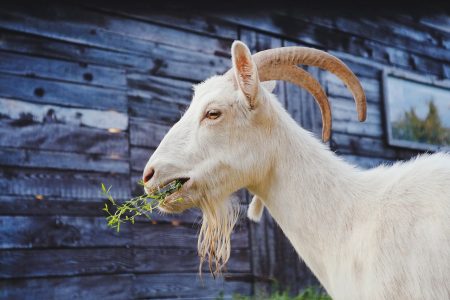
A Man and His Goats
The owner of the goat herd is a fellow by the name of Craig Madsen. He runs Healing Hooves, a Washington-based landscaping service relying on ungulate power.
Madsen used to be a federal office worker, but 18 years ago he was bitten by the goat bug. Well, maybe not literally, but he decided to quit his job and become a full-time shepherd.
In the summer months, he packs his herd into a trailer and drives around the northwest. He sells his goaty services at the request of public officials and private landowners.
It takes about two and a half minutes to get the entire herd out of Madsen’s trailer. Local onlookers have likened the scene to unpacking a clown car.
“I get a lot of requests from people who want [my goats] to do their backyards,” Madsen told OPB, explaining his business practices.
“And I say: ‘I don’t do those, because I can’t put 230 goats in your backyard.’ But there are people who’ll have a dozen or so goats. They’ll come out and do those projects.”
When he’s out on a gig, Madsen lives out of the back of his truck. While the goats chew on grass, his primary duty is putting up an electric fence to keep the herd where it’s supposed to be.
According to Madsen, the fence is needed because his animals can get mischievous. Goats live climbing, and sometimes the closest climbable thing might be someone’s brand new BMW or something.
Madsen also has two other employees – Irish wolf hound Gigi and Nessie, a miscellaneous herding dog. Gigi is the security officer who keeps coyotes and even cougars away, while Nessie is in charge of moving the goats in and out of the trailer in an orderly fashion.
Natural Solutions
According to the Healing Hooves website, the goats provide many other benefits in addition to cost savings. First of all, rough or rocky ground doesn’t deter them, and the goats happily munch away on plants that are harmful to humans, such as poison ivy.
The goats help protect both crews and local residents since they reduce the need to use toxic herbicide and potentially dangerous heavy machineries. Not only that, they often get rid of unwanted plants more effectively.
Some plants’ seed producing parts might escape lawn mower and weed whacker blades. The goats, on the other hand, will consume the plants down to ground level at the speed of roughly an acre per day.
“Goats will open up blackberry thickets, knock back scotch broom and eat a variety of other weeds. When the goats are done the area will not look mowed but they will have a significant impact,” Healing Hooves says.
A Goat-load of Fun
Last, but not least, the goats have a hidden bonus: they’re entertaining.
“They’re fun to watch. Your crew and your family will love watching the herd at work (to them, it’s play) and hearing their gentle bleats as they call to each other,” the company says.
Madsen’s firm is not exaggerating. In Forest Grove, he has been shower facilities and lodging by locals who know and love his goats.
Madsen, however, usually turns down the offers, though he might pop by occasionally to wash up. His work gets lonely, sometimes, but he likes to spend his time reading in the company of his dogs.
Once his goats are done in Forest Grove, Madsen will head over to Spokane.
“I’ll be doing some work in the city of Spokane, and the primary purpose is to reduce fuel loads. And second is to try and manage noxious weeds,” he said.
Mr. Madsen, we thank you and your goats for your service.