
- What a way to go.
For an animal that died off 10,000 years ago, the woolly mammoth sure is an iconic one. These furry elephantine beasts symbolize both the last ice age and early human survival.
That’s probably why so many people, both scientists and regular Joes, are fascinated by the cause of mammoths’ extinction. Multiple theories about why mammoths disappeared have been proposed over the years — some of them more credible than others.
One theory suggests that the warming climate and retreating ice shelves made mammoths’ previous habitats unsuitable for them. Another popular claim is that humans hunted mammoths off the face of the Earth.
We’re sure there’s one theory about aliens having something to do with it out there, as well.
But now, a recent study has proposed a new theory about mammoth extinction. And it’s a decidedly less dramatic one than global climate change or violent death at the hands of cavemen.
According to the study, mammoths died out because of pollen allergies.
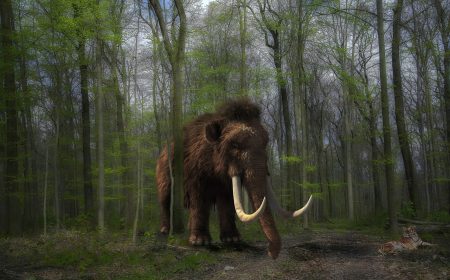
Plants Here, Plants There
So that’s their inglorious end? Mammoths all around the planet sneezed themselves to death?
Well, it’s not quite that simple. The allergy theory actually ties into the earlier ideas about a warming world and human predation.
Now, it is true that Earth started warming up toward the end of mammoths’ life as the last ice age came to a close. With the warming temperatures, plant life could spread into new areas — and the new study claims that the plants everywhere flew into something of a breeding frenzy.
As you surely know, most plants reproduce through pollen. With the number of plants exploding, so did the amount of pollen wafting continuously through the air.
The new study claims that mammoths simply couldn’t deal with that.
Stuffed-Up Trunks
If you or someone you know suffer from pollen allergies, you’ll know that they can seriously clog up your nose. The researchers suggest that’s what happened to mammoths’ trunks.
“One of the possible mechanisms for the extinction of animals during climate change could be a violation of the sense of smell due to the development of allergies when the flora changes,” the study reads.
With the increased amount of pollen, mammoths simply couldn’t smell things. And the sense of smell is kind of a big deal for animals.
For instance, during mating season, mammoths would’ve sniffed out amorous partners’ hormones. But with a stuffed trunk, they wouldn’t know whether their potential mates were in the mood, so eventually mammoth birth rates began to collapse, the study suggests.
In addition to finding opportunities to get it on, mammoths would’ve also relied on their sense of smell to detect danger. A whiff of a saber-toothed cat or a stick-wielding hairless ape in the air would let the mammoth know it’s time to vamoose.
Once again, however, sinuses clogged by allergies would’ve prevented mammoths from smelling their predators. They wouldn’t realize they were in danger until the band of screaming apes was poking them to death with their sticks.
Unfortunately for mammoths, Claritin wouldn’t be invented for another dozen millennia. So, their allergies may not have directly killed them, but they certainly may have hastened their grave-bound journey.
Lacking Proof
On paper, the death-by-allergies theory is a bit strange but it’s not completely implausible. So, what evidence have the researchers produced to support their theory?
Well, not much. Nobody has investigated whether mammoths were allergic to pollen, but the study proposes one way to figure it out.
First, they propose checking mammoth carcasses and their immediate surroundings for possible preserved pollen. Researchers have unearthed many mammoth bodies in almost pristine condition, and some of them do have pollen remaining in their tissues.
Next, the study suggests checking whether any of the pollen is from plants known to cause allergies. If so, they could’ve given the mammoths stuffy trunks.
Finally, there’s one place left where we can look for proof of mammoth allergies — their poop. Allergic responses produce a protein called immunoglobulin (IgE), which remains in excrement. If there’s IgE in mammoth crap, they may have suffered from hay fever.
Not everybody in the scientific community is on board with this research plan, however. The allergy theory’s detractors have called it far-fetched and said there’s little chance of conclusively proving it.
The (Theoretical) Return of the Mammoth
But hold your prehistoric elephant relatives! There may be one remote chance of finding out for certain whether mammoths had allergies.
We simply need to clone a mammoth.
That has been the dream for paleontologists and biologists for decades. Recently, however, a scientific breakthrough brought us a little bit closer to resurrecting the mammoth.
Scientists have successfully produced induced pluripotent stem cells (iPSCs) from Asian elephants. To keep things simple, think of iPSCs as the skeleton keys of cell development — they can become any cell type found in a given animal.
That’s a big deal for both mammoths and Asian elephants. The latter are the closest living relatives of woolly mammoths, but only 52,000 Asian elephants remain in the wild.
If they die out, our hopes of resurrecting the mammoth die with them. But with the Asian elephant iPSCs in hand, biologists can now produce their sperm and egg cells in a lab.
Not only can that help preserve Asian elephants, but also resurrect the mammoth. Basically, researchers can take the Asian elephant stem cells and genetically modify them into mammoth reproductive cells.
And when/if they manage to clone a mammoth, we can then simply have it snort up some pollen. If it starts sneezing uncontrollably, we’ll have proven that allergies may have driven its predecessors into extinction.
What do you mean this project is “a waste of money?” We need to know!