
- We came so close to never having existed at all.
Today, there are 8.1 billion people on the planet and the number just keeps growing. There are scant few places on planet Earth where you won’t find any humans.
Things were a little bit different roughly a million years ago. At the time, humanity wasn’t doing so well.
In fact, we were teetering on the brink of extinction.
Well, “we” is a relative term. Modern humans didn’t exist yet, but our direct ancestors seemed doomed to die off as a species.
Yet, they pulled through. Not only that, the evolutionary bottleneck created by the minuscule human population may have resulted in the birth of Homo sapiens.
But what was it that almost killed off the fledgling human population? And how did they figure out this happened?
Let’s dive into it.
How They Figured It Out
First, we should point out that you should take everything here with a grain or two of salt. Human evolution is a murky subject at best, with very few fossil records surviving from certain periods in time.
We know (or at least estimate) that modern humans — that is, the species of hominin we call Homo sapiens — showed up in Africa some 300,000 years ago. Outside of that, things are pretty anyone’s guess.
This lack of data on the rise of modern humans is what led a team of scientists to embark on a genetic quest in 2023 to find out more. They wanted to figure out the population of the last common ancestor between modern humans, Neanderthals, and the mysterious Denisovan humans.
To this end, they sequenced the genome of 3,150 people from all around the world. Using a novel analytical method, they could examine the diversity of certain genetic sequences and thus estimate the size of the group we all descended from.
The results were somewhat surprising. It turns out that we originate from a much smaller group than previously thought.
Much, much smaller. So small that we were on the verge of extinction.
1,300 Survivors
The year is roughly 928,000 BCE. We’re nearing the end of the Calabrian stage of the Pleistocene Epoch.
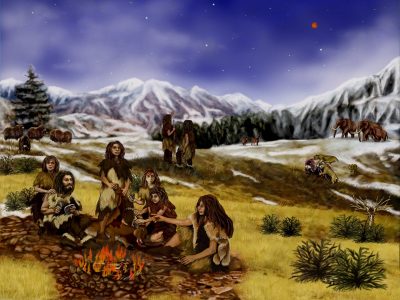
At this point, the planet is populated by fascinating creatures. There are mammoth, saber-toothed cats, wooly rhinos, giant ground sloths — and humans.
They’re not quite like us, mind you. The humans inhabiting the planet at the time are a group that would later splinter into us, the Neanderthals, and the Denisovans.
We’re not quite sure who they were — they may have been Homo erectus, Homo heidelbergensis, or an unknown species of human. But we do know that they were almost all gone.
According to the researchers’ estimates, the entire human population on Earth 930,000 years ago was at most 1,300. Within a short period of time, nearly 99% of early humans dropped dead.
“The estimated population size for our ancestral lineage is tiny, and certainly would have brought them near to extinction,” paleoanthropologist Christ Stringer told LiveScience.
Earlier studies support this theory. One found that the chromosome known as chromosome 2 — which is found in modern humans, Neanderthals, and Denisovans — appeared from the fusion of two other chromosomes roughly 900,000 years ago.
Having such a tiny breeding pool would’ve certainly resulted in genetic changes in early humans.
Ultimately, though, it’s hard to say anything for certain because there are next to no human fossils from this period. Then again, that also kind of supports the theory of there being disappearingly few humans.
After all, you can’t have human fossils if there aren’t enough humans around to leave them behind.
Evolutionary Silver Linings
But why did our ancestors come so close to total annihilation? Well, that’s the next big question.
We do know that the Earth’s climate cooled significantly around the same time that the majority of early humans died out. Scientists believe that the cooling temperatures also brought with it long droughts in Africa, Europe, and Asia.
There were likely more factors at play, but it’s difficult to say anything for certain. The hard times didn’t end quickly, though, as researchers believe the global human population stayed around 1,200-1,300 for about 120,000 years.
In the end, though, something good came out of it, at least from our perspective. That good might be us.
According to current estimates, the three aforementioned human groups split off from their final common ancestor around 750,000 years ago. That would be around the time the human population started growing again.
It’s possible that our 1,300 tough-as-nails ancestors were isolated into small groups with no contact with each other. Over thousands of years, these groups may have started developing in different ways before finally becoming distinct groups.
One of those groups may have ended up becoming Homo sapiens — ultimately leading to you and me.
It does kind of put into perspective how close we came to never existing in the first place. After all, there are roughly 70 times more people attending an average football game than there were on the entire planet a million years ago.