
- Can you imagine what life would be like if we didn’t have buttholes?
No matter how mundane of a body part it is, at some point along the evolutionary line, it appeared for the first time. Something as basic as eyes, blood, or even brains stop existing if you go far enough back in history.
The same goes for the butthole.
An animal’s rear passage can be a real goldmine of historical information. It can tell us a lot about what it ate and how it had babies, for instance.
As such, scientists (and people with questionable interests) have wondered which creature had the world’s first anus.
If you fall into either one of these categories or are just curious in general, we have good news for you. Researchers have figured that one of the earliest, if not the first, butthole in history belongs to a comb jelly.
Not only do these primitive marine creatures have one of the oldest poop chutes, they just might also be related to every other form of life on Earth. Let’s take a closer look at this creature and its ancient bottom.
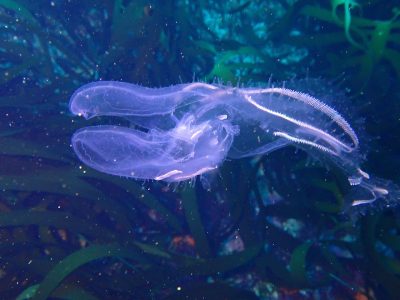
What’s a Comb Jelly?
First things first, you might wonder what a comb jelly is. Scientifically known as ctenophora, these gelatinous blobs float around in all of the planet’s oceans.
A comb jelly’s body consists (to no one’s surprise) of a central mass of jelly-like goo. There’s no template for what shape the jelly should take, and the jellies range from egg-shaped to tubular to completely flat.
They also vary greatly in size. The smallest ctenophora are only a few millimeters long, while the largest can reach sizes of up to five feet.
What they have in common is cilia (well, most species do, anyway). These hair-like protrusions are the “combs” that comb jellies use to swim around.
Comb jellies are also incredibly ancient creatures. They date back to 600-700 million years ago, which is about 350 million years before life moved onto land.
The Discovery of the Hole
Being as old as they are, comb jellies lack many features that evolution has since developed. For the longest time, everybody believed buttholes were one of those things.
Back when comb jellies were a spry, young lifeform, having a separate anus wasn’t in vogue. The style of the time was having a single multi-purpose orifice.
You ate, pooped, and performed all other hole-related activities with the same opening. Simple (and pretty gross), but efficient.
That idea changed in 2016. William Browne, an evolutionary biologist from the University of Miami, fed comb jellies a bunch of microscopic sea life engineered to glow red.
Thanks to the creatures’ translucent bodies, he was able to observe their food traveling through their systems. Browne probably expected them to excrete the indigestible parts out through their mouths.
But that’s not what happened. The comb jellies squeezed it all out from their rears.
Surprised, Brown took a microscope and zoomed in on the jellies’ hind quarters. Sure enough, he discovered tiny pores, surrounded by a ring of muscle.
They were the most primitive buttholes humankind had ever laid its eyes on.
In terms of evolutionary biology, this is a sensational discovery. For instance, the journal Science wrote that “the butthole is one of the finest innovations in the past 540 million years of animal evolution.”
Your Oldest Relative
But why is this ancient gooey creature’s ass such a big deal? Well, this is where their overall age comes into play.
When we said comb jellies are ancient, we weren’t kidding. Biologists consider them one of the oldest lifeforms, rivaling sponges (with whom they may have shared an immediate ancestor).
As such, they are believed to be related — albeit extremely distantly — to every single living thing on the planet today. You, your dog, your neighbor’s goldfish, and that bird in the tree over there all share a common link with the comb jelly.
Consequently, comb jellies carry some of the oldest sets of genes in the world. With all this in mind, what does it say if, for example, we humans and comb jellies both have a certain gene?
Well, that’s got to be one extremely important gene for having persisted through 700 million years.
The genes that result in the butthole, may just be among that distinguished group. Although there’s no hard evidence, it’s possible that you can thank the comb jelly for your own ass****.
Of course, there still remains the question of why the comb jellies developed an anus. Sponges, their close relatives, do not have buttholes, so what advantage does it give to the comb jellies?
Well, we’re no scientists, but we’re guessing it might be because the jelly figured out that eating and pooping with the same hole is just plain disgusting. To confirm this theory, we just need to figure out if comb jellies have a sense of taste.
If they do, you can consider this puzzle solved.