
- If it looks like whale crap, fertilizes like whale crap, and stinks like whale crap, it must be whale crap.
Our oceans are delicate things. Their ecosystems are immensely complex, and even a small change in a single thing can cause a ripple effect that reverberates through the entire ocean.
Such as the lack of whale poop.
Indeed, whales’ gastrointestinal systems produce more than just precious (and revolting) ambergris. They also produce — surprise, surprise — crap.
Lots and lots of crap. So much so, that whale dumps are a significant nutrient source across the world’s oceans.
At least they used to be. The whale hunting craze of the late 19th and early 20th centuries unfortunately almost wiped out all whales.
Subsequently, today’s oceans are having trouble feeding themselves. Now, companies like WhaleX aim to pay off this ecological debt by dumping fake whale s*** into the waters.
Any way to save the planet, we suppose.
A Brown Miracle
Whale poop is very important for oceans. If you’ve ever tried growing a plant, you probably know manure (or most other kinds of poop) are effective fertilizers.
The same goes for whale crap. The oceanic giants’ defecations are chock-full of iron, nitrogen, phosphorus… You name it.
What’s more, the way whales take a dump plays a big role in why they’re so good at fueling the ocean ecosystems. You see, whales dive deep into the sea to feed on plankton, fish, or whatever your given whale wants to eat.
At these depths, however, the immense pressure prevents whales from pooping.
“Their orifices are jammed shut,” summarized David King, a chemist at the University of Cambridge in England, for the Smithsonian.
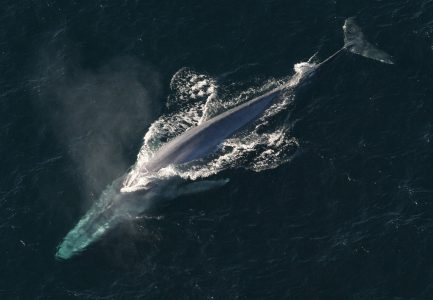
So, once the whale can’t hold it in anymore, it will head to the surface. Once the pressure within finally overcomes the pressure without, the marine behemoth’s feces erupt in what’s scientifically known as a “whale plume.”
In layman’s terms, that’s on average 80 gallons of crap. As disgusting as that sounds, to the various algae, plankton, and other organisms on the ocean’s surface, it’s paradise.
Oceanic surface waters are generally quite low in nutrition. The whale plume provides a burst of nutrients that, within three to four days, results in a green zone on the surface that can be hundreds of thousands of acres in size.
Yet, the poop isn’t yet done providing benefits. It begins to sink slowly, taking with it some of the dead plankton that once lived within its gross confines.
Left on the surface, the would decay and contribute to global carbon emissions. However, as a final “I got you, bro,” the whale plume drags the dead plankton to the bottom, locking the carbon away.
Poopers Wanted
Unfortunately, there aren’t many whales left to crap in the oceans. That’s all thanks to us.
In the 19th and 20th centuries, whale oil was all the rage, being used for various industrial processes. To squeeze oil out of a whale, however, you have to kill the whale.
Industrial whaling wiped out about three million whales — 99% of all large whales that existed. Obviously, dead whales can’t poop and the oceans suddenly had a lot less nutrients to go around.
Now, researchers are trying to resolve this problem by making whale poop of their own. One of the organizations working on the issue is the WhaleX Foundation.
The WhaleX team has created an accurate synthetic replica of whale feces. The liquid mixture consists largely of nitrogen, with some phosphorus, silica, iron… You know, everything good that’s in whale poop.
When sprinkled into the ocean, the brown goo looks and behaves (and we can assume smells) like the real thing. In 2021, WhaleX tested the fake s*** off Australia’s eastern coast by pumping it into the ocean.
In 2025, however, they plan to conduct additional, more sophisticated experiments. They will release five “biopods,” which are 16-foot-long containers filled with seawater and fake crap.
Various algae and plankton can thrive in the tank until it bursts a few days later in a fake whale plume. It will then act more or less like the real thing, providing nutrients to the ocean until it slowly sinks to the bottom.
Limited Success
Ideally, the fake whale poop will replenish nutrient-deprived areas of the ocean. Over a few decades, this could help species — not only plankton but fish and other larger ocean creatures as well — while removing significant amounts of carbon dioxide from the air.
As we said, though, that’s the ideal situation. The fake whale crap isn’t a proven technology, so how well it actually performs still requires further testing.
Additionally, there are legal questions. WhaleX, for example, is approved to spread their artificial s*** in Australian waters, but nowhere else.
Whales, however, used to live all over the place. Sprinkling poop just around Australia will not provide help in other places where it’s sorely needed.
It’s a nice idea, though. We can’t really make more whales for the oceans, but at least we can replicate their poop.