
- Good news, they're not aliens. Bad news, we have no idea what they are.
Lighting flashes illuminate the dark clouds above a stormy sea. Suddenly, for a brief moment, an enormous red-glowing jellyfish appears floating in the sky before disappearing just as quickly.
Oh, that doesn’t seem right at all.
It sounds like a tall tale told by old-timey sailors, but the hubbub about red jellyfish is very recent. If you’ve been active in astronomy, meteorology, or general weird stuff spaces online in the last six months, you likely have run into this phenomenon.
The bizarre nature of the jellyfish lights unsurprisingly led to people throwing around some wild theories about their origin. Soon enough, a consensus formed around the most reasonable explanation — it must be aliens.
Recently, NASA stepped in to explain what’s actually going on. The red jellyfish lights aren’t the result of alien activity, but a fascinating electrical incident.
Yet, there are still plenty of unsolved mysteries about the otherworldly jellyfish. Let’s take a closer look at what we do (and don’t) know about them.
What’s a Red Jellyfish?
The jellyfish lights have been known to happen for centuries. After all, sailors on the seven seas had front-row tickets to some of the freakiest phenomena on the planet.
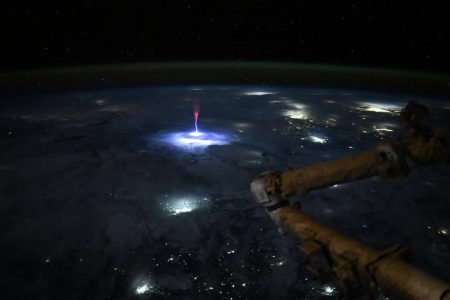
The red jellyfish lights are named for their color and shape. They appear as brief but bright light to dark red flashes, with a blobby upper region from which tendrils of light droop down — like a bell and tentacles of a jellyfish.
It took until 1989 before the lights were first caught on film, according to NASA. However, the picture that broke the red jellyfish into the mainstream was taken in July 2025.
NASA astronaut Nichole Ayers, aboard the SpaceX Crew-10 mission, posted a picture on Instagram of a red jellyfish emerging from an upward-shooting lighting bolt (which would be weird enough on its own).
The attention the picture got encouraged others to share their stories and pictures of red jellyfish lights. They had appeared all around the world at different times of year.
What connected all the stories was that no one seemed to know what the lights were or what caused them. They seemed to appear in conjunction with lightning, but that was it.
Online users suggested many possible explanations, but eventually one started triumphing over the rest.
The lights must be the work of aliens. Because, come on, it has to be.
Sprites and Everything We Don’t Know
The digital noise about the red jellyfish light must’ve gotten loud, because it reached the ears of the folks at NASA. With their mission to educate the masses about everything space, NASA recently posted an explanation of what the red jellyfish really are.
Officially, the red jellyfish are known as transient luminous events (TLE). Slightly less officially, however, they’re called sprites after the fairy-like glowing creatures from European folklore.
So, even NASA thinks they’re pretty fantastical.
According to NASA, sprites occur during thunderstorms, specifically in the instant when lightning strikes. In that moment, at a height of roughly 50 miles, a reddish, undefined shape will appear for a short moment.
“[They] can take a range of shapes, often combining diffuse plumes and bright, spiny tendrils. Some sprites tend to dance over the storms, turning on and off one after another,” explained NASA.
And, uh… That’s about it. All that even NASA knows about sprites/red jellyfish that they happen sometimes together with lightning and they’re high up in the atmosphere.
NASA admits that they don’t understand how or why sprites occur. Nobody knows why they take their jellyfish-like shape, what atmospheric conditions cause them to take place, and whether they can affect the Earth’s electric circuit.
It’s understandable that even the brainiacs don’t know much, though. Sprites are so rare and last for such a short time that they’re virtually impossible to study.
Or how would you study a thing that may or may not happen for a couple of seconds somewhere where lighting might strike? The things might as well be aliens.
Didn’t get enough of weird stuff nature does? Check out our list of 7 odd and unexplained natural phenomena.