
- Why did the hawk cross the road? Because the pedestrian light was green.
Some animals are shockingly intelligent. They can learn to use tools, solve complex environmental puzzles, and remember stuff for longer than humans can.
They can even learn to obey traffic lights — in their own way.
Dr. Vladimir Dinets, a zoologist from New Jersey, has discovered a young hawk that has developed a unique hunting strategy. The urban bird of prey makes use of traffic lights and a neighborhood family’s dining habits to catch other birds.
The hawk has learned that after a certain large family eats outdoors, the leftovers in their yard attract plenty of sparrows, pigeons, and other yummy birds. It then waits for a long line of cars to build at the traffic light situated on the street next to the family’s home.
Once the pedestrian crossing signal sounds, the hawk knows the line of cars is long enough to hide its approach. It swoops toward its prey, concealing itself behind the waiting vehicles, and strikes.
And it does it all while the pedestrian crossing light is green. Efficient and legal.
Far from a Bird Brain
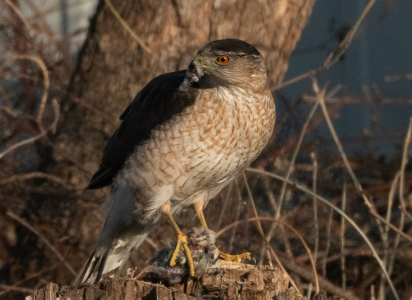
The bird Dinets noticed is a young Cooper’s hawk. He detailed his findings about the bird in a recent article published in the journal Frontiers in Ethology.
Dinets first took note of the hawk one fall morning last year while he was on his way to drop his daughter off at school. He was stopped at a red light when the hunting hawk caught his eye.
He saw the bird at the traffic lights on several other mornings as well. Observing it, he realized that the hawk was hunting based on the intersection’s traffic lights.
Now, Cooper’s hawks are intelligent birds that rely on stealth hunting tactics. They tend to live in thick wooded areas, where they use tree cover to launch ambushes into nearby open areas.
“To hunt this way, they must be able to plan ahead, to know and understand the prey’s behavior, particularly its movement patterns, and to be highly observant — in short, they need remarkable cognitive abilities,” Dinets wrote.
This urban hawk, however, was doing something that went way beyond what Dinets had seen before. So, he decided to start observing it, using his own parked car as a bird hide.
A Cunning Plan
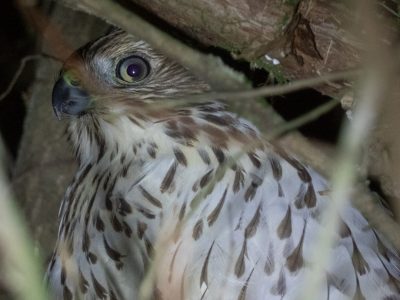
Dinets noticed that the hawk seemed to always be targeting the yard of a certain house. In it, he observed, lives a large family that likes to eat dinner outdoors.
“Next morning, their breadcrumbs and other leftovers attracted a small flock of birds — sparrows, doves, and sometimes starlings. That’s what the hawk was after,” Dinets noted.
However, there was nothing to hide the hawk’s approach on the open street. That is, unless the red light caused a long line of cars to build up.
“The hawk always showed up at the starting point of his attack route when the sound signal for the pedestrian crossing went on, but before the car queue actually formed,” wrote Dinets.
Apparently, the hawk had learned that if the pedestrian signal went off, cars would soon start lining up on the road. It would wait in a nearby tree, safely out of sight, until it saw that there were enough cars.
It would then swoop down along the sidewalk, concealing itself behind the cars, before making a sharp 90-degree turn and plummet into the flock of birds in the family home’s yard. Due to the pedestrian crossing, the hawk could safely cross the road since vehicle traffic is stopped.
Dinets could never see the actual final attack due to the fenced yard. However, one several occasions, he saw the hawk fly away — with freshly caught prey in its claws.
Intricate Strategy
The hawk’s behavior definitely isn’t coincidental. Dinets saw it repeat its red light-dependent attack strategy 18 times, which strongly indicates that the bird knows what it’s doing.
And indeed it does, because there were conditions when the hawk wouldn’t bother to show up. The first one was the pedestrian crossing signal.
If it didn’t go off, the hawk wouldn’t appear. Without it, the bird knew the line of cars wouldn’t be long enough to hide its entire approach, so it might as well save itself the trouble.
Additionally, on weekend, the street is much quieter with fewer cars out and about. On those days, even if the traffic signal sounded, the hawk would again stay away — knowing that any hunting attempts were a waste of effort.
Finally, after rainy evenings, the hawk would once again disappear. It had learned that if it rained, the family wouldn’t eat outside, so there would be nothing for it to hunt the next morning.
According to Dinets, this all shows that the hawk is intelligent enough to understand connection between events and to plan in advance. It also must have a highly accurate mental map of the street to know how many cars must line up before it can attack successfully.
“A city is a difficult and very dangerous habitat for any bird, but particularly for a large raptor specializing in live prey: you have to avoid windows, cars, utility wires, and countless other dangers while catching something to eat every day,” Dinets said.
“I think my observations show that Cooper’s hawks manage to survive and thrive there, at least in part, by being very smart.”