
- One researcher believes the ocean pancakes might be exactly that.
You can find plenty of things washed ashore if you go rummaging on a beach. You might find some pretty sea glass, old furniture, priceless whale puke, or severed human feet, for example.
Or you might find an indescribable doughy mass of unknown origin.
That’s what Canadian beachcombers in Newfoundland have been discovering in the past few weeks. The unidentifiable blobs keep washing up on the province’s beaches, much to the confusion and disgust of those trying to enjoy seaside views.
Perhaps the mystery material would be less off-putting if we just knew what it was. Unfortunately, even biologists and other experts in ocean-borne gunk can’t tell what the white, gooey stuff is.
Well, except for one man. One Newfoundland biologist believes he may know what the blobs are and he’s currently conducting experiments to find out if he’s right.
His theory? He thinks the things are instant batter mix.
Ooey-gooey Ocean Slime
Before we get to oceanic breakfast items, let’s turn the clock back a few weeks and start from the beginning. Reports of the mysterious ocean blobs started appearing in September on Canadian beachcombers’ social media sites.
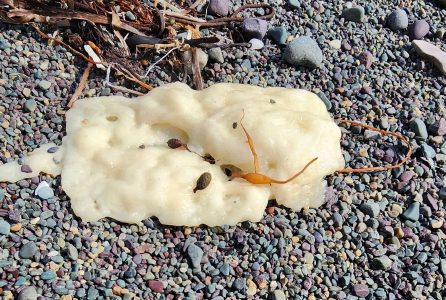
According to those who have found them, the strange masses vary greatly in size. They can range anywhere from a coin-sized dollop to a chunk the size of a dinner plate.
Their appearance and consistency, however, remain similar. The masses bear an off-white to light-gray color despite their size.
On the outside, they’re slimy, gooey, and icky. Pulling one apart, however, reveals a spongy and firm core that keeps the blobs from disintegrating in water.
And there are a lot of them. Dave McGrath, who lives in Patrick’s Cove on Newfoundland’s western coast, said he’s seen “hundreds” of the things scattered on the beaches.
“They looked just like a pancake before you flip it over, when it has those dimpled little bubbles,” McGrath explained to The Guardian.
“They sent the Coast Guard over and I asked them how bad it was. They told me they had 28 miles of coastline littered with this stuff and had no idea what it was,” he said, adding that he’d never seen anything like this in his 67 years of living in the area.
Inconclusive Results
Understandably, the origin of the alien goo has sparked a lot of speculation in online spaces. Some have suggested it could be some kind of industrial runoff material, such as palm oil or paraffin.
Others posit that the material is biological. Perhaps it could be ambergris (the aforementioned whale puke), or perhaps some kind of mold or algae.
Yet, without official confirmation, nobody can know for sure. So, what do the officials say?
Not much more.
The Environment and Climate Change Canada (ECCC), the country’s federal environment agency, said it received a notification about the goo in early September. Since then, it has collected blob samples and conducted surveys on beaches, in the air, and underwater.
Their results: inconclusive.
“At this time, neither the substance nor its source has been identified,” the ECCC told CBS News.
Individual researchers have been stumped, as well. It seems nobody can figure out what the blobs are made of, where they’re coming from, or whether they can be dangerous.
A Doughy Mystery, Indeed
Nobody knows — except perhaps one man. Steven Carr, a biology professor at the Memorial University of Newfoundland, believes he may have cracked the case.
Carr started looking into the blobs as soon as he found out about them. In his professional opinion, they don’t originate from marine life.
If they came from whales in any way, they would smell much worse than they do, according to Carr. They also don’t look like any kind of oceanic organism he’s aware of.
While digging into the blobs, Carr received a photo from a beachcomber. In it, he believes is the key to the mystery.
The photo shows a soggy box of Bisquick baking mix washed up on a beach.
Carr is convinced that the strange goo is Bisquick mix that started coming together in the ocean. With no heat to bake it, it washed ashore as a doughy glob.
No wonder McGrath thought they looked like pancakes.
According to Carr, a freight container of Bisquick may have fallen off a cargo somewhere near the Newfoundland coast. Now, its contents are leaking into the ocean and turning into the blobs.
To prove his theory, Carr is now conducting an incredibly complex experiment.
“I went down to our waterfront with several bags of Bisquick, and I anchored them so that they will be under cold seawater. … If I can artificially make a blob, that will prove it,” Carr told The Weather Network.
That’s science for you, folks. We’ll await the results of Carr’s experiment.