
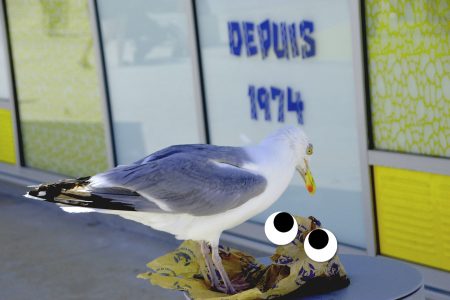
- Would you want to eat a thing that stares unblinking at you?
Ah, it’s a perfect day at the beach! Feeling a little peckish, you wander to the food truck and buy yourself your favorite snack.
But just before you manage to take the first bite, a seagull swoops down and steals your treat. Day ruined.
Thieving seagulls plague beachgoers around the world, but now we may be able to fight back — with science. Recent research has discovered an unusual but surprisingly effective seagull deterrent.
Googly eyes.
The rolling plastic eyeballs have been shown to discourage seagulls from going after food containers. Attaching googly eyes to your snack package can reduce seagull attacks by up to 50%, according to the study.
It’s not a bullet- or beak-proof strategy. But hey, if it saves your hot dog or ice cream, it’s worth a try.
Inspired by Experience
The research into seagulls and their aversion to endlessly staring eyeballs was carried out by a team from the University of Exeter in the U.K. Leading the team was associate professor Laura Kelley from the Center for Ecology and Conservation.
She was inspired to begin her work after witnessing a seagull steal some chips from a beachgoer in summer 2025. Kelley built her experiment on previous research that had shown that seagulls approach food more cautiously if someone is looking at them.
But what if the food itself gazed back at the gull?
To find an answer to that question, Kelley’s team acquired a bunch of takeaway boxes. To half of them, they attached a pair of stick-on googly eyes.
They then took their boxes, with and without eyes, to coastal towns in Cornwall, southern England. They left both kinds of boxes out in areas with seagulls and began to observe.
Promising Results
Kelley’s team soon noticed that the eyes made a difference. The seagulls were significantly more careful when approaching the eye-equipped food box, and preferred going for the ones without eyes.
But would the seagulls learn over time that the box’s staring eyes couldn’t actually harm them?
“To test this, we presented 30 gulls with one takeaway box either with or without eyes, but did this three times for each gull over a short amount of time,” Kelley wrote in The Conversation.
Roughly half of the seagulls would never approach the box with eyes at all. The other birds, meanwhile, didn’t seem to care that much about the eyes and went for the box after brief hesitation.
According to Kelley, this indicated that the googly eyes will keep working on seagulls who are too birdbrained to realize they aren’t real.
It also shows that this isn’t a silver bullet against seagull attacks. Half of them will still come after your food, but perhaps the initial hesitation will give you time to safeguard your snack.
Next, Kelley wants to test the googly eyes under live fire. She plans to ask food vendors using takeaway boxes to fix googly eyes on them and see if that makes a difference in a real beach situation.
Here’s hoping it does. Even if they don’t deter all gulls, having your food be 50% safer is a win.
No One Likes Being Watched
As we mentioned, the idea of putting googly eyes on the food containers didn’t pop up in a vacuum. In fact, attaching eyes to things has been proven to be a very effective deterrent against attackers.
Most animals are cautious about eyes because direct, unbroken eye contact typically communicates aggression. The logic goes that if someone’s staring at you, you’d better not mess with it.
Consequently, eyes are a popular safety pattern in nature. Many animals, such as caterpillars, butterflies, and snakes, have colorful markings on their bodies that resemble eyes.
Humans have harnessed animal aversion to eyes as well. In Botswana, for instance, cattle farmers paint big eyeballs on the butts of their cows because they’ve been proven to keep lions and leopards away.
Meanwhile, in some parts of India, rural villagers wear human masks on the backs of their heads to confuse lurking tigers. Even in the U.S. and Canada, some forestry workers pain eyes on the backs of their hard hats as protection against cougars.
Eyes even work on us humans. Simple posters with a pair of watchful eyes plastered on walls in problem areas have been shown to slash bicycle theft by more than half. Images of eyes also make people more honest and charitable.
Maybe we should just start putting googly eyes on everything. It seems to fix a lot of problems.