
- Harvesting swarms of ants is a strange thing to do for fun.
People will try to smuggle anything, including animals. As such, it will take a lot to take an experienced customs agent by surprise.
Uncovering thousands upon thousands of ants just might do the trick, though.
That’s what Kenyan authorities recently found in not only one but two smuggling attempts. Four men in two separate cases have been charged with illegal wildlife trafficking.
In the first case, two Belgian teenagers were caught with more than 5,000 ant queens in bags. The duo claims they weren’t trying to smuggle the ants for sale.
The second case involves a Kenyan and a Vietnamese man. They didn’t have such a large haul, and were caught with only a few hundred ants.
The kinds of ants the men had caught are highly sought after by people who like keeping ant farms. In total, they would’ve been worth thousands of dollars.
Who knew that ants were so valuable?
It’s Just a Prank, Bro
The only connecting factor between the two ant smuggling incidents are the ants themselves. Otherwise, they’re separate cases — we doubt each pair of guys even knew the other existed.
Nonetheless, due to the coincidental timing of the two smuggling busts and the similarity of the cases, all four men appeared in front of a Kenyan court on April 15. Each was charged with illegal possession and trafficking of wildlife.
The first case involves two 19-year-old Belgian nationals, Lornoy David and Seppe Lodewijckx. They were arrested on April 5 at a guest house where they were staying during their trip to Kenya.
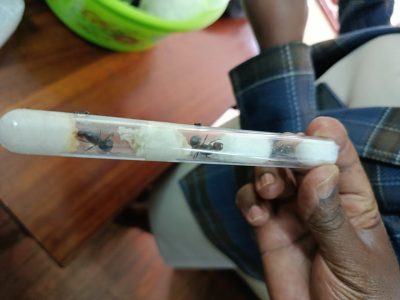
In their possession, officers from the Kenya Wildlife Service (KWS) found roughly 5,000 ant queens packed into 2,244 containers. The ant housings were fashioned out of test tubes and modified plastic syringes stuffed with wool for cushioning.
“Investigations revealed that the test tubes had been designed to sustain the ants for up to two months and evade airport security detection, including X-ray scanners,” the KWS said in a statement.
According to the KWS, the Belgians came to Kenya on tourist visas. The wildlife authority claims they planned to sell the ants to exotic pet collectors in Europe and Asia.
For their part, the teens pleaded guilty, but denied they intended to sell the ants. They claimed they had simply collected the bugs for “fun.”
“We did not come here to break any laws. By accident and stupidity we did,” Lornoy said according to Reuters.
They say that, but why did they then pack the ants with such care to make them as difficult to detect as possible?
The other case involved Kenyan Dennis Ng’ang’a and Vietnamese Hung Nguyen. They were also charged with trafficking after they were caught with 400 ants.
They didn’t make excuses. At least they had the integrity to admit they were smugglers.
Expensive Bugs
But why were these fellas trying to smuggle ants? For the same reason people smuggle anything — they’re worth a lot of money.
Traditionally, wildlife traffickers have focused on smuggling body parts of large animals, such as elephants and rhinos. They have been sought-after items among big game hunters and such, but recent crackdowns and tightening security has made carrying elephant tusks more difficult.
So, smugglers have turned to much smaller animals, such as ants. Despite their minuscule size, bugs can be very valuable.
Both of these cases involves an ant known as Messor cephalotes, or giant African harvester ant. These ants are native to Kenya, and they’re very popular among people keeping ant farms.
That’s mostly due to their size and coloration. Their queens are more than two inches long, and even the smaller workers measure upward of an inch. The ants also have a shiny red and black carapace, and they build complex colonies that make for an impressive ant display.
Due to all these facts, they’re very expensive. England-based Ants R’ Us, for instance, sells one queen for $132, while the Polish Ant On Top store asks for a whopping $260.
The Kenyan authorities estimated that the smugglers’ haul was worth around $7,800. Considering the Belgians alone had more than 5,000 ants, we can probably assume they were worth a whole lot more, even with a black-market discount.
Now, it is actually possible to take the ants out of Kenya with proper permits. However, that includes stringent health and biosecurity checks, in addition to committing to harvesting a sustainable number of ants.
We suppose these four were too busy for all that bureaucratic nonsense.