
- You can now add jellyfish to the list of potential causes of massive nuclear catastrophes.
The humble jellyfish is truly one of the weirdest and most fascinating creatures of the sea. They’re brainless, they can be gigantic, they can murder you, and they’ve cracked the code to immortality.
They can apparently also attack and shut down nuclear plants.
The Gravelines nuclear plant in France recently went into emergency shutdown mode. Its reactor cooling system became inoperable due to an outside disturbance and the entire plant was taken offline.
What was going on? Interference from a malicious foreign power? Terrorists?
No, it was just jellyfish.
Huge swarms of an invasive jellyfish species had gotten sucked into the plant’s cooling water intake pipe. They completely clogged the intake’s debris filter and stopped the flow of cooling water.
Fortunately, the plant’s safety systems functioned exactly as they should. As soon as a flow sensor in the coolant pipe noticed the clog, it tripped an emergency failsafe, and the reactors shut down.
Strangely enough, this is far from the first time jellyfish have disrupted nuclear power plant operations. In fact, it happens constantly — and experts believe that it will only get more common with the warming seas.
Perhaps it’s only a matter of time before jellyfish cause the first nuclear meltdown.
Sudden Emergency
The Gravelines nuclear plant is located on France’s northern coast, roughly halfway between the cities of Calais and Dunkirk. It’s no small installation, either.
With six reactors, each putting out 900 megawatts, Gravelines has a total power output of 5.4 gigawatts. In more practical terms, it powers around 5 million homes, providing roughly 6% of France’s entire electricity demand.
This summer, two of the plant’s reactors had already been shut down for routine maintenance. So, the plant was already operating at reduced capacity.
However, on August 10, something strange happened. Alarms started going off and emergency lights began blinking, indicating a serious malfunction in one of the plant’s systems.
Specifically, the plant’s cooling system had failed. Like many other coastal nuclear plants, Gravelines sucks in water from the sea to keep its reactors cool.
However, an unknown anomaly had entirely clogged the plant’s water intake system. Consequently, Gravelines’ emergency failsafe systems kicked in, taking the entire power plant offline.
The Swarm Cometh
Well, if anything, at least the people of France now know that the emergency systems at one of their major nuclear plants function flawlessly. But what was it that stopped the flow of cooling water into Gravelines?
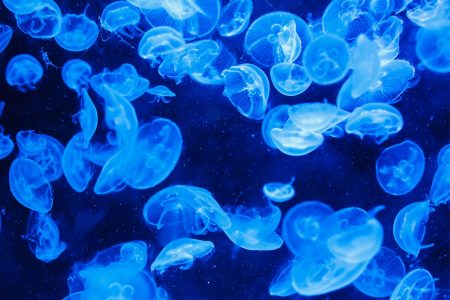
It was jellyfish. An investigation found that the filter drums that normally keep seaweed and dead fish out of the reactors had been entirely jammed with hordes upon hordes of jellyfish.
Specifically, the marine creatures belonged to a species known as the Asian moon jellyfish. These jellies are native to the shores of China, Japan, and Korea.
However, they’re extremely invasive and have been transported to many places around the world in the ballast water aboard cargo ships. They arrived to the North Sea between France and the U.K. in 2020.
You might not expect tropical Asian jellies to thrive in the cold North Sea. But the thing is, the North Sea has been getting less cold — and that’s perfectly fine with the jellyfish.
“Jellyfish breed faster when water is warmer, and because areas like the North Sea are becoming warmer, the reproductive window is getting wider and wider,” Derek Wright, a marine biology consultant at the U.S. National Oceanic and Atmospheric Administration, told Reuters.
Common Jelly Issues
Bizarre as it sounds, jellyfish shutting down power plants is not a new problem. It has happened many, many times all around the world.
Asian moon jellies have brought nuclear plants offline in Japan, China, and India. In the Philippines, they caused a major blackout throughout the entire country in 1999 — which people eventually feared was the result of the dreaded Y2K Bug.
However, due to the aforementioned oceanic warming, the jellyfish are now becoming a pest in more northern parts of the globe. The Torness nuclear plant in Scotland, for instance, experienced a jellyfish shutdown in 2011, and then again a decade later in 2021.
Even Sweden in the famously cold Scandinavia hasn’t escaped unscathed. In 2013, the Oskarshamn plant, which houses one of the largest nuclear reactors in the world, went down when its coolant pipes got clogged with jellies.
Not only do the living, free-floating jellies clog nuclear plant filters, but they could also pose a danger after they die. When jellyfish perish, they almost liquefy, which could allow them to slip past the filter and into the reactors.
That’s a problem on a whole other level, so it’s good that Gravelines shut down when it did.