
- ‘He just smiled and wouldn’t give me a Vegemite sandwich.’
There are a few things so quintessentially Australian that they practically scream “Crikey!” These things include (but are not limited to) beer, hordes of venomous or otherwise deadly animals, and Vegemite.
If you’re in Australian prison, however, you will be deprived of most of these things — especially Vegemite. Now, one inmate is fighting for his right to eat the divisive yeast extract.
Andre McKechnie has sued the state of Victoria. The 54-year-old is serving a life sentence for murder, but he feels his punishment is cruel and unusual as he isn’t allowed to consume Vegemite behind bars.
It’s no wonder McKechnie might miss Vegemite. The spread is immensely popular in Australia, with the vast majority of households having it in their pantries.
Prisons in Victoria state, however, have prohibited Vegemite as the authorities believe it could be used to produce or hide intoxicants. McKechnie argues that the ban is unduly preventing him from engaging with Australian culture.
His case has landed in the Supreme Court of Victoria. Soon, the court must decide what weighs more — potential prison security risks or the love every Australian, murderer or not, holds for Vegemite.
Part of Australian Culture
Andre McKechnie is being held at a maximum-security Port Phillip Prison, to the west of Melbourne. He has been serving a life sentence since 1994, when he stabbed to death Otto Kuhne, a property developer from Gold Coast, reported the Associated Press.
He started his sentence in Queensland, but in 2004, was moved to Victoria. Now, two decades later, he has gotten sick and tired of prison life.
Specifically, he can’t stand the lack of Vegemite.
In his lawsuit, he claims that the Vegemite ban prevents him from enjoying “his culture as an Australian.” This quote comes from the Australian Charter of Human Rights and Responsibilities Act, which McKechnie states is being violated.
Under this law, all people “with a particular cultural, religious, racial, or linguistic background” are free to “enjoy their culture, to declare and practice their religion, and use their language.” And indeed, McKechnie does — in theory, at least — have a particular cultural background (Australian) that he wishes to enjoy (by consuming Vegemite).
Additionally, he has quoted the Corrections Act, which requires the prison system to provide “food adequate to maintain [inmates’] well-being.” Without Vegemite, McKechnie states he isn’t feeling well.
Spreading Crime
Vegemite has been banned in the Victoria prison system since 2006. As bizarre as the prohibition sounds, inmates did try to use the concoction in illicit ways.
According to Corrections Victoria, inmates used to smear the sticky, pungent spread on drug packages going in and out of prisons. The authorities said the powerful smell of Vegemite had the potential to interfere with drug detection dogs’ noses.
We couldn’t find out whether the ploy worked in any cases. But it could theoretically happen.
Additionally, Corrections Victoria claims that Vegemite’s yeast content could allow it to be fermented into alcohol. This claim, however, has been disputed by Mondelez International, Vegemite’s producer.
In early 2010s, there was a minor moral panic in Australia over concerns of people turning Vegemite into booze. According to Mondelez, this is impossible, since although Vegemite is a yeast-derived spread, the production process reportedly kills all yeast in it.
“Vegemite cannot be fermented into alcohol,” Mondelez consequently concluded.
So, does McKechnie’s lawsuit have a leg to stand on? That’s up the Supreme Court of Victoria, which is scheduled to hear the case next year.
Until then, it’s still no Vegemite for Victoria prisoners.
What’s Vegemite?
As we mentioned, Vegemite is an Australian staple. But what even is it, and why does it have such a notorious reputation?
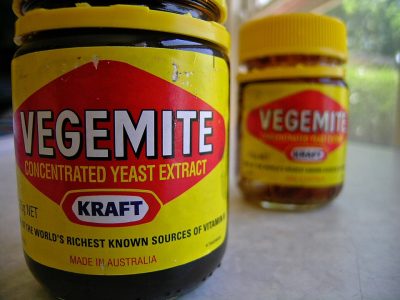
Vegemite is a thick, brown, strong-smelling yeast extract spread introduced in 1923. It strongly resembles the British Marmite and was created as a replacement product after World War I interrupted Australia’s Marmite imports.
Australians seem to love the stuff, and parents often have their kids eat it as the concoction is a good source of vitamin B. To anyone else (expect maybe the British used to Marmite) it’s a controversial foodstuff to say the least.
As stated, Vegemite doesn’t look, smell, or taste particularly appetizing on a first try. It’s definitely an acquired taste, and most foreigners simply have no motivation to learn to tolerate Vegemite.
That goes to the highest echelons of power. President Barack Obama (the last U.S. president to visit Australia) simply said, “It’s horrible.”
Vegemite’s divisive status has elevated it to international fame. It also got a popularity boost from the 1980 hit song “Down Under” by the Australian band Men at Work. The song, documenting the band’s travels around the world, has them speak to a man in Belgium who, upon hearing their accents, simply smiles and gives them a Vegemite sandwich.
The only question is, why did the Belgian have Vegemite?