
- Would you decorate your home with an eternal reminder that your grandfather once got busy?
Picture yourself as an archeologist digging through the ruins of an ancient Neolithic city. Then, you find something.
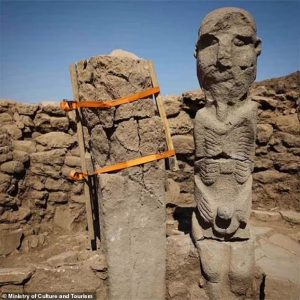
Slowly, from beneath sand and soil, you discover a statue. It’s a huge slab of stone carved into the shape of a giant man, more finely detailed than what you would’ve expected from the period.
And the man is clutching his penis.
This scenario played at the digs at Karahan Tepe, a Stone Age temple complex and possible city that once stood in what is now southern Turkey. The sculpture of the man stands roughly 7.5 feet tall, making it much taller than an actual adult male — particularly at the time of its carving.
Researchers haven’t yet determined the exact age of the dong-grabbing giant. However, the Karahan Tepe complex dates to around 8500 BCE — about 11,000 years ago — so it’s likely the statue is from the same period.
The archeologists also aren’t clear on what the massive masturbator’s significance is. But if nothing else, it (and its phallus) stand as proud testaments to humanity’s eternal obsession with our own genitals.
So, So Old
As we said, the statue of the man and his wang dates back 11,000 years. That’s old, but it can be a bit difficult to grasp just how old it is.
So, let’s put things into perspective.
The Roman Empire’s most glorious days took place some 2,000 years ago. Around the same time, there was some guy called Jesus going around telling people we should be nicer to each other.
Moving the clock even further back, the great pyramids of Giza in Egypt were built around 2500 BC. That means that to the aforementioned Romans, the pyramids were already more ancient than the Romans are to us. Makes you think.
But we have to go deeper into the past. Metal tools (originally made with copper) were invented roughly in 6400 BC, or about 8,500 years ago, give or take.
Now, we finally get to the period when our penis-grasping protagonist was hewn out of a rock. Its creator probably still would have been a hunter-gatherer who didn’t live a sedentary life — mostly because this thing called agriculture was just catching on.
And there you have it. The giant groin grabber is as old as the human concept of “living permanently in one place.”
The Ancestral Dong
Why would somebody go through the effort of creating the statue if they didn’t live by it, though? After all, you can’t really drag the enormous and heavy thing along with your nomadic tribe.
As we mentioned, the place where the statue was found — Karahan Tepe — wasn’t necessarily a city where people lived. The current archeological understanding is that the site served as a temple complex.
It’s also generally understood the Neolithic people were animists, worshipping a colorful variety of gods and spirits — alongside their ancestors. And that just might be what the ancient penis man is.
You see, the man the statue depicts doesn’t seem to be in very good health. His ribs, spine, and clavicles are carefully exaggerated, making him appear and gaunt and skeletal.
So, we can infer that this guy is probably long dead. But why is a dead man grabbing his crotch?
This is where we should probably crack a joke about a “boner.” Yet, the penis-holding gesture might imply that the statue depicts a progenitor — a significant ancestor of its sculptor’s tribe or family.
After all, you do need to involve a penis to get a family line going.
“The fact that the figure is clutching its penis is … consistent with this interpretation by potentially symbolizing that this person was the progenitor of a social group,” Ted Banning, an anthropology professor at the University of Toronto, told LiveScience.
Perhaps the statue was housed at a family shrine in Karahan Tepe. But there’s also a possibility that it decorated one of the first permanent family dwellings in human history.
This really makes us want to ask — would you be comfortable living in a house with an enormous statue of your great-great-great-great-grandpa grabbing his groin?