
- Some people think they’re so far above others that even their crap is of higher pedigree.
Millennia-old poop can tell archeologists a lot about the person or animal that squeezed it out. The fossilized feces can reveal facts about their creator’s diet, health, and other conditions.
However, the place where the dump was dropped can be no less important. That’s the case with a recent archeological discovery in Korea.
In the remains of a more than 1,000-year-old palace, archeologists have discovered a crown prince’s throne. That is, his flush toilet.
Although this isn’t the oldest flush toilet ever found, it still shows that people have wanted to flush away their waste for thousands of years. However, this isn’t the most significant thing about the toilet.
In addition to the prince’s latrine, the researchers also discovered others. They seem identical at first, but there’s a crucial difference.
The royal throne flushes into a nearby stream, while the others empty into a shared cesspool. According to the archeologists, this reveals significant clues about the ancient Korean court’s hierarchical structure.
Essentially, if you’re hot s***, your s*** won’t have to mingle with lesser turds.
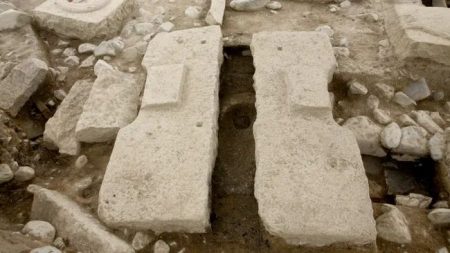
High-Tech for the Time
The ancient toilets were discovered at the site of the Donggung Palace. The word “donggung” translates to “crown prince,” which tells you who once called this magnificent structure his home.
The Donggung complex was built in the year 674, making it around 1,3000 years old. It consists of a number of palaces, pavilions, and other structures surrounding the central Woji Pond.
At the site, archeologists have found many priceless items and relics that have proven valuable both scientifically and monetarily. Recently, they made another discovery.
This one isn’t quite as glamorous, however. Namely, the researchers unearthed the ancient palace’s toilets.
While they may not be jade or gold, the toilets are nonetheless fascinating. These are the oldest flush toilets discovered in Korea, and they tell us something about the people who used them and the technology of the time.
For instance, they’re flush toilets. It appears the Koreans were allowing water to carry their waste away while medieval Europe still relied on good old outhouses.
That said, these aren’t your modern water closets. The toilets have no tank, so they can’t be flushed with a press of a lever or a pull of a string.
Instead, someone would have to manually pour water into the toilet bowl to send its contents on their way through a drain built into the back of the toilet. Considering how reluctant royals around the world have historically been to get their hands dirty, that someone was probably a servant.
We really should’ve included “the crown prince’s toilet flusher” on our list of history’s weirdest jobs.
Honor the Royal Poop
Alright, so the Koreans had figured out flush toilets more than a millennium ago. However, there’s also more to them than meets the eye.
At the Donggung Palace, there were several flush toilets, likely to accommodate the number of people living at the complex. One of them, however, differs from the rest.
The stand-out lavatory is the one found in the crown prince’s palace itself. This one, when flushed, discharges the royal refuse directly into the river that flows through the palace grounds.
The rest of them do not. Instead, they flush into an adjoining storage tank, meaning that they’re something of a cross between a modern flush toilet and an outhouse.
According to the archeologists who discovered the toilets, this is clear evidence of the hierarchy that stood at the palace.
It was fine for the servants and lesser courtiers to poop in shared tanks that had to be emptied regularly. But that won’t do for the crown prince.
Can you imagine having royal poop floating around in the same cesspool with that of filthy commoners? How disgraceful!
To prevent such shame, the crown prince’s turds (as well as those of the high-ranking royal ladies allowed to live in his palace) were flushed into the river. This way, the royal waste would never come into contact with the common rabble.
You know, the archeologists were right — this does reveal something about ancient Korean courts. It shows the crown prince was full of s***, in more ways than one.