
- Do you know where your favorite stick treats came from?
Have you read The History of Dessert on a Stick And Where They Came From? Because this is part two.
It takes 43 pounds of ice to manufacture and deliver one gallon of ice cream. But Harry Burt created the delivery truck.
Ford was producing reliable trucks at the time and Burt wanted to rework the vehicles. The idea was to get the ice cream out of the parlor to bring it to where the people were.
He thought the motor that powers the refrigerator could be used to power a freezer in the vehicle at the same time. Burt asked for 12 of the trucks, at a cost of $4,000 total. (It would have cost him $60,000 in vehicles if it were today.)
Burt’s fleet of mobile mini ice cream parlors were released the first spring day of 1923 and his sweets on a stick were live.
This was the first of the food trucks and revolutionary at the time. But the idea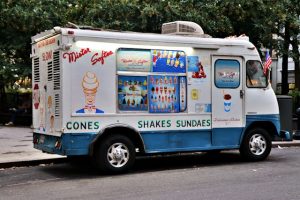 was too far ahead of its time and the people don’t trust the ice cream trucks.
Epperson started selling his product at the local beach resorts amusement parks. Popsicles for just 5 cents a piece. Within hours, he sold out. He needed to expand to meet the demand.
Burt knows he has to convey cleanliness. He paints all his trucks white and puts “Good Humor” on the outside of them. The white gives that clean, sanitary appeal.
He adds a bell from his kids bobsled on the truck and creates a white uniform so drivers look pristine like the new white trucks, all to put out a good look for his sweets on a stick.
It was a bit Pavlovian, the idea that the kids would hear the bell and know that the truck was coming. The relaunch was a huge hit. Burt put his profits back into the business to spread across Ohio and to other neighboring states.
His plan is to expand across the nation.
Epperson tries to find financing and goes to Joe Lowe, the largest supplier of confectionary ingredients. Even though the investors want to hold majority of the business, Epperson agrees. What will the end of the sweets on a stick be?
Burt’s trucks start to get some competition, with others taking his ice cream truck idea and in turn, his profits. He applied for a patent to make frozen treats on a stick and it’s approved in 1923. He sells the rights to manufacturers across the country.
Epperson moves into mass production with his popsicles. The idea spread and quickly went bicoastal. Sales reached $325,000 by 1924, over $4.8 million today. Epperson patents his frozen popsicle on a stick without knowing Burt already owns a similar patent.
The both have patents for frozen sweets on a stick, but only one will remain.
Burt begins to go after those who are producing frozen desserts on a stick. He ends up settling and licensing for some of these other companies.
Competitors to licensed subsidiaries and in 1925 Good Humor was the first true ice cream brand
The Good humor bar is reliable and dependable no matter where you get and eat it, great sweets on a stick.
Epperson‘s popsicle corporation is spreading in from the coast and rather than negotiating with copycats, he sues them out of business.
Epperson and Burt’s competing patents come to light and the patent office had trouble keeping up with drawing the lines. Burt proposes a partnership with popsicle to operate under the Good Humor umbrella.
Burt thought of himself as the innovator of a frozen dessert on a stick idea but Epperson disagreed. Epperson launches a legal battle against Burt instead but his investor, Jew Lowe is over the loss of profit.
Do you want to hear how this sweets on a stick all ends? Let me know in the comments!