
- It’s a little eerie how retail work can drive even a soulless robot to burnout.
Being afraid that machines will replace you at your job is a perfectly reasonable concern these days. Tech companies seem to come up with some new AI-powered thingamajig every other day in an attempt to replace human workers.
But some jobs, at least, are safe for now. For instance, this experiment from China shows that robots are not ready for retail work.
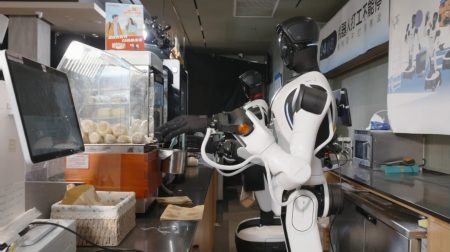
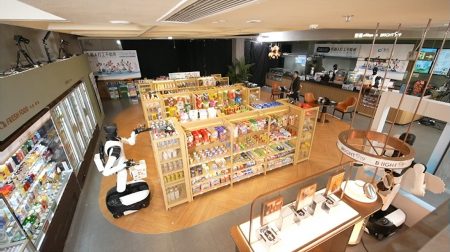
Robot manufacturer Agibot recently put its machines’ customer service abilities to an ultimate test. Six of the company’s bots pulled a 24-hour shift at a Shanghai convenience store.
The robots carried out a slew of basic tasks, but the manufacturer also threw intentionally difficult customers their way. Because it’s not a real retail job experience without a nightmare customer, right?
In the end, the results weren’t flattering. Two of the robots got fired right off the bat at the end of their evaluation shift, and the efficiency of the others is also questionable.
Rolling Robots
The retail robots’ manufacturer, Agibot, is not new to the robot game. In fact, the company has achieved global recognition with its robots. For instance, the Agibot A2 robot completed a 60-mile hike alone.
You can read more about the hiking robot here.
For this challenge, however, Agibot chose its G2 industrial robots. These machines feature a human-like head, torso, and hands, but instead of legs, they roll around with a four-wheeled platform that kind of resembles an overgrown Roomba.
The G2 is marketed as an industrial robot with upper-body capabilities comparable to humans. However, with its cameras and machine precision, it can perform much more accurate tasks than a person could, like assemble intricate parts. They are also capable of limited emoting through emoji-like expressions and sound bites.
But can they withstand the fury of an irate late-night convenience store customer? That’s what Agibot wanted to find out, so the company organized a livestreamed 24-hour challenge at a Shanghai store.
Six robots went in to do everything a flesh-and-blood employee would. Not all of them came out (at least with their employment contracts intact).
Hard Day’s Work
The all-day shift was deliberately chosen so the robots would have to face every foreseeable situation the convenience store experiences. They started right before the lunch hour and worked through the evening crowds, quiet overnight hours, and the morning’s breakfast rush.
Over those 24 hours, the robots did everything you’d expect a convenience store employee to do. They had to greet customers, stock shelves, clean, take out the trash, and prepare food and drinks.
But Agibot wanted to know if the robots truly were ready for retail duty. To that end, the company employed people to deliberately make the bots lives difficult.
The selected problem customers would stand in the robots’ way, throw objects in front of them, or attempt to grab containers the robots were handling. They also tested the machines’ social skills by asking them to, for example, identify a sugar-free soda from a regular one.
By the end of their shift, Agibot said the G2 bots had carried out 1,730 tasks. These included 683 customers greeted, 369 items retrieved from shelves, and 147 hot coffees served.
Slacker Bots
That’s a job well done, right? Not exactly.
Only four of the six robots performed to the standards the convenience store’s management expected. Two of them were fired on the spot as their shift wrapped up.
One of the fired robots had turned out to be a slacker. The store management justified its dismissal by saying the robot “lacked initiative” and allowed shelves to run empty instead of proactively stocking them.
The other robot that got the boot apparently grew so fed up with its job that it left. Encountering a full trash can, it turned around, went outside, and refused to return to the store.
While it’s understandable that the bots were fired, their reactions are so human that it’s honestly pretty impressive. Any of us who have worked in retail can certainly relate.
But even the other four robots that passed their evaluation period weren’t necessarily stellar workers. Agibot hasn’t reported some key details about their performance.
Although a robot can theoretically work without tiring, Agibot hasn’t said how often and for how long the machines needed charging over their shift. The company has also not stated whether they required human assistance during the job.
Finally, and perhaps most damningly, Agibot hasn’t gone public with whether the robots were cheaper or faster workers than human beings. Previous tests, however, have indicated that robot workers in factories are only half as fast as their human colleagues.
So, my dear retail workers, your jobs are safe for now, and you’ll get to work in them for the foreseeable future. I’m sure you’re all overjoyed.
Want to read about more weird robots? Here’s a story about a rescue robot designed to look like a satanic goat.