
- Wonder when we’ll see the first robot running a marathon.
In science fiction, robots are comparable to, if not better than, real people. They can run, crawl, jump, speak, and use guns and computers just like a human would.
Real robots, however, are much clumsier and clunkier things. Although some industrial machines can manipulate objects with incredible accuracy, humanoid robots are a far cry from their fictional counterparts.
However, they seem to be slowly getting there.
A Chinese robot recently set a new world record by walking where no robot has walked before. The AgiBot A2 completed a more than 60-mile hike across the Jiangsu province.
It wasn’t exactly a sprint, as it took A2 three days to complete the march. Yet, the bot did it independently without human assistance.
To make the achievement possible, AgiBot developed a special battery system for A2. It could swap batteries without shutting off, allowing to complete its walk in one go.
Walking 60 miles in three days might not seem all that impressive to some, but every hike starts with baby steps. And the robot performed better than a lot of people probably would.
What’s the Robot?
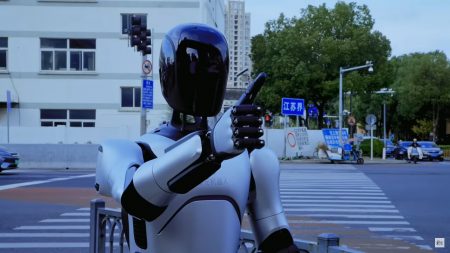
The hero of the day is the model A2 humanoid robot. It’s developed and built by Chinese AI and robotics company AgiBot.
The company was founded in 2023 and released the A1 robot only six months later. In August 2025, it released the A2 model, having by now sold more than 1,000 of the machines.
This robot is pretty much human-size
d, standing at 5 feet, 6 inches tall and weighing 152 pounds. It’s surprisingly agile on its feet, and can pick up objects quite deftly.
In its default configuration, the A2 has a black face that can project various graphics and messages for “expressions.” It can understand simple commands and carry them out.
For the most part, A2 has found work in the marketing, hospitality, and entertainment industries. Among the various jobs it’s held are a receptionist, a brand ambassador for Pepsi, and a dancer.
Walking Along
Now, A2 can add “hiker” to its resume. As part of a Guinness World Records challenge of developing a robot that could walk more than 62 miles (100 kilometers), A2 set off from the eastern Chinese city of Suzhou on November 10.
Its destination was the Bund district in Shanghai. Doing this hike through the sprawling cityscape in between would rack up the required miles to complete the challenge.
Yet, successfully completing the walk was no easy task for the robot. The unit participating in the challenge was A2’s generic commercial robot with no additional specialized tweaks or equipment.
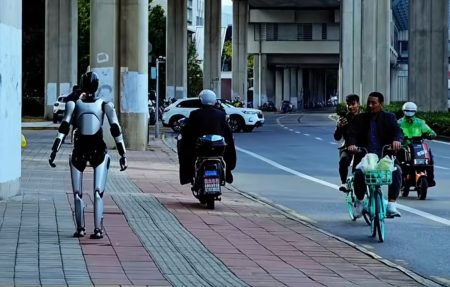
What’s more, it had to traverse a living city with plenty of unpredictable obstacles, from reckless drivers to pedestrians and stray trash. The walk began quite slowly, as A2 had never seen this kind of environment before.
However, the robot is equipped with two GPS modules and lidar and infrared depth cameras, alongside an advanced AI to control its movements. As A2 walked, it learned more about the city and slowly picked up the pace as it figured out the most common things in its way.
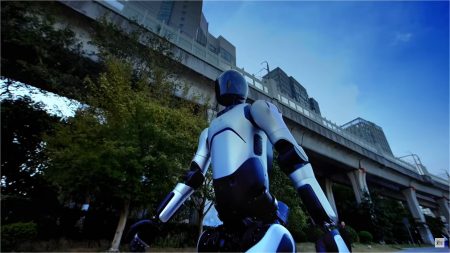
And so, the black-and-silver bot walked past parks and highways, crossing bridges, and climbing stairs. In several locations, it drudged overnight over areas with no streetlights, relying on its limited night vision to guide its path.
Battery Problem
In addition to the difficulties of navigating a city, A2 faced another issue. As the basic model, its battery held only a three-hour charge — if it stood perfectly still.
Start walking and actively processing the environment, and the battery level starts dropping fast.
There was no way A2 could complete the walk as is. Fortunately for AgiBot, the company’s engineers had devised a perfect solution to this problem ages ago.
A2 has a hot-swappable battery system, meaning that the robot doesn’t have to shut down when its battery is removed. It stores just enough power to function for a brief moment while an operator plugs in another battery.
So, A2 didn’t complete its walk completely alone, since someone had to be there to help it swap batteries. However, the machine never powered down and kept walking, thus qualifying as the winner of the Guinness challenge.
‘I Need New Shoes’
Three days later, on November 13, A2 arrived in Shanghai. The exact distance it walked came in at 66.04 miles, or 106.286 kilometers.
On November 20, Guinness World Records confirmed that A2 had broken the record for the longest journey walked by a humanoid robot.
“Walking from Suzhou to Shanghai is difficult for many people to do in one go, yet the robot completed it,” Wang Chuang, AgiBot’s senior vice president, told Global Times.
After reaching the finish line, A2 briefly used its speech recognition abilities to chat with reporters. It called the walk a “memorable experience in its machine life” and noted that it might “need a new pair of shoes.”
Indeed, A2 had worn through the impact-absorbing rubber layer on the soles of its feet. Surely, the robot has earned its new kicks.
A2 isn’t the only Chinese robot capable of pulling off incredible feats. Check out our story about the Chinese robot that kidnapped 12 other robots.