
- That’s no moon… Except it is. But not really.
Black holes, supervoids, galaxies you can’t even see because they’re made from dark matter, oh my! Things get really weird once you leave the solar system and venture into the abyss of space.
That said, astronomers and other science nerds have done an admirable job of identifying and cataloging the universe. Yet they’ve only scratched the cosmic surface, and there’s so much about space that we still don’t understand.
Take, for example, this latest freak they spotted floating about in the void.
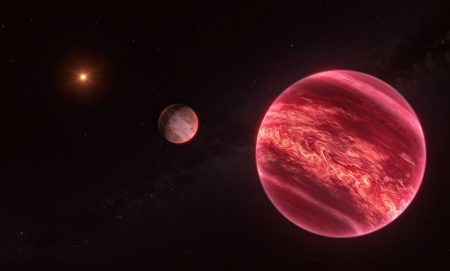
Recently, astronomers discovered a new thing that defies the current classification of celestial objects. It’s certainly big, as the space ball is about the size of Jupiter.
You might think that makes it a planet. However, the system it’s located in is also so bizarre that, based on today’s standards, we can’t call this thing a planet.
So, is it a moon, a planet, or something else altogether? Let’s zip through the cosmos and take a closer look at this space oddity.
Strange System
Our intergalactic oddball is located in a system called CD-35 2722. The object, along with its star system, was discovered using the European Southern Observatory’s (ESO) delightfully literally named Very Large Telescope.
CD-35 2722 has not received any kind of special name and is known simply by its catalog number. However, it deserves one, because the place is just so weird.
But don’t take my word for it. Even Kevin Hoy from ESO, who has spent months investigating the system, called it “super weird.”
“This system is somewhat hard to define using Solar System-based words like ‘planet’ and ‘moon’,” Hoy said in a statement.
But what is it that makes CD-35 (I’m tired of writing out the full name) so bizarre? Well, things aren’t arranged quite like they are in other systems.
At the center of the system is a star. Everything’s about normal so far. However, orbiting that star is another star.
Except that it’s not a star. It’s a brown dwarf, which is – and pardon my simplifying things – a star that failed to be a star. Instead, it’s now a sad, if massive, orb of gas floating in space.
So, we have a star, and then we have a failed star orbiting it. And orbiting that brown dwarf, in turn, is our strange space object.
Moon or Planet?
The bizarre nature of this orbiter stems from the strangeness of the CD-35 system. It is massive, but there are factors that make it not a planet.
“The satellite we report is a giant gaseous body orbiting a highly massive companion, itself several times the mass of Jupiter,” ESO stated.
If it’s big enough to outshine Jupiter, it has to be a planet, right? Well, no, since planets orbit stars.
Ah, but our object does orbit a star! But it’s a dead, failed star, which in turn orbits its more successful relative.
In this cosmic conga line, our undefinable object is the third wheel. Oh, so that must mean it’s a moon!
Indeed, the thing could be classified as one of the very few exomoons (moons orbiting foreign planets) discovered so far. However, it’s certainly nothing like the cold, rocky moons we’re used to seeing in our solar system.
And this is why the giant gas ball confounds astronomers. It doesn’t fit neatly into any of the boxes they have, so they’re stuck wondering what to file it under.
First Exosatellite
Despite the difficulty in describing it, the discovery of the moon-planet-thing has been exciting news to space enthusiasts, both professional and amateur. It highlights how our current concept of the cosmos, firmly rooted in how our own solar system works, is not at all universally applicable.
“We have a clear delineation between the planets and the Sun in the Solar System, so defining things like moons is simple. In the CD-35 2722 system, where we are blurring the lines between stars, planets, and moons, the whole thing becomes more complicated to describe,” Alice Zurlo, an astronomer who worked on researching the system, noted.
Having your entire understanding of how the thing you’re working on go down the drain sounds incredibly frustrating to most people. To scientists, though, that is incredibly thrilling, because now they can geek over all new stuff.
Like our weird space object. For lack of a better term, they’ve taken to calling it an “exosatellite.”
“As exotic as it is, this system is truly unique and represents a breakthrough: the first plausible detection of an exosatellite,” gushed Zurlo.
Hooray for the latest incomprehensible space thing!
In the mood for more space oddities? Check out our lists of 6 Strangest Objects Found in Space and the Most Horrifying Planets in the Universe!