
- Apes together—strong. Apes kill all other apes—even stronger.
After World War II, G.I.s returned from the front and got busy building families. That resulted in a baby boom, and that’s how we got today’s Boomers.
It turns out that the same thing can also happen with our closest relatives.
In the late 1990s and early 2000s, a bloody war raged in Uganda. This conflict, however, wasn’t fought between people, but chimpanzees.
Various chimpanzee troops inhabiting the same area of jungle had been fighting over territory, food, mates, and other resources for years. Finally, the war ended, with one group of chimps emerging as the supreme rulers of the territory.
A new study recently took a look at the postwar chimpanzee society. And what do you know?
The chimpanzees experienced a baby boom, with increased fertility and infant survivorship, much like the Western world after WWII.
Researchers believe that this observation not only helps us understand chimpanzee behavior, but it may also shed light on why humanity developed a taste for war in the first place.
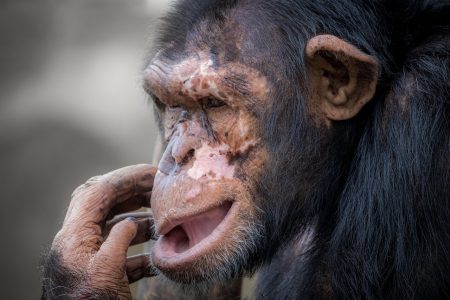
Bloodthirsty Apes
Chimpanzees engaging in warfare is nothing new. It’s been common knowledge for decades that they raid and kill each other with rather disturbing glee.
Already in the ‘70s, Jane Goodall (better known for her work with gorillas) observed one chimp community in Tanzania’s Gombe National Park splintering and engaging in a four-year civil war. By the end of the conflict, every last male of the losing group had been slaughtered.
What Goodall, or anyone else for that matter, didn’t understand was why. Why would the chimps war for years on end when the only result seemed to be a bunch of dead chimps?
A recent study published in the journal PNAS has potentially provided at least a partial answer. It seems going to war helps chimps make babies.
10-year Chimp War
Several chimpanzee troops inhabit the Kibale National Park in Uganda. One of them is known as the Ngogo group.
In 1998, the Ngogo chimpanzees began a series of violent conflicts with their neighbors. What started as minor border skirmishes spiraled into an all-out chimp war, in a chilling mirror of how many human wars start.
This chimpanzee war ended up lasting from 1998 to 2008. It was a bloody one, too, resulting in the death of at least 21 chimps from groups other than Ngogo.
That doesn’t sound like much, but considering the size of chimp troops, it was pretty rough.
By the end of the war, the Ngogo troop had conquered the area previously held by their rivals, increasing their territory by almost 25%. The years following the war surprisingly showed a reason why the chimps may have chimped out for a whole decade.
Before the war, the Ngogo group’s females gave birth to 15 babies over three years. In the three years after the war, the troop got 37 new infants.
Not only did the chimps make more babies, but those babies became much more likely to survive. Before the war, a Ngogo baby chimp had a mere 8% chance of living past the age of 3; after the war, it was 41%.
Now those are significantly better odds.
Winner Takes It All
According to the researchers, the chimp baby boom is likely a result of two factors. First is health, second is the removal of rivals.
With their increased territory, the Ngogo chimps gained access to more food. Consequently, the adult chimps could eat their fill, which helped them stay healthy and make babies. With healthy moms also came healthier babies, and the infants’ survival chances went up.
Another thing helping the babies survive was that there were no other chimpanzees around anymore. The largest cause of mortality among baby chimpanzees is getting killed by members of rival groups — the targets of chimp raids are invariably enemy infants.
However, the Ngogo chimps have now eradicated all competition. They rule the roost, and for the time being, they won’t have to worry about someone coming after their children.
Things aren’t as happy for the rival chimps because, well, they’re dead or driven off far away. It appears that the foundations of chimpanzee success are built on the corpses of their enemies.
We Love War (But Find It Dumb)
In addition to shedding light on chimpanzee behavior, the new study may also explain how violence and warfare developed in humans. After all, we’re closely related to chimpanzees, and we both love war.
As such, it’s likely that our last common ancestor was a war-like creature as well. It seems that a thirst for violence may simply be baked into who we are.
However, the researchers also pointed out a significant difference between intergroup interactions in chimpanzees and humans. Chimps have a very simple approach to diplomacy with other groups: ape see, ape kill.
And while we humans are more than capable of acting in the same way, we no longer tend to resort to violence as a first resort. Instead, we might try to negotiate and find a non-violent solution, like establishing a trade deal.
According to the researchers, one reason for the difference might be that humans got so good at the whole killing business that we eventually learned that defaulting to war is kind of stupid in terms of our own survival. Chimpanzees, on the other hand, seem to only benefit from wiping out all competition.
Maybe that’ll change if they learn to tie a stone to a stick to make a club.