
- Today’s menu includes whale puke, toxic pears, and Frankenstein’s pig-chicken monstrosity. Bon Appetit!
Cuisine is a form of art, and just like all art, it has changed again and again throughout history. Case in point, hand a Pop-Tart to a medieval peasant to blow his mind.
Some ancient dishes, like stews and porridges, have been with us for thousands of years. Others, however, have fallen to the wayside over the centuries — and in some cases, that’s for the best.
Here are 11 dishes, food products, and ingredients that aren’t eaten today. Not all of them are necessarily gross, though. They’re just different enough from modern tastes to confuse you.
1. Ambergris
Ambergris is still used today, particularly in perfumes. Historically, it was also used as an ingredient in foods — for some reason.
We’re saying that because ambergris is whale vomit.
When freshly produced, it has a revolting, fecal stench. As the stuff ages, its odor becomes less instantly revolting and develops a more astringent character.
We can’t think of any reason why you would ever put ambergris in something meant to be eaten outside of it being ridiculously expensive. Which is probably why it was done.
2. Isinglass
Gelatin didn’t become affordable and widely available until the late 19th century, yet people have had a taste for gelatinous desserts and candies long before that. To get that sweet, sweet goo, they used isinglass — which is dried fish swim bladders.
Fish swim bladders contain natural collagen that can be used to goo-ify foods. It might sound a bit gross, but you wouldn’t think twice about isinglass if you didn’t know what it was.
We still use isinglass today in beer and wine production. The stuff turns yeast and other impurities into a goo that sinks to the bottom of the beer or wine barrel, making the drink cleaner and more appealing.
3. Melas Zomos
Nobody is quite sure what Melas Zomos — Greek for “black soup” — was. This ancient Spartan dish likely contained pieces of pork in a delightful broth of blood, salt, vinegar, and nothing else.
That said, throughout history, it has been known as one of the most revolting foods to ever exist.
It seems nobody but the Spartans could stomach eating Melas Zomos. Some Greek writers quipped that the black soup was probably the reason why Spartans didn’t fear death in battle; it was better to die than live to eat it again.
We’re certain Melas Zomos’ bad reputation is at least in part due to Athenian propaganda. That said, we’re not in any rush to try cooking it ourselves.
4. Flamingo Tongue
When you’re filthy rich, you can afford to eat the most bizarre and difficult-to-obtain foods. For the nobles of ancient Rome, that meant the tongues of flamingoes.
According to Roman sources, flamingo tongues were one of the finest delicacies in the entire empire. Although rich Romans ate the entire birds, it was the tongues that were the piece de resistance.
You can’t help but wonder if the tongues actually taste that good or if the Romans liked them simply because they were expensive. It would be kind of cool to find out, but where are you going to get flamingo tongues?
Actually, that probably answers our question.
5. Beaver Tails
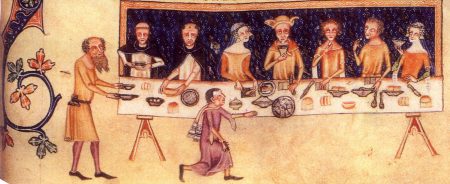
In medieval England, roughly half of the year consisted of fast days — which meant meat was off the menu. Fortunately, the Catholic Church allows the faithful to eat fish.
That means you could whip up a nice dish of beaver tails.
According to the scientific knowledge of the time, beavers’ tails were made of fish. After all, they were scaly, spent most of their time underwater, and they kind of looked like a flounder if you squint a little.
Beaver tails were so popular that they contributed to the animals going extinct in the British Isles. They’ve since been reintroduced as the British have lost their taste for beaver tails (for now at least).
6. Purple Pears
Purple pears were likely invented in Renaissance Europe and their recipe was first written down in the 18th century. To prepare this dish, cooks were instructed to boil pears and cover the pot with a pewter plate, which turns the fruit into a delightful purple color.
Here’s a disclaimer: do not actually do that. Purple pears are poisonous. The color change is due to the pears’ acidity leaching lead from the pewter plate, which both changes their color and turns them toxic.
It’s impossible to tell how many people have died from this horrible dish, as lead poisoning is a slow and insidious killer.
7. Live Bird Pie
Serving birds in a pie is not weird in itself — after all, we have dishes like chicken pot pie. In medieval Europe, however, the birds in the pie weren’t necessarily dead.
Sometimes, cooks would place live birds in a pie crust and take the “dish” to the dining hall. It wasn’t meant to be eaten, however, and instead served as pure spectacle.
As the host cut open the pie, the birds would fly out to impress and entertain the guests. You have to wonder if they then just stayed flapping all over the dining hall and pooping on everything.
8. Redressed Birds
Here’s another strange medieval fowl dish. Unlike in the live bird pie, redressed birds were dead — but you wouldn’t necessarily be able to tell.
To prepare a redressed bird, the chef would first cook its meat. The cooked flesh was then stuffed back into the bird’s skin before its feathers were sewn back on.
The unsettling undead bird was then presented to the dinner guests. Redressed birds took a lot of time and effort to make and we can’t imagine they were pleasant to eat — but at least the local lord could impress (and potentially gross out) his guests.
9. Cock Beer
Oh, get your mind out of the gutter. The “cock” in cock beer is a rooster.
That rooster, however, was boiled and chopped up before being thrown into a barrel of beer. It was then left to steep in there like a fowl tea bag.
Supposedly, doing this would infuse the beer with the rooster’s strength, courage, and virility. As such, cock beer was often drunk by the sick and the manliest of men who were a little insecure about their masculinity.
10. Rôti Sans Pareil
You’ve heard of the turducken. If you haven’t, it’s a chicken cooked inside a duck, cooked inside a turkey.
But a turducken has nothing on the Rôti Sans Pareil — or the “roast without equal.”
This early-19th-century French dish consists of 17 birds stuffed inside one another before being roasted. The ingredients included (from smallest to largest) a warbler, an ortolan bunting, a lark, a thrush, a quail, a lapwing, a plover, a partridge, a woodcock, a teal, a guinea fowl, a duck, a chicken, a pheasant, a goose, a turkey, and finally, a bustard.
11. Cockentrice
Alright, people have and will eat any existing animal. But what about animals that don’t exist?
That’s where the cockentrice comes in. This medieval monstrosity was prepared by sewing one or more animals together to create a “new” animal.
The most famous variety of cockentrice consisted of the front half of a piglet sewn to the butt half of a chicken or duck. That said, we’re certain enterprising cooks have prepared this dish from many other creatures as well.