
- A cat of any other color would purr just as sweetly — but the new coat certainly looks pretty.
Solid, tabby, piebald, calico, Siamese, bald… Our kitty cats come in all kinds of coats and colors.
Now, crazy cat ladies and lords can add a whole new type of cat to the list.
A Finnish research team has identified a new kind of coat in cats. Called “salmiak,” this never-before-seen coloration is black and white, with the black undercoat fading into white toward the tips of the hair.
The coloration has existed (as far as anyone’s aware) for less than 20 years. It’s all because of a rogue genetic mutation.
These new types of cats lack parts of the appropriately named KIT gene that controls certain aspects of cat coloration. That also makes the salmiak coloration very rare, as both parents must have the mutation for a kitten to develop the distinctive colors.
Bizarre mutants have never been this adorable.
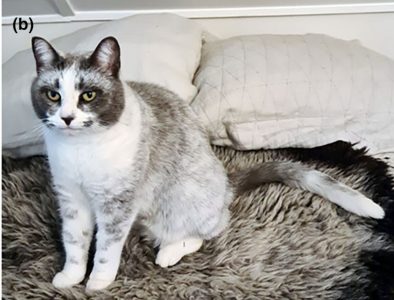
What’s the Color?
On a quick glance, the new cat coat looks like the good old tuxedo coloration. It’s mostly black, with white faces, paws, and (typically) tail.
However, unlike a tuxedo, the black part on the back and sides isn’t entirely black. The dark color is present only at the root of the hairs and fades into pure white toward the tips.
Consequently, the cats end up with their distinctive salt-and-pepper fur that’s entirely new in the kitty world.
It’s also what got the novel coat its name, salmiak. That stems from “salmiakki,” a somewhat notorious Finnish salty black licorice candy often sprinkled with additional salt.
All that said, salmiak cats can come in variations. The dark parts of their fur can be black, brown, or tortoiseshell, but they all share the white-at-the-tips feature.
Oh, and the cats’ eyes tend to be green or yellow.
A Feral Creation
The first time the salmiak cats were recorded was in 2007. That’s when people living in Central Finland realized that some local semi-feral cats had developed unusual fur colors.
It’s possible the coloration has existed for longer than that. All we’re saying is that 2007 was the first time people put pen to paper about it.
Since then, the salmiak cats began popping up more often, although they remained a rare sight. They weren’t called “salmiak” at the time, though, and instead had the decidedly less flattering name, “the Finnish mutation.”
But whenever new animal variants, such as the weirdly colored cats, appear, scientists tend to want to know why. They began examining the animals (mostly those that had been captured and domesticated) and soon figured out that they had all come from the same feral population.
Unfortunately, all the cats that had been rescued had been spayed or neutered according to local laws, so the researchers had no idea if the strange new cats could reproduce. That is, until they found one rogue adoption that had given birth to four bouncing salmiak kittens.
Rare Mutants
Something was afoot and so researchers from the University of Helsinki teamed up with the pet DNA testing company Wisdom Panel to find out what. The results of their study were recently published in the journal Animal Genetics.
The team initially suspected that the fading coloration might have something to do with the W genes controlling white coloration in cats. Initial DNA tests, however, showed that there was absolutely nothing unusual with the cats’ W genes.
Clearly, it was time to break out the big guns. So, the researchers sequenced the entire genome of two salmiak cats.
That was a bunch of work, but it revealed the culprit. The sequenced genome clearly showed that salmiak cats have a partial deletion in the KIT gene, which determines whether white will show up in a cat’s coat.
The mutated KIT gene allows for white to appear — but only in parts of the hair, which explains the distinctive coloration.
In addition, the researchers figured out that this KIT gene mutation is recessive, meaning that both parents of the new kitten must carry it for the kitten to come out salmiak. That explains why salmiak cats are so rare.
Thanks to this information, we now know how the new fur coloration was born and how we can prevent it from disappearing now that it’s here. What remains to be seen is whether the salmiak coloration will be recognized by organizations like the International Cat Association.