
- If you find one, call the number. You’ll help threatened sea turtles.
The Gulf Coast of Texas isn’t the country’s most renowned beach vacation destination, but you shouldn’t sleep on it. You can find some great sand on the shores of the region’s barrier islands.
Recently, however, the residents and visitors of the area have been puzzled by a bizarre phenomenon. Strange things are washing up on Texas shores.
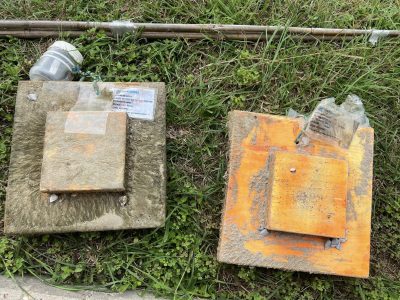
People in Galveston and Freeport have discovered multiple algae-covered wooden blocks littering the shores. Under the cover of sea scum, they’ve been brightly painted and sported a phone number.
What’s going on? Are the blocks some shipwrecked sailor’s desperate call for help?
Not at all. They’re artificial sea turtle carcasses.
The Gulf Center for Sea Turtle Research (GCSTR) responded to the public’s confusion about the blocks. Researchers from the GCSTR released these “effigy drifters” to the sea to study how far ocean currents can push a dead sea turtle from its home waters.
As such, the GCSTR encourages everyone who finds the beached blocks to call the number listed on them. It’s an easy way to help everyone’s favorite shelled oceanic reptiles.
Bizarre Blocks
In the last couple of weeks, both permanent residents and visitors to the Gulf Coast of Texas have been finding weird objects around the cities of Galveston and Freeport. The beached things come in the form of a square wooden block attached to a larger wooden square.
The blocks have been painted in various bright colors. Most have been orange, but they can also be pink, yellow, or neon green.
But perhaps the strangest thing is that they all have instructions on them to note down the location of the block’s discovery. They also encourage the finder to call a certain telephone number.
Well, that’s what you find if you clean the blocks, anyway. The ones that have washed ashore have been covered in algae, seaweed, and other kinds of ocean-borne gunk, implying they’ve been in the water for quite a while.
The bizarre discoveries have left local communities puzzled and confused. That’s understandable because you probably wouldn’t guess their purpose yourself.
Scientific Effigies
It turns out that these are not just any pieces of wood someone tossed into the sea. They’re simulated sea turtle corpses.
After people started questioning the purpose of the blocks, the GCSTR released a statement clarifying their purpose. They’re important tools for the study of a phenomenon known as sea turtle stranding.
The stranding itself isn’t particularly complicated. A sea turtle dies and its carcass drifts on the waves and currents until it washes ashore — often dozens and dozens of miles of the ex-turtle’s home turf.
But the thing is that all sea turtles that live in U.S. waters are listed as threatened at best and endangered at worst. As such, marine biologists would love to know where the turtles came from to try and figure out what’s killing them.
And that’s where these “effigy drifters” come in.
“In an effort to understand how weather patterns and ocean currents influence annual sea turtle strandings, NOAA Fisheries scientists have deployed wooden effigy’s [sic] to replicate sea turtle carcasses,” the GCSTR said in the statement.
“A total of 80 effigy drifters were released off Chandeleur Island, LA, and over half are headed towards the Texas coast.”
Attached to each block is a GPS tracker that keeps a record if the fake turtle’s journey. As such, the GCSTR and NOAA would love it if you called them after finding one of the blocks.
Anyone who discovers a turtle block is encouraged to note down where it was found and call 1-866-TURTLE-5. You can then tell the researchers where they can find the block, or arrange a drop-off if you happened to pick it up.
That said, if you see the effigies floating in the water, leave them be. They might still drift farther, so don’t interrupt their natural voyage.
The Alien Buttons
The turtle effigies aren’t the only that’s washing up on Texas shores right now, however. Locals have also noticed unusual, small, blue creatures beaching in Galveston and Surfside.
These things, however, are not part of any research project. They are called blue button jellyfish, although that name is misleading.
Despite their jellyfish-like appearance, blue buttons are a collective of various polyps, tiny organisms that bundle together and act more or less like a single creature. These roughly two-inch-wide blobs are currently being attracted to Texas coasts due to the abundance of plankton and other small things they like to eat.
Unlike the turtle effigies, however, you shouldn’t go poke at a blue button. It won’t kill you, but they are covered in stinging tentacles that can irritate your skin like a jellyfish’s sting.
But if you happen to find one of the turtle blocks covered in blue buttons… Well, you’re on your own. Hope you have a pair of thick gloves.