
- What are the odds of your long-lost relative rescuing you from a deserted island?
It really is a small world. No matter where you go, you just might run into someone you know.
For proof, take this story of a shipwreck that led to a bizarre family meeting.
Three fishermen out practicing their jobs on the Pacific Ocean got struck by a storm and shipwrecked on a deserted island. For the next week, they lived as if in a pirate novel, subsisting on coconuts and spring water.
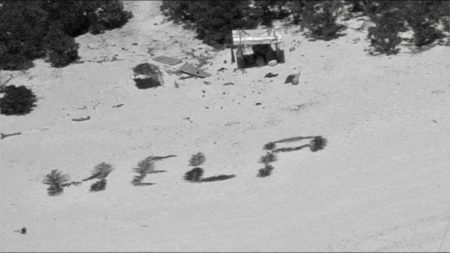
They even built a huge “HELP” sign on the beach out of palm fronds. That was a smart move, as the U.S. Coast Guard plane noticed the call for help.
But when the rescuers finally arrived, the three men were in for a final surprise. It turned out that the first Coast Guard serviceperson to hop ashore was related to all of them.
As we said — small world.
Not Bad for a Deserted Island
The fishermen’s shipwreck ordeal began on March 31, according to the U.S. Coast Guard Forces Micronesia (USCGFM). On that day, they set off from Polowat Atoll, 850 miles off the coast of Papua New Guinea.
Each of the three men, all in their 40s, was an experienced fisherman who knew the local islands like the backs of his hands. But even the most intricate knowledge of the Pacific Ocean won’t help you if a storm hits.
And that’s what happened.
Large waves damaged the engine of the men’s fishing boat, knocking their only mode of propulsion out of service. Fortunately, they managed to get ashore on Pikelot Atoll.
Well, that’s “fortunately” in a relative sense. They were no longer drifting on the ocean — just stranded on an uninhabited island a whopping 0.049 square miles in size.
That said, there are much worse islands to be stranded on. Visiting fishermen have built a makeshift chapel (it’s really just an awning with a tarp for walls) and expanded a small spring into a functioning well.
Additionally, Pikelot’s palm trees are full of coconuts. So, at least the men had a rudimentary shelter and weren’t about to immediately die of hunger or thirst.
For the next week, they survived by eating coconuts and drinking water from the well. We’ll assume their fishing equipment was damaged or otherwise unusable.
Even with some food and water, the men did want to eventually get off the atoll. So, they spelled a large sign calling for “HELP” on the beach, using fallen palm fronds.
They Saw the Sign
When the fishing trio failed to return on time from their trip, their families grew worried. On April 6, the USCGFM received a distress call from a relative asking for help.
Fortunately, the fishermen had told their families that they planned to fish in the waters surrounding Pikelot. That gave the USCGFM a handy starting point for their search.
It didn’t take long for them to find the shipwrecked men. On April 7, a U.S. Navy P-8 Poseidon reconnaissance aircraft noticed the “HELP” message on Pikelot’s beach.
“This act of ingenuity was pivotal in guiding rescue efforts directly to their location,” Lt. Chelsea Garcia, the coordinator of the rescue mission, told CNN.
The following day, another Coast Guard aircraft flew over the island and airdropped a radio and survival packages to the men. With the radio, they were able to let their families know they were alive, in good shape, and waiting for a ride home.
‘It’s a Crazy World’
That ride arrived the next day, on April 9. The U.S. Coast Guard cutter Oliver Henry dropped anchor by Pikelot Atoll.
On the vessel was Petty Officer 2nd Class, Eugene Halishlius. He was among the first group of rescuers to come ashore on Pikelot.
Halishlius is Micronesian, as were the stranded fishermen. They seemed surprised to see Halishlius among the European Americans, and they were even more surprised that Halishlius also spoke the same local language.
The men asked how come the U.S. Coast Guard serviceman knew their language. We wish we could’ve been there to see the castaways’ faces when Halishlius told them his name and background.
That’s because they were all related. One of the fishermen was Halishlius’ third cousin, while the other two were fourth cousins.
“It’s a crazy world,” Halishlius said. “He couldn’t believe I’m with the Coast Guard trying to rescue them.”
Perhaps so, but we can’t imagine a much better way to get rescued. With the help of their cousin, thrice or four times removed, the fishermen were safely united with their more closely related families.