
- NYC’s most famous sewer dweller is finally getting the recognition it deserves.
You can find a lot of things living in New York City’s sewers. There are cockroaches, rats, and probably some kind of a race of underground morlocks.
What you won’t find is the sewers’ most famous resident. Although rumors of its existence have circulated for a century, NYC’s legendary sewer alligator is nothing but a myth.
Despite being pure make-believe, the supposed gator has had a big impact on popular culture. It has been featured in books, comics, movies, and — of course — NYC memorabilia.
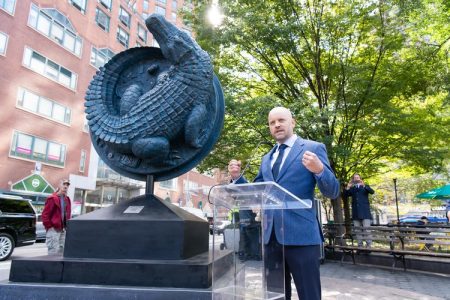
Now, the city has given official recognition to the nonexistent king of its sewer system. On October 17, the NYC Department of Parks & Recreation (NYCDPR) and the Union Square Partnership (USP) unveiled “NYC Legend,” a statue commemorating the supposed sewer gator.
“Stories are the very backbone of human civilization, giving shape to our shared consciousness through sculptures, paintings, and architecture,” said the statue’s sculptor, Swedish artist Alexander Klingspor at the unveiling event.
“This piece is a testament to our timeless drive to find icons in nature, and to the bridge that myth builds between the ancient and modern that still echoes today.”
‘A Beautiful Representation’
The “NYC Legend” statue is hard to miss. First of all, it’s located in Union Square, one of Manhattan’s central locations.
Second, it’s not exactly a small piece of art. The work consists of a huge, vertically mounted manhole cover, on which rests a life-sized bronze sculpture of an alligator.
In total, the statue stands more than 7 feet tall. It’s a hefty one, too, weighing more than 3,000 pounds.
Suppose we won’t have to worry about any art thieves swiping it any time soon.
According to the artist Klingspor, the work combines the symbolism of ancient legends — such as those surrounding alligators — with modern urban folklore. He adds that the alligator symbolizes the resilience and adaptability of NYC with its sturdy scales and ability to regrow body parts.
Yes, it’s true. They can regenerate severed limbs.
The sculpture was commissioned by the NYCDPR and USP, and funded by the Mollbrinks Gallery in Sweden. Klingspor sculpted, but the casting itself was carried out at Perseo Foundry in Switzerland, renowned for the high quality of its work.
“This sculpture is a beautiful representation of our enduring resilience as New Yorkers, and embodies one of the most famous urban legends about our city,” said Anthony Perez, New York City Parks Manhattan Borough Commissioner.
“Public art installations like this are one of the many ways we use our public parks to celebrate the stories and spirit that make our city so unique. I’m so excited to see this sculpture take its place in iconic Union Square Park, where I’m sure it will surprise and delight both New Yorkers and visitors.”
“NYC Legend” will be displayed in Union Square until June 2024. Where it will go after that, the USP didn’t say.
Hopefully not in the sewer.
A Kind-of-sort-of True Story
It may be make-believe, but the story of NYC’s sewer alligators has proven to be a good one. It has to be — it wouldn’t have stuck around for a century, otherwise.
The legend about alligators lurking in NYC’s sewers has its origins in the 1920s and ‘30s. It was spawned by a questionable practice in animal trading.
At the time, shops in Florida would sell baby alligators to northern visitors as souvenirs. People would bring the gators back to NYC with them, only to soon realize that they grow quickly — and they get big.
Unable to deal with the expanding gator, people would then dumb the ravenous reptile down into the sewers. Up to this point, the story is probably true.
But the legend states that some of the gators survived. Stories of the gators began spreading and we still tell them today.
In reality, there’s no way alligators would survive in NYC’s sewers. It gets way too cold for them in there and the general environment in the sewers is toxic to them because of…
Well, all the crap.
That’s not to say that you can’t come across an alligator in NYC. Every year, city officials rescue around 100 gators that people have brought to the city as now-illegal pets.
Considering that, it’s not impossible that there’s an alligator in NYC sewers. We’re just saying that if there is, it won’t last long.
But at least the new statue now stands as a memorial to the potential perished sewer gators.