
- Even the most common product may have one heck of a story behind it.
There’s a first time for everything, and that includes the items and products we use every day. Many, if not most, such items are purpose-built to serve a specific purpose.
But there are some whose origins are quite odd.
It might be because the thing was originally built for a completely different purpose than what we use it for today. Or, there might be an incredibly unlikely series of events that led someone to come up with the invention.
Here are eight origin stories behind common everyday items.
1. Play-Doh
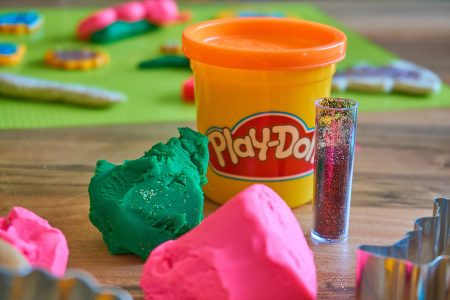
These days, Play-Doh is a staple of most kids’ (and fiddling adults’) toy boxes. Originally, however, it was a cleaning product.
Back in the 1930s, when the product that would become Play-Doh was introduced, most houses were heated with coal. An unfortunate side effect of coal heating was the dust and residue it left on the house’s wallpaper.
Play-Doh was invented as a product to clean off that coal residue. Just take a wad of putty and dab it on the walls to remove the dust.
After World War II, gas heating became common, and no one needed a coal-residue absorbing putty anymore. However, the manufacturers had noticed children liked playing with their non-toxic cleaning putty, and Play-Doh was born.
2. Bicycle

In 1815, the volcano Mount Tambora erupted in Indonesia with enormous destructive power. The eruption sent ginormous clouds of ash and dust into the air, resulting in a global environmental catastrophe known as the Year Without a Summer.
What does this have to do with bicycles? Well, German noble Karl Dreis observed the plight of peasants, who were struggling to grow enough food to feed themselves, never mind their livestock. However, as their horses died, the peasant became unable to go anywhere or plow their field.
Dreis was inspired to design a vehicle that didn’t require an animal. Surely the people would appreciate being able to get to places even without a horse.
Consequently, in 1817, Dreis introduced his Laufmaschine, or running machine. Although this early two-wheeled contraption lacked pedals, its invention led directly to the bicycle.
3. Smoke Detector

In the late 1930s, Swiss physicist Walter Jaeger was trying to develop a device to detect poisonous gases in factories. However, things weren’t going to plan — his gadget wouldn’t react to any kinds of toxic fumes.
The frustrated Jaeger lit up a cigarette to soothe his nerves. Lo and behold, his gas detector started going nuts as soon as it caught the first whiff of smoke.
Although there had been earlier, primitive smoke and heat detectors, Jaeger’s invention paved the way for the modern smoke detector. This whole thing is a bit ironic because, considering how harmful cigarette smoke is, Jaeger did sort of succeed in developing a poison detector.
4. Metal Detector

Alexander Graham Bell invented more than the telephone — he also came up with the working principle of most modern metal detectors. And it’s all due to the assassination of U.S. President James Garfield.
After Garfield was shot, the bullet got lodged in his body, and the presidential doctor was unable to find it. Bell, who had already been tinkering with a metal detecting device, rushed to his lab to try to help save the president’s life.
His device worked very well in the lab, but for some reason, it couldn’t reliably find the bullet in Garfield’s chest. In the end, it was too late, and the president died of his wounds.
And then Bell realized the bed Garfield had been lying on had metal springs. His metal detector functioned perfectly well — it was just detecting the bed instead of the bullet.
5. Treadmill

Today, you can find a treadmill in virtually every gym. However, they have been making people sweat for thousands of years.
Their original purpose wasn’t to build your muscles, though. Instead, they were engines that used human muscle power to do something else, like spin a grindstone to grind grains. That’s where the “mill” comes from.
Yet, perhaps the most infamous use of pre-gym treadmills came from the prisons of Victorian England. Here, criminals (and sometimes innocent people) sentenced to hard labor trod endlessly on giant, heavy wheels to produce flour for their food.
Sometimes, though, the penal treadmills had no purpose. They didn’t produce anything, except suffering for the prisoners who were forced to spin them upward of six hours a day.
6. Bra Hooks

Anyone who has ever struggled to open bra hooks, causing an awkward delay in getting down and dirty, can thank the author Mark Twain for their embarrassment. Twain, however, didn’t invent the hook-and-eye clasp for bras.
Instead, he did it for his pants. At the time, most men relied on suspenders to keep their pants from falling down, but Twain found suspenders uncomfortable.
So, he invented and, in 1871, patented a string of cloth with a hook and eye that he could strap around his waist to keep his pants up. You know… Like a belt.
Because belts already existed, Twain’s pant strap never gained popularity. However, the hook-and-eye clasp was eventually adopted for bras.
7. Kleenex (and Menstrual Pads)

Shortly before World War I, the American company Kimberly-Clark discovered a material they dubbed cellucotton, made from pulp and paper. It was incredibly absorbent, and the company shipped it en masse to the front for use as medical bandages.
Once the war was over, Kimberly-Clark was left with massive piles of cellucotton they had no use for. However, they heard that nurses had been using their bandages to soak up their period during the war, so the company started producing the world’s first disposable menstrual pads under the Kotex brand.
Although Kotex pads are still sold today, they didn’t sell as well as the company hoped. So, using the same technology, they made the pads paper thin and started selling them as Kleenex tissues.
Considering “Kleenex” is now a generic word for disposable tissues, they were pretty successful.
8. Graham Crackers

Dr. Sylvester Graham was a 19th-century American minister and health advocate. He hated sex.
He really, really, really hated sex and everything associated with it. In his mind, you could bang begrudgingly to produce children, but you’d better not enjoy it.
However, most people didn’t seem to agree with him, which perplexed Graham. Finally, he figured out the reason — people’s extravagant diets were inflaming their carnal lust!
So, he resolved to design a vegetarian diet that was so bland and tasteless that it would kill the sex drive of even the most promiscuous Casanova. One part of that diet was graham crackers — small slabs of water, wheat flour, and little else.
The original graham crackers were indeed horrendous things to eat. Fortunately, nobody used them for their intended purpose, and through a modification of the original recipe, we got the essential component of ‘smores.
Does this sound weirdly familiar? It might be because it’s basically identical to the story behind Kellogg’s corn flakes.