
- Bet you’ve never seen machines this outlandish.
Robots are fascinating constructs in fiction, but in reality, they can be a little disappointing. While many have impressively complex computer processes running them, majority are little more than single arms building things in factories.
But there are more interesting robots out there, too. Whether they’re built to entertain people, train workers, or just because someone had a bizarre idea, they certainly make you think.
Here are eight of the weirdest robots ever built.
1. Aibo
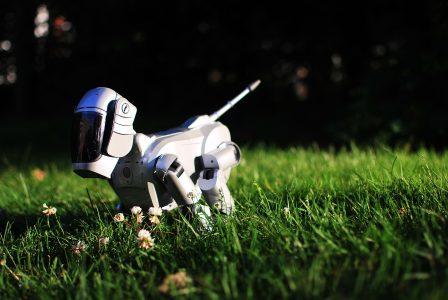
You might remember Aibo. This Japanese robot puppy was released by Sony in 1999 and soon became something of a minor pop culture sensation.
Aibo was (and is) basically a robot pet or a toy. It doesn’t do all that much out of the box, but it can play simple toys, learn basic tricks, and whatnot.
The biggest thing about Aibo is that it’s supposed to develop its own personality over time as it learns what its owner likes and dislikes. Modern version of Aibo are pretty advanced, and will slink away to their charger pod when their battery is running low.
Aibo has never been particularly useful or accessible, but it’s a fun little thing that has gone through several iterations. Some models look more dog-like while others are… Well, they don’t really resemble a cuddle puppy.
2. R.O.B
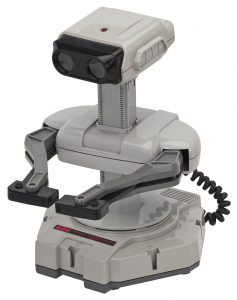
The Robotic Operating Buddy, or R.O.B. for short, was an accessory for the Nintendo Entertainment System from 1985. It must be one of the weirdest video game controllers anybody has ever made.
R.O.B. is a small robot with a two grabbing arms and two big camera eyes. Once connected to the NES, it’s supposed to watch the gameplay on the screen and use its arms to manipulate various objects, like rubber wheels, to play along.
Initially, R.O.B. supported two games, Gyromite and Stack-Up. Nintendo promised addons to allow R.O.B. to play many other games too, but those never materialized.
That might be because, to be blunt, R.O.B. sucked at playing even the games it was designed for. It was so slow and clunky that all it did was suck the fun out of the gaming experience.
3. H1N1 Patient
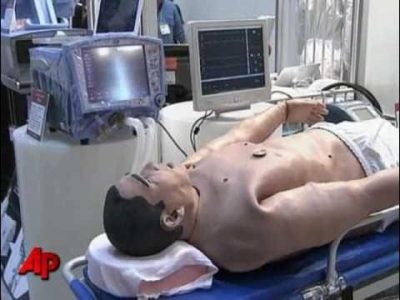
Remember the 2009 H1N1 or swine flu pandemic? If not, well it wasn’t an amazing time. The disease caught the world unawares, so there was a need to quickly train medical staff to deal with the pandemic.
That resulted in the robotic H1N1 patient. Built in Japan, this rubber skin-covered humanoid robot is disturbingly realistic in depicting the symptoms of the illness.
It can sweat, cough, complain, moan in agony, cry, experience seizures… You know, everything a sick person might do.
To top it all off, if the robot doesn’t get proper care, it goes into simulated respiratory failure and drops dead. At least this patient can be reset and rebooted, but it’s still one creepy machine.
4. EATR
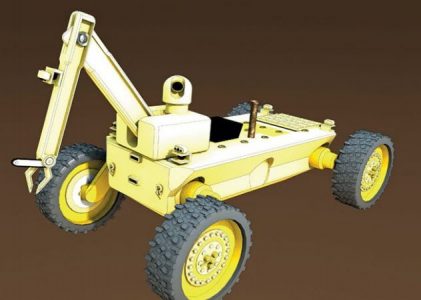
A robot that consumes biological matter to power itself sounds like a science-fiction horror villain. So, naturally, the U.S. military had to build one.
The Energetically Autonomous Tactical Robot or EATR (that is, “eater”) was a machine developed by now defunct clean-tech company Cyclone Power Technologies in 2003. It’s most distinctive feature is its chainsaw that it can use to chop down plants and stuff them in its combustion system to power itself.
Although its design document states it simply uses “biological matter” for go-go juice, Cyclone insisted that it’s strictly vegetarian. That’s despite the fact that documentary proof shows that it could also consume flesh, like chicken fat.
It’s probably for the best that this thing never became a real usable machine.
5. Last Moment Robot

Your life is coming to an end, but for one reason or another, your loved ones aren’t there by your bedside. Fortunately, the Last Moment Robot can offer you some cold comfort.
The robot consists of a padded machine arm that gently caresses your hand as you expire. It also reads out a customizable recording to lull you to eternal sleep.
“Hello [PATIENT], I am the last moment robot. I am here to help you and guide you through your last moment on Earth. I am sorry that your family and friends can’t be with you right now, but don’t be afraid. I am here to comfort you,” it says.
Luckily, this isn’t an actual product that someone built but a conceptual work by artist Dan Chen. Still, the thought of this thing’s automated platitudes being the last things you hear in this life is pretty horrifying.
6. Elektro
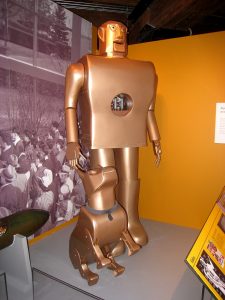
Elektro was a machine man built by the Westinghouse Electric Corporation for the 1939 New York World’s Fair. You might not expect such an old robot to do much, but Elektro was surprisingly advanced for its time.
It could was (sort of), move its head and arms, recognize the difference between red and green, and even speak with a vocabulary of 700 words (played through vinyl). Yet, he received the most attention for his ability to smoke cigarettes.
Look, it was 1939. Of course Elektro was a smoker.
7. Tomatan

Have you ever wished that an unwieldy and heavy thing sitting on your shoulders would feed you tomatoes? No? Really?
Well, if you had wished for that, then Tomatan would be the answer to your prayers. Developed by fruit juice company Kagome as a marketing stunt, Tomatan is a nearly 20-pound, child-sized, tomato-headed contraption.
Once placed on a person’s shoulders, it will use its two arms to pick tomatoes out of its gaping mouth. It then moves the red fruit down for its wearer to eat.
You know, this thing would’ve been perfect for our list of inventions that solved problems nobody had.
8. Digesting Duck
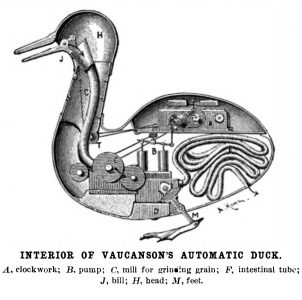
Jacques de Vaucanson was an 18th-century French inventor who was slightly obsessed with automata and robots. In 1739, he built his pièce de résistance — the Digesting Duck.
Consisting of more than 400 parts, it was a marvel of automated machinery. The mechanical duck would eat grains, chew them up, pass them through an intricately modeled digestive system, and then poop.
Magnifique!
Except that the Digesting Duck was a robot, so it couldn’t actually digest. Instead, it stored whatever it ate in a compartment in its guts and then pumped out duck crap that was held in another container.