
- What do a pyramid, a hockey puck, and a binder have in common? They’re all PCs.
These days, computers are getting more and more boring — at least in the looks department. With everyone trying to make the thinnest and lightest computer, there’s not a whole lot of room for unique designs.
Oh, but it didn’t use to be that way at all. Back in the day, computer manufacturers were constantly trying to outdo each other with creative and often outlandish machines.
We’ve covered some strange computers before, but there are many more out there. So, here are another six bizarre computer designs from the past (with one exception)
6. Maingear Prysma (2006)
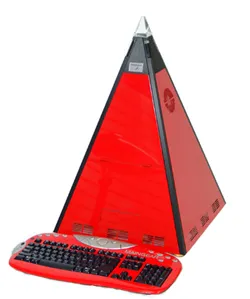
If you were told to think of a desktop computer case, you’d probably picture a six-sided box. In 2006, Maingear decided boxes were for squares and released the Prysma.
True to its name, the Prysma was shaped like a prism or a pyramid. It came in many different colors, including red, yellow, blue, silver, black, and white.
Performance-wise, the Prysma wasn’t stellar but it did well for the time. Unsurprisingly, though, the expensive engineering solutions stemming from the strange case made the computer so expensive that the average-at-best performance just wasn’t worth it.
Unless you were a reincarnation of an Egyptian pharaoh.
5. Gateway Profile 5.5 (2004)
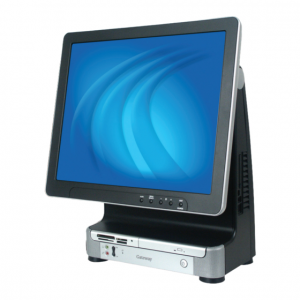
Computer builder Gateway has been building all-in-one computers for around 25 years — and they’re still in business. In 2004, they released the Profile 5.5.
The machine was about as middle-of-the-line in terms of performance as you could be back in the day. Its selling point was to be a simple, all-in-one package for people buying their first computer.
And while its design was praised for saving space, which it admittedly does, it was also horrendously ugly. Maybe Gateway did the best they could with the technology of the day, but that doesn’t make the thing look any prettier.
4. The Barbie/Hot Wheels PC (2000)
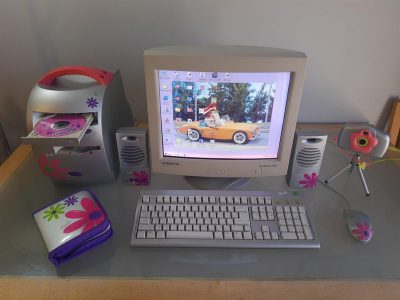
The year was 2000 and PCs had gotten just cheap enough that parents might consider buying their kid a computer of their very own. But what kid would be interested in a plain, off-white computer case?
That’s what Mattel thought when it released the Barbie and Hot Wheels PCs. They were the exact same computer — one was just enclosed in Barbie-branded plastic while the other had toy cars on it.
The things were… Fine for a child’s first computer in 2000, we suppose. Still, they performed pathetically and suffered from constant freeze-ups and crashes.
3. Sony Vaio TP1 (2007)
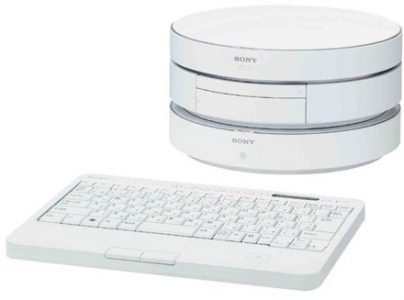
Toward the end of the ‘00s, the idea of having a PC in your living room for playing movies and music was no longer completely ludicrous. There was just that ever-present problem — computer cases are ugly.
Sony tried to remedy the situation with the Vaio TP1 home theater PC. Its puck-shaped design is reminiscent of a Roomba.
The Vaio TP1 didn’t have great performance. Not that it needed it to play videos, but the unique design resulted in a price tag that should’ve warranted much more powerful tech.
Additionally, the case was still that PC off-white shade that a lot of people found unpleasant. Sony later released an updated version that also came in black, but the moment had passed and barely anyone bought it.
2. Jack PC (2024)
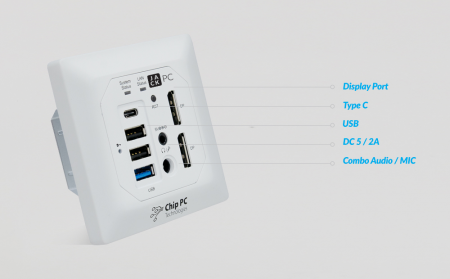
We know we said modern slim computers don’t leave much room for creativity. The Jack PC is here to prove that we’re wrong.
You’re not looking at just a wall socket — this thing is a fully functional computer that’s installed into a wall. Sure, the extremely compact form factor means it doesn’t have massive amounts of power, but talk about an office space saver.
And yes, it’s still sold. Maybe this is the direction computer technology should go.
1. IASIS IA7301 (1976)
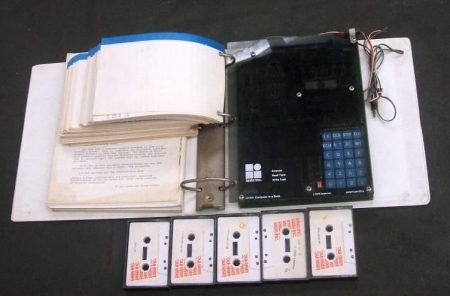
The Jack PC might be a modern product, but people have wanted slim computers since computers first became a thing. In 1976, IASIS released the IA7301 — and it was truly flat.
So flat, in fact, that it came inside a three-ring binder.
The IA7301 was a single-board computer with a whopping one kilobyte of RAM, a small LCD screen, and a minimalistic keyboard. It was intended to teach new computer users of ’76 the basics of coding and computing.
That’s what the binder is for. The basic computer came with a 250-page programming course.
What it didn’t come with was a power supply. Yeah, you had to buy your own.