
- Great works of art can be born from strange situations.
Creating art is a process. It doesn’t matter whether you’re painting, drawing, sculpting, or gluing fruit onto a wall — there’s a story behind every work of art.
Some of those stories are pretty strange. And that doesn’t go just for obscure works created by less-than-stable local artists.
Many works by famous artists have some pretty bizarre backstories as well. Here are six of them, some stranger and more messed up than others.
6. Campbell’s Soup Cans, Andy Warhol
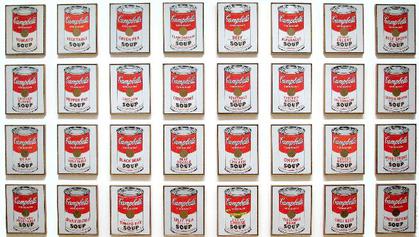
Let’s start innocently enough with Campbell’s Soup Cans, often considered pop artist Andy Warhol’s masterpiece. That’s kind of weird in itself, considering it’s a 32-painting series of soup cans.
Man, Warhol really must’ve loved Campbell’s soups, huh?
In reality, it was quite the opposite. He loathed Campbell’s soups because, in his poor youth, he would eat them day after day after day.
Despite his distaste for Campbell’s soup, he decided to paint the cans after a discussion with his artist friends. Lacking inspiration, he asked them for ideas, and someone told him to paint what he really hated to give the work emotional depth.
So, Warhol painted the soup cans. Clearly, the idea worked.
5. The Charnel House, Pablo Picasso
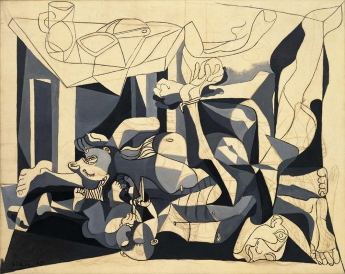
The Charnel House is an unfinished painting by the master of cubism, Pablo Picasso. It’s a mishmash of various shapes resembling human body parts that doesn’t seem to make much sense.
However, even if Picasso had finished the painting, it probably wouldn’t be much clearer. And that’s completely by design.
Picasso began working on The Charnel House during World War II as a statement against the Nazi regime’s genocidal acts. Yet, the direct inspiration comes from a few years earlier, from the Spanish Civil War.
Picasso had seen a photograph of a murdered family and couldn’t figure out what he was looking at — until he began spotting the hacked-apart limbs and body parts. With The Charnel House, he tried to emulate that moment of horrific realization.
4. Ophelia, John Everett Millais
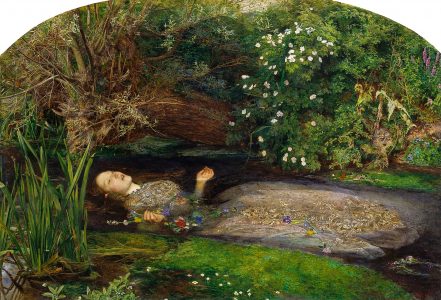
Like many other famous paintings, John Everett Millais’ Ophelia was critically panned at its time. Today, however, the painting depicting a scene from Hamlet is widely considered a masterpiece.
Its creation, however, was a real ordeal and not for Millais. Although he didn’t have a great time either.
He painted the work in two phases. In the first, he stayed on an English riverside painting the background and getting eaten alive by various bloodsucking bugs.
In the second phase, Millais asked his model to lie down in a bathtub heated only by oil lamps in the middle of winter. During painting, the oil lamps went out, but the model didn’t want to distract Millais by complaining.
So, she lay in the freezing bathtub for hours and got seriously sick. Although she later recovered, Millais ended up paying reparations to her father.
3. Washington Crossing the Delaware, Emanuel Leutze
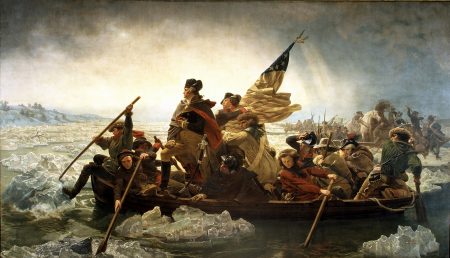
Washington Crossing the Delaware is often seen as a great patriotic painting. And while it certainly makes Washington look heroic, it’s not exactly a very American work of art.
First of all, its painter, Emanuel Leutze, was German. He was, however, brought to America as a child and admired the country’s system in the mid-1800s.
After moving back to Germany in 1842, Leutze became involved with revolutionary politics in Europe. He wanted to encourage a revolutionary spirit on the continent, and he decided to do so with a painting of the great American revolutionary leader, Washington.
Essentially, Leutze was a fan of Washington and the painting is an attempt to make him look as cool as possible. He may have succeeded, but he also introduced various historical inaccuracies in the work.
The most glaring one? Well, the American flag depicted in the painting didn’t yet exist when Washington crossed the Delaware River.
2. The Enigma of My Desire, Salvador Dali
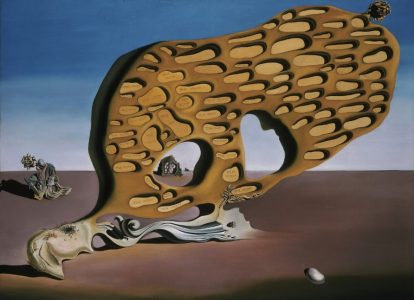
The surrealist master Salvador Dali was a strange, strange man, so it’s no wonder many of his paintings have strange stories behind them. The Enigma My of Desire is actually one of the most self-explanatory ones, but that doesn’t make it any less weird.
So, what is the mystery behind this vaguely cheese-like… Thing?
Well, if you peer into the “eyes” of the “cheese,” you may notice the words “ma me?re” written in several of them. That’s French for “my mother.”
Then there’s the full name of the painting, which is The Enigma of My Desire, or My Mother, My Mother, My Mother. Finally, Dali stated that the smaller rock structure attached to the lower left side of the “cheese” represents himself.
Do you think Dali may have had some unresolved mommy issues?
1. The Scream, Edvard Munch
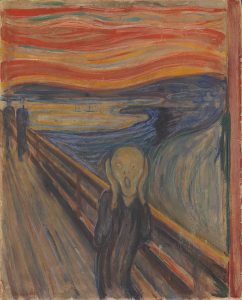
Everybody knows The Scream, with its strange green figure yelling in abject terror under blood-red skies. But fewer people know what the figure is screaming about.
Many art historians have promoted various theories about the painting. One states that the sky is inspired by the eruption of Krakatoa which resulted in red skies across Europe in 1883, while others claim the screaming figure is a depiction of a Peruvian mummy Munch may have seen at the 1889 World’s Fair.
All these explanations, however, ignore Munch’s own account from his diaries. He states he was walking with friends during a bright sunset when suddenly he became overwhelmed with a feeling of anxiety and “sensed an infinite scream passing through nature.”
The painting’s figure is screaming because — as Munch likely did during that walk — it’s having a panic attack.