
- There are bones in places where there shouldn’t, and none in places where there should.
What’s inside you is what really matters. No, we’re not talking about your good heart, but your skeleton.
In vertebrates, the skeleton provides support for the creature’s entire body. It has to adapt and specialize to allow each animal to get through its everyday life.
Consequently, some of them end up pretty freaky-looking.
Here are 10 examples of strange and unusual animal bones and skeletons that may surprise you.
1. Narwhal
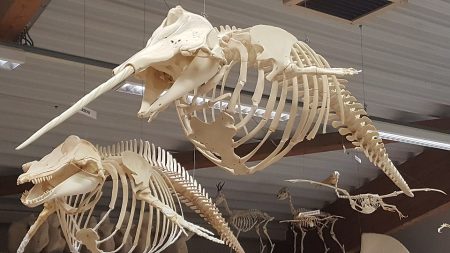
Narwhals are sometimes called the unicorns of the sea, and not without reason. However, unlike the legendary horned horse, the narwhal’s “horn” isn’t a horn — it’s a tooth.
Male narwhals have, or in rare cases two, spiraling, enormously long tusks jutting out of their mouths. Likely used for attracting mates, narwhal horns can be up to 10 feet in length.
Weirdly, although they are toothed whales, narwhals have no teeth outside their tusks. They occasionally develop tiny vestigial teeth, but they’re functionally completely useless.
2. Giraffe
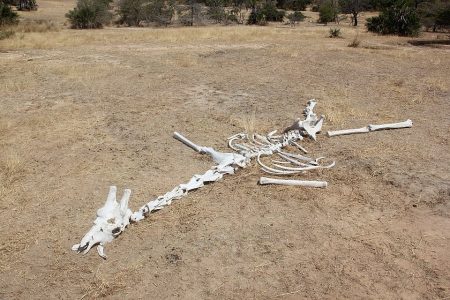
Giraffes are famous for their long necks, so they must have plenty of neck bones, right? Surprisingly, they don’t.
A giraffe has seven neck vertebrae — exactly as many as you have. They’re just a lot longer.
The neck isn’t the only bony oddity about giraffes. Know those two horn- or antler-like protrusions on their heads? They’re called ossicones and they’re not horns or antlers — they’re extensions of the giraffe’s skull.
3. Sloth
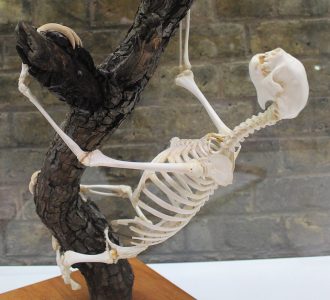
Alright, so giraffes don’t have a lot of neck bones. But you know who does? The sloth.
Some sloth species have 8 or even 10 vertebrae in their necks. Consequently, they technically the “longest” necks out of all animals, if you simply go by the number of neck bones.
Thanks to those extra vertebrae, sloths are able to twist and turn their heads in various ways to observe their surroundings and reach food. Life’s tough when you lazily hang upside down from a branch for most of your life.
4. Frog
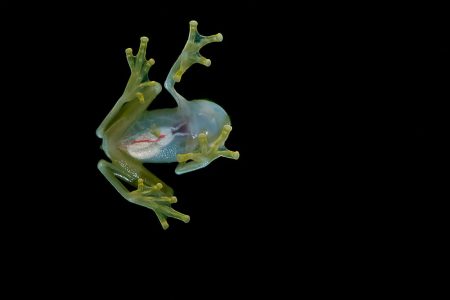
Frogs have some of the freakiest skeletons out of all vertebrae. And that’s due to because they have very little skeleton.
Frogs’ bones have fused and atrophied to the point that their skeletons consists of very few bones. Additionally, what bones they do have are very archaic, retaining skeletal structures that have been lost to most other species on the evolutionary path.
Yet, even among the frogs, the biggest weirdo must be the glass frog. These tropical little guys are famous for their practically translucent skin. But why can’t you see bones inside the frog?
Well, glass frog bones are so thin and delicate that they’re almost invisible.
5. Armadillo
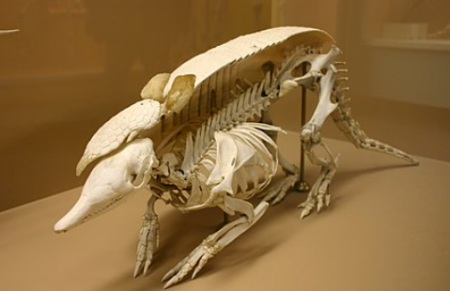
Most creatures on the planet make due with one skeleton. The armadillo, however, is the spoiled kid of the animal world whose mom let it have two skeletons.
The armadillo’s skeleton is pretty much what you’d expect. But around that inner skeleton are its armor plates, which are fused with its skin.
Looking at a living armadillo, you might think its protective plates are just really tough hide. But nope, it’s all bone, baby.
6. Turtle
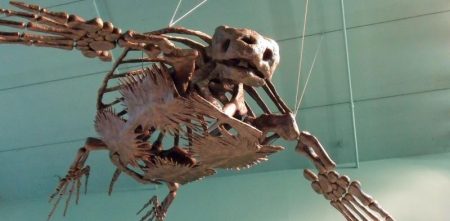
You might think turtles do it similarly to armadillo, having their shells around their skeleton. But in reality, their shells are their skeletons.
A turtle’s spine and ribs are fused to its shell. It’s impossible to remove a turtle’s shell without killing it, since you’d be prying its ribcage open.
Consequently, turtles are one of the few vertebrates that don’t just have a skeleton inside their bodies. In practice, they more or less live inside their skeletons.
7. Axolotl
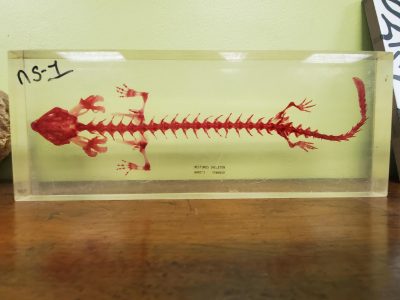
The funky-looking axolotls’ most distinguishing features are their external gills. They retain those gills because axolotls are neotenic or paedomorphic — they never fully mature, remaining partly juvenile even into adulthood.
Basically, they’re overgrown tadpoles.
Due to their neoteny, axolotl skeletons don’t ossify completely, either. Whereas most amphibians develop fully bony skeletons, axolotl bones are forever stuck in a youthful, partially cartilaginous state.
8. Aye-aye
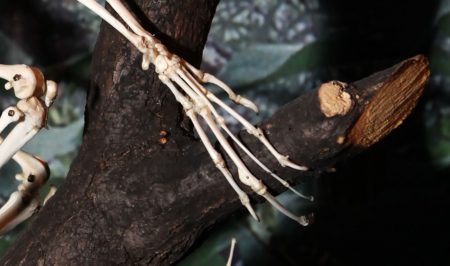
The aye-aye is a creepy-looking lemur from Madagascar. If you can get past their spooky faces, you might notice their bizarre hands.
Aye-ayes have an extremely long and skeletally thin middle finger. They use this flexible finger to tap on tree trunks to find grub-filled holes. After finding one, they chew an opening and then use that same skinny finger to dig the grubs out for dinner.
Yet, the skeleton finger isn’t the only freaky thing about aye-aye hands. Unique among, they have six fingers. They have what are called pseudothumbs — small, stubby fingers that help them in grabbing branches.
They don’t really look like it, but they’re essentially an extra finger, complete with a unique fingerprint.
9. Platypus
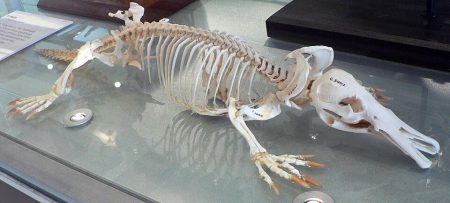
Platypuses are little freaks of nature to begin with, so it’s no surprise that their skeletons are bizarre, too. They display an outlandish mix of features typically found in mammals, reptiles, birds, and even fish.
The spine and ribcage are fairly mammalian, but then the platypus’ legs are splayed apart like a lizard’s. On their feet, male platypuses (or platypi) have hollow bone spurs for injecting venom — unheard of in mammals but common in reptiles and some birds.
And then there’s the bill, which has receptors for detecting electric fields, similarly to, say, a hammerhead shark’s head. What a weirdo.
10. The Baculum
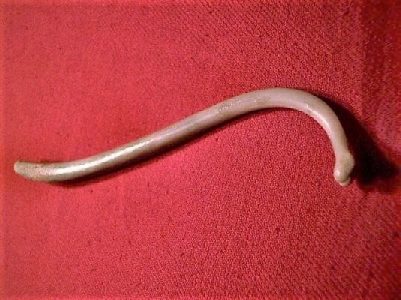
What’s a baculum, you ask? Well, it is an anatomical feature found in many mammals that puts the “bone” in boner.
It’s a penis bone.
The baculum’s purpose is exactly what it sounds like. It’s there to help male mammals’ equipment stand at attention during mating, so to speak.
Baculums are found in several different families of mammals, from some apes and monkeys to rodents, hedgehogs, seals, bears, and bats. What’s curious about the baculum is that biologists have determined that almost every kind of animal that has it developed it independently.
Animals that are not in any way related may have beculums, and it’s estimated that it has developed separately at least nine times. What’s more, the fossil record shows that other animal groups have lost baculums in 10 separate lineages.
One of those lineages is ours. And that’s why the human boner is completely bone-free.
Want more animal anatomical weirdness? Check our list of 8 creative ways animals use their tails.