
- These horses are making a comeback after missing from the wild for hundreds of years.
Every baby is a small miracle, but some of them are just a bit more miraculous. Especially if they’re the first of their kind in centuries.
The Przewalski’s horse is the last remaining true wild horse in the entire world. That’s not a small achievement in itself, as the species disappeared from large parts of the western Asian steppes centuries ago.
Since then, the horses have survived through captive breeding programs. In 2024, conservationists released a number of Przewalski’s horses in Kazakhstan to roam freely once again.
This marked the horse’s return to its ancestral roaming grounds for the first time in ages. This year, they achieved a whole new milestone.
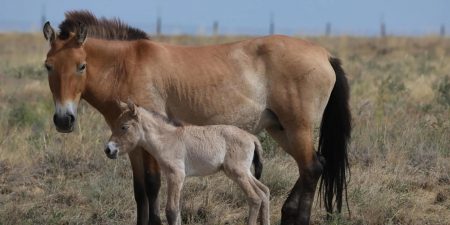
A mare from the 2024 herd gave birth to a healthy foal. This marks the first time a new Przewalski’s horse has been born in the wild in Kazakhstan for 200 years.
Here’s hoping this bouncing baby is only the first of many to come.
‘Important Milestone’
The new, as-of-yet unnamed male Przewalski’s foal was born on August 22, 2026, in the Alibi Reintroduction Center for Wild Ungulates, located within the Altyn Dala nature reserve. Despite being called a “reintroduction center,” it is not a zoo or an enclosed space. The Alibi Center consists of a large area of the steppe where the Przewalski’s horses live freely.
Our newborn foal’s parents belong to the group of seven horses released to the wild in 2024. Again, although they were kept an eye on, they mated and gave birth completely on their own without human intervention.
Which means there were eyes on them while they danced the equine horizontal mambo. A little creepy, but I digress.
The foal’s birth marks the first Przewalski’s horse birth in the wild in Kazakhstan since the species disappeared from the country more than 200 years ago. As such, it’s a major victory for the efforts of bringing the horses back to their native habitat.
“This … is the first new generation of Przewalski’s horses born in the steppes of central Kazakhstan and a very important milestone for the whole reintroduction program,” Albert Salemgareyev, the project coordinator from the Association for the Conservation of Biodiversity in Kazakhstan, said in a statement.
“For me, seeing him standing beside his mother in the Kazakh steppe is something I will remember for the rest of my life,” he added.
New Parents
The foals’ mother is a seven-year-old mare called Tessa. She was born in Germany in the Tierpark Berlin zoo before traveling to Kazakhstan.
According to reports from conservationists at the Alibi Center, Tessa has proven to be an attentive first-time mother. She stayed by her foal as he wobbled up on his hooves soon after birth before starting to nurse him. The young male now trots behind Tessa, exploring the steppe and learning how to horse around before returning for milk.
Sadly, the foal will never meet his father, Zorro. Born in the Prague Zoo, the conservationists had high hopes for the young and strong stallion. When he mated with Tessa, those hopes seemed to be fulfilling themselves.
But then disaster struck. In fall 2025, Zorro accidentally stepped into a marmot burrow and fell, severely breaking his front leg.
As you’re probably aware, a broken leg is typically a death sentence for a horse. Zorro perished from his injuries soon after.
Difficult History
It’s no surprise that conservationists expect great things to follow this new birth. After all, the Przewalski’s horse is emblematic of the Asian steppe – despite not having lived there for decades or even centuries.
These horses are the last remaining truly wild horse species in the world. Although American mustangs and other such horses are often called “wild,” they’re technically speaking feral. They’re descended from domesticated horses that ran away and adapted to a life in the wild.
The Przewalski’s horse, on the other hand, has lived in western and central Asia for thousands of years. They’re depicted in 20,000-year-old cave paintings from the area.
In 1878, Russian explorer Nikolai Przewalski officially described the horse in terms of Western science, and his name was attached to the species. Unfortunately, by that time, the horses were already on their way out the door.
Their numbers had been dwindling for centuries at this point due to overhunting, being captured for domestication, and breeding with domesticated horses. When Przewalski first laid eyes on them, the horses no longer existed in large parts of Asia – including Kazakhstan.
The last Przewalski’s horses in the wild were spotted in southern Mongolia in the 1960s. Afterward, they were declared extinct in the wild.
In 2024, they made their aforementioned comeback with seven horses returning to Kazakhstan. Another seven more followed them the year after, and eight more were released this year.
The conservation program’s ultimate goal is to bring 40 horses to Kazakhstan by 2029. Hopefully, this new foal is a sign of those numbers soon growing even further.
“I hope this is only the first of many foals and many more good stories to come from Altyn Dala,” said Salemgareyev.