
- You have to wonder what made this elephant so murderous.
Some families have a nemesis. It might be a neighbor, a distasteful distant cousin, or maybe an employer who mistreated one of the family members.
Shanichara Bote’s family is different. Their archenemy is an elephant, and for a good reason.
That elephant has killed four members of her family, despite them relocating to get away from the animal.
The beast in question is called Dhurbe. This Indian elephant is notorious for quite possibly being the most violent elephant in existence.
Over nearly two decades, Dhurbe has cut a bloody swathe through northern India and Nepal. In total, he has killed more than two dozen people.
Despite full-scale military operations to put an end to his reign of terror, Dhurbe has proven untrackable and unkillable. Considering his brutal history, it’s just a matter of time before he strikes again.
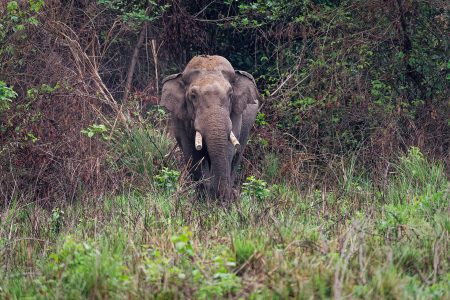
The Tragedy of the Bote Family
The story of the Bote family is a sad one, and it’s all because of Dhurbe. They first ran afoul of the murderous beast in 2012.
At the time, the Botes lived in the Nepalese town of Madi on the Indian border, just outside the Chitwan National Park. One day, while they were visiting the local market, an elephant rampaged out of the woods and trampled several people to death.
Among them were Budhiram and Jharali Bote, the parents of Shanichara Bote. This wasn’t the first time the village had encountered an elephant attack, but it was the first that affected the family directly.
It was also the last straw for Mr. Bote. He decided he wouldn’t put up with the marauding elephants any longer.
“The constant terror of wild elephants forced us to sell what we had and migrate to Jagatpur,” he told Kathmandu Post.
Jagatpur is not far from Madi, but separating them is the wide East Rapti River. Mr. Bote believed it would deter elephants and keep his family safe.
Sadly, he was wrong. On July 5, Mr. Bote found himself reliving the moments of horror 14 years ago when he was called to the local police station.
The police told him that his 25-year-old daughter-in-law and 4-year-old grandson were dead. They had been killed in an elephant attack.
And the killer was the same beast.
“After all these years, the exact same elephant found us again, raided our home, and took my daughter-in-law and my little grandson. There is nowhere left for us to run,” despaired Mr. Bote.
Proboscidian Murderer
Mr. Bote is not alone in his grief. The elephant, Dhurbe, has terrorized the Nepalese-Indian border region for 17 years.
Over that span, he has killed 25 people. He has attacked humans on many more occasions, but fortunately not all of them have resulted in fatalities. In fact, this latest killing of Mr. Bote’s relatives was the first fatal Dhurbe attack since 2017.
But why? Although elephant attacks are not unusual in the area, Dhurbe is so bizarrely aggressive that he has been nicknamed the most violent elephant in the world.
No one can say for sure. It’s impossible to rule out the possibility of Dhurbe being violently insane or somehow being wired wrong to enjoy rampant violence.
However, some wildlife experts have speculated that he may be traumatized by how Indian elephant herds treat young males. Dominant males typically drive potential young competitors away from the herd, often violently. Life is rarely easy for these youngsters, and Dhurbe may have learned that it’s better to kill than be killed.
Another theory that regularly crops up in local media is that Dhurbe is a product of failed human-wildlife coexistence. Loss of wildlife habitat may have driven Dhurbe into close contact with humanity – too close.
Maybe he’s scared to death of us, or perhaps he hates us. Either way, he seems to want all of us dead.
Military Response
The area’s residents aren’t taking Dhurbe’s violence sitting down. Some, like Mr. Bote, have moved elsewhere, while others have demanded an official response to the elephantine murderer.
That outrage has often spilled into the streets. Indeed, in the aftermath of the most recent tragedy, residents of Mr. Bote’s community staged public protests and blocked roads, demanding better management at Chitwan National Park.
Some in the crowd were also calling for Dhurbe’s death.
Authorities haven’t been sitting around completely idly, however. After his initial attacks in 2009-2010, Dhurbe was fitted with a radio collar so officials could monitor his movements. However, the transmitter broke within weeks.
In 2012, Nepalese authorities declared Dhurbe to be officially “mad” and authorized him to be killed. The Nepali Army sent a contingent of 93 soldiers into Chitwan with the sole mission of hunting down Dhurbe.
They couldn’t find him. The elephant went underground and laid low for years until 2018.
And that’s when he took his revenge on the military. Dhurbe smashed through the gates of an army outpost near Chitwan and freed a captured female elephant.
You know what they say about elephants and never forgetting.
For more stories about hateful beasts, check out our list of 9 animals that hold grudges.