
- Keep walking, folks. There’s nothing to see on the Strip.
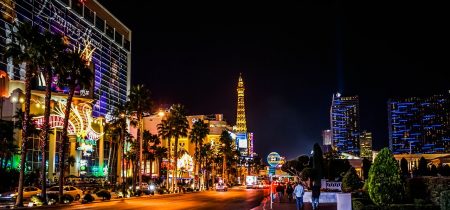
Ah, the world-famous Las Vegas Strip, with its lights, colors, casinos, and everything else luxurious and decadent! When visiting Vegas, especially for the first time, it’s hard to not stop to snap photos every few steps.
A new law passed by the Sin City should make it much easier to keep moving your feet, though. That’s because not doing so could earn you a hefty fine.
That’s right — Las Vegas has made it illegal to stop walking on the city’s pedestrian bridges.
The Clark County (in which Las Vegas is located) voted to pass the ordinance prohibiting standing on the walkways on January 2. A couple of weeks later, on January 16, the law went into effect.
In case you stop and stand around, you could end up paying hundreds of dollars in fines or face multiple months of jail time.
On paper, the legislation’s goal is to prevent dangerous conditions from forming on crowded bridges and to prevent criminal activity. Although the intentions behind the new law might be good, it does have its opponents.
Most significantly, the American Civil Liberties Union (ACLU) of Nevada argues the law could be used to circumvent civil rights established in the First Amendment. The wording of the law is admittedly quite broad and could theoretically be open to abuse.
You’d better hope no irate cop sees you if you have to stop and tie an open shoelace.
Safety in Mind
Let’s be clear, though — the new law doesn’t stop you from standing around everywhere in Las Vegas. According to the text of the law, it only concerns the city’s “Pedestrian Flow Zones.”
In plainer terms, that means the pedestrian bridges crisscrossing the Strip, alongside the connected stairwells, escalators, and other structures up to 20 feet away. All in all, the bridges account for some 6% of the total walkable areas available to pedestrians on the Strip.
Despite that, the ordinance text states that the pedestrian bridges experience a disproportionately high number of calls for law enforcement assistance. Emergency and service calls are twice as common on the pedestrian bridges than on Las Vegas’ regular sidewalks.
Lawmakers argue that the lack of space on the bridges is a big part of the problem.
“Unlike on a sidewalk where a pedestrian has a greater ability to avoid disorder, on the pedestrian bridge, the pedestrian is confined to the restricted space of the pedestrian bridge,” they write in the ordinance.
“Stopping on the pedestrian bridges creates conditions that can foment disorder which, in turn, can lead to crime and serious safety issues.”
The new law, then, seeks to improve safety by keeping the narrow bridges from clogging up. As long as people keep walking, they’re less likely to encounter problems, whether that’s pickpockets or anything else.
There’s also a caveat that allows people to stop while waiting to get on elevators, escalators, or stairs. It’s nice that you don’t have to keep walking in a circle while the elevator gets up to you.
‘Absolutely Not’ Stopping Tourists
The new law sounds alright in principle. However, some of its opponents have taken issue with its wording.
According to the law, it is now “unlawful for any person to stop, stand, or engage in an activity that causes another person to stop or stand within any Pedestrian Flow Zone.”
Does this cover all cases of stopping? To use our example from before, can you halt for a few seconds to tie a shoelace?
Going by the letter of the law, that could be a misdemeanor offense and earn you a fine of up to $1,000 or up to six months in jail. Yet, Clark County Sheriff Kevin McMahill went on record saying that his deputies would target people actually seeking to stir trouble.
“Are we going to stop people for stopping and taking a picture at all? Absolutely not,” McMahill told Las Vegas Review-Journal.
“But those chronic individuals up there that are preying on our tourists and our locals that are visiting the Strip are just not going to have a place to do it anymore.”
Despite the assurances, the ACLU of Nevada has said that it would sue to get the new law repealed. According to the organization, the ordinance makes it possible to stop people from exercising their First Amendment rights.
“That might mean the right to protest, that might mean someone who’s sharing expressions of their faith. That might mean a street performer,” Athar, Haseebullah, executive director of the ACLU of Nevada told the Associated Press.
“Making criminals out of ordinary Nevadans stopping for a mere moment on the pedestrian bridges they fund as taxpayers is lunacy.”
For the time being, however, if you visit Vegas, it’s best to keep walking and immortalize the sights in your own memory.