
- So it is written — when seven stars that shouldn’t be appear, you will find the hole in the sky.
Hearing someone talk about “stars that should not be” sounds unnerving at best to an average person. The phrase brings to mind something about ancient prophecies, biblical visions of the apocalypse, and dormant evils from beyond time and space.
To astro nerds, however, this all is very exciting. That’s because what we’re actually talking about is the rarest type of black hole.
Black holes basically fall into three size classes. However, all astronomers have found are either (relatively) tiny or horrifyingly massive holes.
They’re not sure why, but medium-sized black holes have eluded them for some reason. Now that’s changed.
Astronomers believe they’ve finally located a nice, middle-of-the-road black hole. And it’s all thanks to the seven stars that shouldn’t be.
Nope, it still sounds ominous.
No Middle Ground
Let’s kick things off with a quick astronomy lesson. In case you were unaware (like we were), not all flatulent space holes weigh the same.
Black holes can — at the most simplified level — be organized into three weight classes. The featherweight division consists of stellar-mass black holes with a mass of “only” up to 100 times that of the Sun.
In the heavyweight league, we have the supermassive black holes. These are monstrous, terrifying things sitting in the centers of large galaxies that swallow anything and everything, including light, space, and time.
But what about the middle-sized black holes? Well, that’s an excellent question, because so far, nobody has really found one.
Astronomers have spotted signs of intermediate-mass black holes (IMBHs) but have never been able to confirm their existence. They should, in theory, be just as common as tiny and giant black holes but, for reasons unknown, you just can’t seem to find them.
For Pete’s sake, it’s easier to find a black hole flying through space than a medium-sized one.
As such, astronomers consider IMBHs the missing link of black holes. Not having been able to research them, there are many unanswered questions about black holes, such as whether an IMBH could grow into a supermassive one.
Seven Out of 1.4 Million
Now, however, astronomers from the European Space Agency (ESA) may have finally discovered evidence of an IMBH. The neat thing is that you can see the place where it’s lurking with your bare eyes.
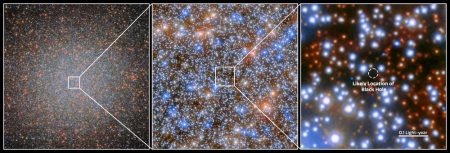
The supposed medium black hole is located in the central regions of the Omega Centauri star cluster. If you look at the night sky in a dark, rural area, Omega Centauri is about a moon-sized bunch of stars.
Scientists from the ESA, however, looked at the cluster a bit closer with the help of the Hubble space telescope. During their research, they examined 500 images of Omega Centauri to map and measure the velocities of 1.4 million stars.
This is the largest catalog of star motion ever made, which is impressive in itself. But among that vast number of stars, the astronomers noticed something… Strange.
“We discovered seven stars that should not be there,” summarized Maximilian Häberle of the Max Planck Institute for Astronomy in Germany, the study’s lead astronomer, in a statement.
Cosmic Speedsters
These seven freak stars are performing a rather bizarre cosmic dance. The biggest issue lies in their speed.
“They are moving so fast that they should escape the cluster and never come back,” said Häberle.
Essentially, the stars are careening through space at such an enormous speed that they should break out of any gravitational orbit and fly away into the void. Yet, they don’t.
The seven stars always come back, repeating their ridiculously fast loops over and over. Yet, the gravity of Omega Centauri alone shouldn’t keep them in place.
There must be something else lurking among the stars — something like an IMBH.
“The most likely explanation is that a very massive object is gravitationally pulling on these stars and keeping them close to the center. The only object that can be so massive is a black hole, with a mass at least 8,200 times that of our Sun,” explained Häberle.
Although he used the word “massive,” that weight would put the Omega Centauri black hole firmly in the middle-weight division of black holes.
“This discovery is the most direct evidence so far of an IMBH in Omega Centauri,” said Nadine Neumayer, also from the Max Planck Institute.
“This is exciting because there are only very few other black holes known with a similar mass. The black hole in Omega Centauri may be the best example of an IMBH in our cosmic neighborhood.”
Indeed, if the Omega Centauri hole is confirmed, it’s the closest non-stellar-mass black hole to the Earth. It’s okay, though, since it’s way too far to cause any issues for us.
Probably.