
- They said I was mad, but it’s alive! It’s alive! Well, maybe.
Have you ever seen a Tasmanian tiger? Unless you’re nearly 100 years old, you haven’t — the animal went extinct in 1936.
Still, Australians still occasionally claim to have seen the long dead creature prowling the wilds. Well, in the future, they actually might spot it again.
The Thylacine Integrated Genetic Restoration Research (TIGRR) Lab at the University of Melbourne is planning to pull a biblical stunt. Researchers from the lab intend to resurrect the Tasmanian tiger, reported Cnet.
Their plan may just be possible for two reasons. The first is the generous $3.6 million philanthropic donation the university got that allowed them to set up the lab.
The second reason is that the Tasmanian tiger went extinct relatively recently. As such, there are still preserved specimens with enough genetic material for researchers to work with.
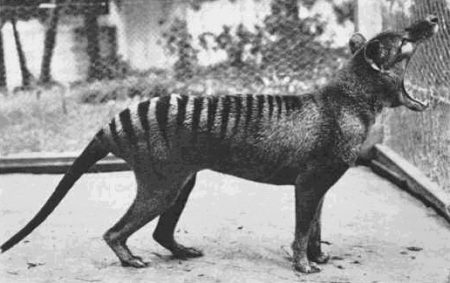
The Tasmanian What?
But let’s figure out what the scientists are trying to resurrect in the first place. After all, who’s ever heard of a Tasmanian tiger?
Well, the Australians, definitely. The animal is deeply ingrained into Australian folklore.
To begin with, the Tasmanian tiger — also known as the thylacine — is not a tiger. Like it’s relative the Tasmanian devil (of Looney Tunes fame) it’s actually a carnivorous marsupial.
That puts the Tasmanian tiger in the same order of animals as koalas, wombats, possums, and kangaroos. So why do they call it a “tiger?”
The name mostly stems from the tiger-like stripes the animal had on its back. But in body shape, the thing resembled more a medium-sized dog.
Like most other marsupials, the Tasmanian tiger had the famous pouch for holding its offspring. The exclusively meat-eating animals preyed on pretty much anything small enough for them to eat, but preferred birds.
Due to various factors, such as human activity, the arrival of the dingo, and changes in climate, the thylacine was nearly extinct already 2,000 years ago. It still clung on to parts of Australia until the 1830s and survived in Tasmania into the 1930s.
The last known Tasmanian tiger, called Benjamin, lived at Hobart Zoo in Tasmania. But on September 6, 1936, Benjamin died and took his whole species the grave with him.
CRISP Tiger DNA
But if the TIGRR project succeeds, we might see Benjamin and his kind crawl back out of the ground. We’re not talking about some kind of a supernatural zombie-marsupial scenario, though.
Instead, scientists have already used their sciences to decode the Tasmanian tiger’s full genome. To do it, they needed a DNA sample both from a Tasmanian tiger and a dunnart — a related, mouse-like marsupial.
“It turns out the dunnart is pretty much the closest thing to a thylacine of any living marsupial,” said Andrew Pask, an evolutionary biologist and the TIGRR project lead.
The Tasmanian tiger samples the scientists had weren’t good enough on their own to resurrect the species. But thanks to a tool called CRISPR, they could edit the dunnart’s DNA to match that of the thylacine.
Essentially, CRISPR allows scientists to turn genes on or off. They could compare the fresh dullart DNA to the Tasmanian tiger’s and mess with bits of it until they had a new, crisp Tasmanian tiger sample.
More Than Just Resurrection
But that’s not enough yet to resurrect the species. Pask says that any attempt to recreate the Tasmanian tiger is still at least a decade away.
Whether the TIGRR team can even attempt to pull off the resurrection depends entirely on advances in technology in the next few years. But if the tools become available, they have the DNA to give it a shot.
Pask, however, said that although resurrecting the thylacine is TIGRR’s ultimate goal, it’s not the only one. Instead, they hope their work can help still living marsupials.
“It’s not all Jurassic Park and, you know, ‘we shouldn’t be playing God.’ We actually need a lot of this stuff for protecting marsupials right now,” Pask explained
Take, for example, the quoll, another Australian marsupial. The Australian quoll population is currently crashing because of invasive cane toads.
Quoll’s love trying to eat the toads, but the issue with them is that they’re toxic. But what if researchers could use the knowledge from recreating the Tasmanian tiger DNA to give the quoll’s immunity to cane toad poison?
The quoll would survive and they could eat the toads that are threatening native Australian ecosystems. Win-win.
Of course, there are many other issues to solve before anyone can try resurrecting the Tasmanian tiger — including the question of whether we should do it in the first place. But thanks to the funding, the possibility is at least on the table.
And besides, if they’re trying to resurrect the mammoth, then why not the Tasmanian tiger? At least it’s smaller in case we do run into a Jurassic Park scenario.