
- You rarely see things that are so impressive, creepy, and revolting at the same time.
What would you want to do with a cockroach? Most people would like to squash, smash, or burn the verminous pest, but scientists aren’t wired like that.
Instead, a Japanese-led research team in Singapore has turned cockroaches into remote-operated brainless drones.
By inserting probes into the roaches’ nervous systems, the scientists can pilot them around like tiny robots. They envision their lobotomized cockroach slaves coming in useful in scenarios requiring access to extremely tight spaces, like during construction or disaster relief.
However, they ran into a problem. Water is probably the one place where cockroaches can’t survive, and their disgusting drones kept drowning in puddles and waterlogged areas.
What is a totally not mad scientist to do? Ah, of course!
They built tiny diving suits for their cockroaches. Now the mind-controlled little freaks can effortlessly dive through water.
Creepy but Useful
I suppose we should start from the beginning. So, why and how are researchers using cockroaches as controllable drones?
Behind this completely normal idea is a team led by Professor Hirotaka Sato at the School of Mechanical and Aerospace Engineering and Nanyang Technological University in Singapore. They’ve devised a way to insert tiny electrodes into Madagascar hissing cockroaches’ sensory organs and nervous system.
With the probes in place, the cockroach will physically respond to electrical stimuli sent through a tiny controller strapped to its back. Thus, the researchers can steer the bug’s movements as if it were a remote-controlled robot.
You’d feel bad for the thing if it wasn’t a cockroach.
They’re not doing this (at least entirely) to satisfy some evil mad scientist quota. Puppeting the zombie roaches around is a response to a real-world need.
In some scenarios, such as in the aftermath of a natural disaster or during large construction projects, it may be necessary to fit cameras or other equipment into tight spaces. Traditionally, this has been done with actual remotely operated robots.
However, these robots have their limitations in battery use, according to the researchers.
“Conventional artificial small robots which consume substantial power to drive actuators, draining the energy stored in their onboard batteries,” they wrote in the journal Nature Communications.
The cockroach drones don’t suffer from this issue as their electrodes consume next to no power. Additionally, roaches are notoriously adept at squeezing into minuscule gaps, so the puppet bugs can traverse terrain small robots can’t.
Literal Oxygen Suit
However, there’s one obstacle in the cockroaches’ way: water. Although cockroaches can infamously survive even a nuclear blast, they can’t live without oxygen and will eventually drown in water.
“The inability of terrestrial hosts like cockroaches to absorb aquatic oxygen prevents underwater functions,” the researchers put it.
That’s a problem in the cockroach drones’ intended operating zones, as both disaster and construction sites tend to get waterlogged. Puddles and flooded crevices will significantly reduce the capabilities of the roach robots.
If only the cockroaches had diving suits. Well, now they do.
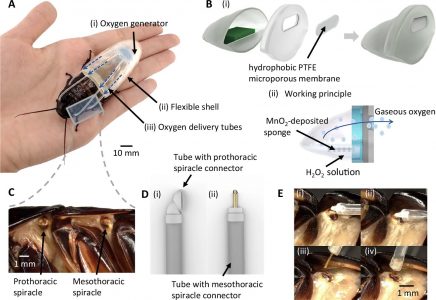
The researchers created a tiny scuba suit that supplies their enslaved cockroaches with oxygen underwater. Instead of a rubbery close-fitting outfit, though, it’s a 3D-printed watertight shell that slips over the roach’s abdomen.
From the main suit, tiny tubes stretch into the roach’s spiracles, or holes in its abdomen, through which the pest absorbs oxygen.
From the main suit, tiny tubes stretch into the roach’s spiracles, or holes in its abdomen, through which the pest absorbs air. Instead of having a conventional oxygen tank, the shell contains chemicals that react to produce oxygen.
According to the researchers, the diving suit works excellently. It barely hindered the roaches’ movements on land, and allowed them to speed through water as well.
“On land, the suit-wearing cyborg insects achieved an average forward speed of 87.5?mm/s … Underwater, the average forward speed was reduced to 78.4?mm/s,” they wrote.
The suits work for a long time, too. The drone roaches stayed underwater for more than three hours and weren’t worse for wear, although they were getting physically tired from swimming for so long.
Professor Sato’s zombie cockroaches are ready to help disaster relief workers. They’ve already done so without the diving suits, conducting search operations after the 2025 Myanmar earthquake.
Now, the lobotomized cockroaches can reach whole new areas. What a thrill.