
- What a time to be alive.
Scientists do much groundbreaking research, staging experiments that last years to discover ways to improve human life on a global level. But sometimes even they need a break and a chance to relax with something that’s more fun than world-changing.
This is when researchers start carrying out projects for the heck of it just to see what would happen. For instance, they might build a vodka-powered robot.
And why would they do that? Because they wanted to see if the phenomena that allow beetles to skate on water and cause Cheerios to cluster together could be used for… Something.
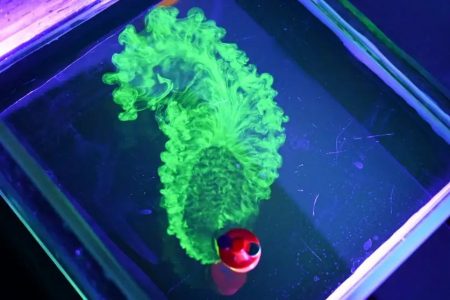
At least the things work as expected. The tiny alcohol-powered robots glide across the water like bugs, and they form groups just like Cheerios when you put several of them in the same container.
As to the practical applications, well, they’re not immediately clear. However, the researchers believe the robots can at least demonstrate their operational principles to school students, and they could also have industrial applications in some situations.
If nothing else, at least we can now say humanity has unlocked the ability to walk on water through the power of vodka.
Propelled by Vodka
This more or less earth-shattering discovery was unveiled in a recently published paper. Behind the study is a team led by Harvard graduate student Jackson Wilt.
Wilt and his team had observed that rove beetles in the genus Stenus use the phenomenon known as the Marangoni effect to zip and slide over bodies of water. To put it simply, the Marangoni effect takes place when a fluid with a lower surface tension spreads across a fluid with a higher surface tension.
This surface tension difference causes the fluids to flow, propelling whatever deposited the lower-tension fluid forward across the water’s surface. In addition to beetles, you may have seen this same effect with soap-powered toy boats.
Wilt’s team wondered if there was some kind of more serious application for the phenomenon. That’s why they decided to build a small alcohol-fueled robot.
Mind you, this is a robot at its most primitive. The thing is a small 3D-printed puck with an air chamber for buoyancy and a small tank for alcohol.
Fill the tank, and the alcohol will slowly leak out, pushing the robot forward. It couldn’t get much simpler, but hey — it works.
But why did Wilt’s team choose alcohol as the fuel when we already know soap would work as well? Well, alcohol is much more environmentally friendly as it evaporates quickly, whereas soap sticks around to contaminate bodies of water.
When it comes to the choice of alcohol, the robots prefer vodka (or methanol of similar concentration). They work with beer, too, but the stronger the alcohol, the stronger the propulsion.
“Absinthe… you’d have a lot of propulsion,” Wilt mused to NewScientist.
Like Cereals of a Feather
Having determined that the puck robots could move like the beetles, Wilt’s team started seeing how far they could push the concept. They started printing pucks with more than one fuel vent and then they began attaching several pucks together.
They discovered that with the right number of pucks and fuel outlets, they could get the robots to behave in certain ways. For instance, one combination caused them to slide around in wide arcs, while another made them spin wildly in one spot.
However, when placing multiple single-vent pucks in the same container, they noticed that they behaved like cereal. This phenomenon is known as the Cheerios effect — which is kind of fun in itself.
Just like Cheerios, the robots form a small dent on the surface of the water (or milk). With gravity, multiple objects of similar size and weight (i.e. the robots or Cheerios) are attracted to each other and tend to cluster together.
Thus, we now know how to build vodka-powered robots that behave like surfing beetles and your morning cereal. Thank you, science.
Pretty Pointless (For Now)
In the end, however, this all would be a wasted effort if the vodka bots can’t be used for anything. So, do they have a purpose?
Well… No. At least not for the time being.
Wilt is well aware that the vodka robots are currently nothing more than toys. However, he believes they could have a real purpose.
The most obvious use for them that Wilt sees is in education. The robots could help students of all ages understand how water surface tension works, and how animals and people use it to their advantage — and why their Cheerios behave the way they do.
All the teacher has to do is try and explain why they brought a bottle of vodka to class.
Yet, the robots could also serve environmental or industrial purposes. For instance, imagine a situation where ecologists or engineers need to disperse one liquid chemical over another.
As long as the liquids have different surface tensions, these robots could do it. What’s better, they could do it automatically, without supervision, and potentially at an incredibly low cost.
“I feel like there’s some really interesting behavior here,” said Wilt.
But even if they never end up doing anything important, at least we are happy with the robots as they are.
Come on, it’s a cute little robot powered by vodka. This is basically the Holy Grail of stupid but fun science.