
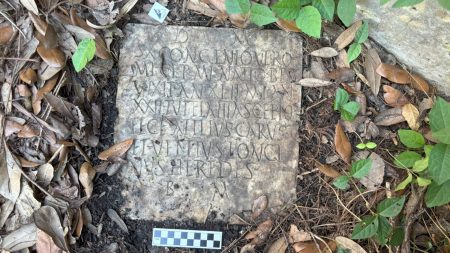
- The stone marked the grave of an ancient sailor, who would be very happy that people around the world remember his name.
You never know what you might find when you start going through your property. There might be all kinds of cool, old stuff buried somewhere.
That said, you’d probably expect to find your treasured in the attic or the basement, and not in your backyard. And you certainly wouldn’t expect to find a 2,000-year-old relic commemorating a ancient military veteran.
Yet, that’s a discovery of a New Orleans family recently made. When cleaning their overgrown backyard, they stumbled upon an unusual marble tablet.
Daniella Santoro is a professional anthropologist, so she’s familiar with historical artifacts. To her, the Latin writing on the tablet seemed unusual, so she asked a colleague to identify it.
It turned out that the slab is a gravestone that once marked the last resting place of a decorated ancient Roman navy soldier. It had disappeared from an Italian museum in the midst of World War II, and no one expected to see it again.
Now, the authorities are working to return the slab to its native country. The artifact’s homecoming will please a lot of Italians — not least among them the ancient sailor, whose has been remembered again after two millennia.
‘This Is Not an Ordinary Thing’
Daniella Santoro and her husband Aaron Lorenz, acquired a historical property in New Orleans, near the Mississippi River, in 2018. The old house had seen better days, and its backyard was almost completely overgrown.
One day in March 2025, Santoro and Lorenz were working to clear the vegetation from their backyard. Suddenly, they stumbled upon a half-buried slab of marble, covered under roots and leaves.
The discovery caused Santoro some concern for a couple of reasons. First, she was worried their “new” home sat on top of a forgotten graveyard (not an unusual occasion in New Orleans).
Second, the Latin inscription on the stone looked odd to Santoro. She works as an anthropologist at Tulane Univesity, so she’s familiar with a range of historical relics.
“The fact that it was in Latin that really just gave us pause, right? I mean, you see something like that and you say, ‘Okay, this is not an ordinary thing,’” Santoro told the Associated Press.
However, headstones inscribed with Latin wasn’t Santoro’s area of expertise. So, she contacted her colleague Susann Lusnia, and associate professor of Classical Studies at Tulane.
She also got in touch with the Preservation Resource Center of New Orleans. This way, she hoped to rule out the possibility of the slab marking the grave of an ex-New Orleans resident.
Decorated Serviceman
The good thing about the stone’s inscription was that it was quite detailed, if only you could read it. Lusnia certainly could, and what she read shocked her.
“When I first saw the image that Daniella sent me, it really did send a shiver up my spine because I was just floored,” said Lusnia.
The piece was indeed a gravestone, but it was way, way older than New Orleans. Its inscription explained that it marked the final resting place of one Sextus Congenius Verus.
He had died at the age of 42 at some point during the 2nd century. Although he died relatively young, he had behind him a long and apparently illustrious career in the elite praetorian fleet of Roman navy.
Verus had served for more than 20 years on the Asclepius, a trireme vessel named after the Roman god of medicine. Whether he fell in battle is impossible to tell, as the marker doesn’t mention his cause of death.
The gravestone calls the sailor “well deserving” of commemoration, implying that he had served the empire with honor. The memorial was commissioned by two men described as Verus’ “heirs” — likely being his fellow sailors as Roman servicemen weren’t allowed to marry at the time.
Not that this would prevent Verus from having children. But they wouldn’t have been recognized as his heirs, so his shipmates probably bought the gravestone to immortalize a beloved brother in arms.
Remembered Forever
Intrigued, Lusnia began to dig further into the slab’s history. As it turns out, the grave marker itself has gone on an adventure comparable to those of Verus himself.
The marker was originally discovered already in the 1860s, near the eastern Italian town of Civitavecchia (or Centumcellae as the Romans called it). This was a major military port back in the day, and an archeological dig unearthed a navy cemetery with some 20 graves — including that of Verus.
From here, the gravestone went on display at the National Archeological Museum in Civitavecchia. However, the building was utterly destroyed in World War II and it took decades to rebuild.
During those years, Verus’ gravestone disappeared and was assumed either destroyed or lost forever. However, following its rediscovery in New Orleans, we now know what happened to it.
After the news about the slab broke, Santoro received a call from Erin Scott O’Brien, the previous owner of their home. She had recognized the gravestone, saying she had inherited it from her grandparents — an Italian woman and a U.S. WWII veteran who was stationed in Italy.
O’Brien’s grandfather must’ve picked up the slab from the ruined museum as a wartime souvenir. She herself always only thought of it as a “cool-ass piece of art” that she kept in her yard.
Now, the FBI is reportedly working with Italian authorities to repatriate Verus’ memorial plaque. For the ancient sailor, all this international hubbub about his gravestone is probably the best thing he could imagine.
“Now Sextus Congenius Verus is being talked about so much,” Lusnia explained.
“If there’s an afterlife, and he’s in it, and he knows, he’s very happy because this is what a Roman wants—to be remembered forever.”