
- Apparently, machines can learn things we never meant to teach them.
Have you ever done a really good job at something but you’re not exactly sure how? Maybe you aced a big exam even though you’re fairly sure your answers were complete BS.
A group of astrobiologists are currently probably experiencing something similar.
The researchers developed a novel algorithm powered by artificial intelligence to help them figure out if certain materials recovered from space and other planets could be of a biological origin. In other words, the AI determines if a given piece of material presents proof of alien life.
The system has exceeded all expectations. It can determine with 90% accuracy whether samples are biological or nonbiological.
Not only that, it can classify samples into three different categories. The researchers found that fairly unexpected, considering they only taught the AI to sort samples into two categories.
How does the AI do it?
That’s the thing — the researchers aren’t sure. They built and trained the AI, but they don’t exactly know the inner workings of the identification process function.
Must be a weird feeling getting outsmarted by a piece of coding.
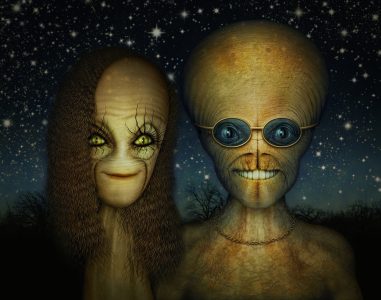
Smarter Than It Was Meant to Be
The new AI is a big deal for those searching for alien life. Its co-creator, astrobiologist Robert Hazen from the Carnegie Institution for Science, called it “the holy grail of astrobiology.”
“This routine analytical method has the potential to revolutionize the search for extraterrestrial life and deepen our understanding of both the origin and chemistry of the earliest life on Earth,” said Hazen.
“It opens the way to using smart sensors on robotic spacecraft, landers, and rovers to search for signs of life before the samples return to Earth.”
The AI has two advantages over the methods that came before it — it’s relatively simple and, above all else, it’s reliable.
The whole process begins by subjecting a material sample to pyrolysis, or airless heating that breaks it into gas and burnt, decomposed parts. Those parts can then be collected and given to the AI for analysis.
With 90% accuracy, the AI can say whether the sample originated from:
- A living source
- A fossil of a once-living being
- A non-biological source
That’s already impressive as it is. But the AI wasn’t supposed to do that.
According to Hazen, the team trained the AI to only tell biotic and abiotic samples apart. In other words, it was supposed to be able to say whether a sample was a rock or something that was alive at one point in time.
Somewhere along the way, the AI figured out on its own that it’s probably best to further split the biological category. And it’s right — being able to tell whether a biological sample was alive recently or millions of years ago is very useful to scientists.
How the Hell Did You Do That?
The research team must feel a bit puzzled, though. Their work has resulted in a potentially enormous advancement in their field — they just don’t know how.
Sure, they build the AI and its machine learning algorithms. They fed it the training samples and corrected mistakes as they went along.
Nonetheless, the scientists don’t know for sure what kind of a process the AI goes through to make its determination.
That’s the thing about this AI (and most others for that matter). They are really smart for machines and can make new associations between things as they work.
They wouldn’t really be artificially intelligent otherwise, would they?
Yet, AI developers often consider their creations only in terms of input and output. They care about what they can feed the AI and what it spits out on the other end.
What happens in the middle is less of a concern. And often, the developers might not actually really know.
This is the case here. The researchers have stumbled upon a significant discovery by accident — or maybe they’re just that good at programming thinking machines.
‘A Vast Ocean of Possibilities’
In the end, though, what’s the big deal? How exactly does the AI benefit astrobiology?
It does so in a few ways. First, through its advanced learning, it has demonstrated that even fossilized materials of biological origin are significantly different enough from nonbiological materials that it’s possible to tell them apart.
This can be a big deal in astrobiology. For example, a human scientist might think an alien fossil is just a funny-looking rock, but the AI will know better.
Second, it enables scientists to look for life completely unlike what we know on Earth. It’s relatively simple to identify things like DNA or amino acids — but what if alien life doesn’t have those things? The new AI should be able to identify even utterly bizarre life forms based on molecular distribution.
Finally, since it uses machine learning, the AI will get smarter the more it works. In the future, it could benefit not only astrobiologists but also researchers studying our own blue planet.
It could help paleontologists figure out important details about ancient fossils. Or, it could help an archeologist determine what kind of wood an ancient people used to build their huts.
“It’s as if we are just dipping our toes in the water of a vast ocean of possibilities,” said Hazen.