
- This ant theft shows that absolutely nothing is safe from thieves.
Even the most law-abiding and upright citizen can understand why criminals steal some things. Money, jewelry, cars, electronics, or tools all at least have either value or utility to make them worth swiping.
But an ant nest?
That’s the kind of outlandish theft the police and nature conservators are dealing with in Great Britain. Someone has pilfered an entire nest of England’s rarest ants.
The once widespread but now critically endangered ants live only in one nature reserve. They’re so rare that wildlife agencies have been able to count and map every single remaining nest.
Imagine their surprise then when one of those nests vanished. Where was once a teeming ant colony is now only a hole in the ground.
Signs at the site indicate that the nest’s disappearance was not the work of some enterprising ant-eating animals. It was clearly dug up with human tools and taken away.
But who did it? And more importantly, why?
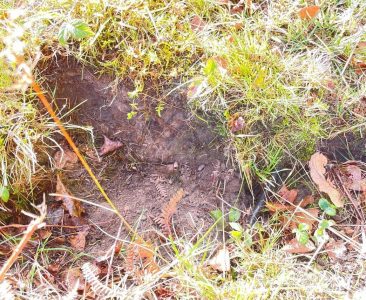
Empty Hole
The stolen ant nest was built by a species known as the narrow-headed ant. True to their name, the most defining feature of these ants is their head shape, which looks like someone pinched their heads, which cartoonishly remained in their squashed state.
Narrow-headed ants live only in the Chudleigh Knighton Heath in southwest England. It was here that the Devon Wildlife Trust (DWT) discovered in mid-October that a nest had been stolen.
During a regular check at the nest’s location, the DWT said that its staff only found a newly dug hole. According to the organization, signs at the nest site clearly show that the earth had been disturbed with a shovel or spade.
A narrow-headed ant nest typically contains 1,000 to 5,000 ants. It can also have more than one queen, which may live for up to 25 years.
The ant nests are designated as Sites of Special Scientific Interest under U.K. law. Disturbing or removing them is a criminal offense, and the DWT has reported the nest theft to the police.
“This is a crime every bit as serious as illegal raids on wild bird eggs. It shows the pressures that our nature and wild places are under,” Julia Balfour, DWT species recovery officer, told Mid-Devon Advertiser.
‘Significant Loss’
The narrow-headed ant was once common across much of England and Scotland. However, it has fallen on hard times in the last 100 years.
Loss of the ants’ native heathland habitats has spelled doom for the species in virtually all of the British Isles. These days, the insects only hang on in Chudleigh Knighton Heath.
Even there, they’re not exactly thriving. The DWT knows of 142 recorded living nests. Although that might sound like plenty, when you consider how widespread ants usually are, it’s not many.
On the positive side, knowing where each nest is helps wildlife conservation agents keep an eye on the ants, as they can easily verify their condition. At the same time, however, losing even one of those nests is a big blow to the ants.
“The removal of an established nest is a significant loss for this species. Narrow-headed ant colonies develop slowly, and each mature nest, with its long-lived queens, represents many years of growth that cannot quickly be replaced,” explained Balfour.
Why Steal Ants?
Of course, the big question with this bizarre crime is why. Why on earth would anyone dig up and steal an entire nest of ants?
That’s just the thing – we don’t know. The DWT and the police are investigating the theft, but they haven’t yet found any suspects (or at least they haven’t said they have).
However, the DWT has two educated guesses of why somebody might have pilfered the ants. One is more positive than the other.
In the best possible scenario, the theft might be a rogue insect enthusiast’s misguided attempt at helping the ants. Somebody might’ve dug up the nest in the hopes of taking it somewhere else so that the ants could spread to new areas.
The big problem with that is that the ants are picky about their environment. Additionally, the shock of the nest removal might cause them to abandon the colony and wander off to their deaths.
The more nefarious option is that the ants may have been stolen by a private collector. An amateur entomologist might want the ants for themselves, or the criminals might be hoping to sell the extremely rare insects for a big pile of money.
In either of these cases, though, it’s unlikely that the demanding ants will survive the domestication attempt. We can only hope the authorities find the ant thieves before they steal more irreplaceable nests.