
- Then again, we’ve thought they were gone before…
They’re big, they’re mean, they’re potentially fatal to bees and humans alike. That’s a murder hornet for you.
These giant Asian hornets arrived on U.S. soil in 2019, when they were first detected in Washington state. Since then, state and federal officials have waged a battle to prevent the invaders from advancing farther.
That battle required some high-tech weaponry. Exterminators used everything from poison to tiny GPS trackers to keep the hornets at bay.
At times, it seemed like it was already over — like in 2020, when we reported that the threat was thwarted. Yet, new nests that had been previously missed kept cropping up in Washington.
Now, however, it has been three years since the last murder hornet sighting. Consequently, Washinton state and federal officials have both declared that the war is over.
We won.
Or at least we beat back this invasion. You see, they still don’t know how the first hornets got over here in the first place.
That’s reassuring.
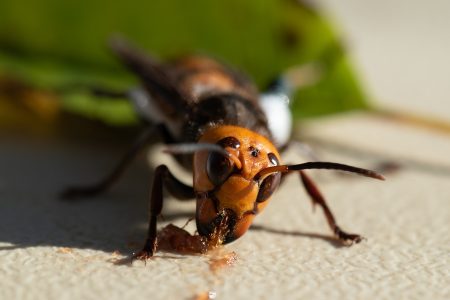
What’s a Murder Hornet?
In case you’re unaware of the murder hornet threat, here’s a quick refresher for you. The murder hornets are officially known as northern giant hornets, native to East and Southeast Asia.
And when they say giant, they mean it. This is the world’s largest hornet, with the queens growing to be more than two inches long.
Fortunately, they don’t really leave the nest. You just have to contend with the worker hornets, which are still the size of your thumb — and pack one hell of a stinger.
The murder hornet’s stinger is typically a quarter-inch long and strong enough that it can punch through a regular beekeeping suit. It delivers a dose of potent venom that can be lethal.
In Japan, for instance, these things kill 50 people a year on average.
Yet, believe it or not, their ability to take down a human isn’t the biggest problem with the murder hornets. That would be their penchant for eating bee larvae.
However, the larvae are inside the bee nest. How are the hornets to get to them?
It’s simple, really. They massacre the entire nest.
Only a couple dozen murder hornets can wipe out a colony of tens of thousands of bees in a few hours. Their favorite method of killing bees is to rip their heads clean off.
You can see why they’re called “murder hornets.” And you can also see why U.S. beekeepers really don’t want them to get a foothold here.
Bringing Out the Big Guns
Yet, in 2019, they came. A Washington state beekeeper found one of his nests destroyed, filled with decapitated bee carcasses.
Soon enough, they found the nest. That marked the beginning of a multi-year struggle against the invading hornets.
The battle was made all the more difficult by the fact that environmental agents and exterminators couldn’t just kill individual hornets. They needed to find the nests — otherwise, the hornets wouldn’t go anywhere.
After all, a single nest can hold up to 200 queens, each capable of establishing a nest of its own.
Whenever authorities sighted a murder hornet, they would establish a network of traps in the vicinity to catch more of them. These captive hornets, however, weren’t killed.
Instead, the authorities fitted tiny GPS trackers on the hornets before releasing them near their point of capture. As they returned to the nest, they unwittingly led the exterminators there.
Then, it was a matter of vacuuming up every last hornet and gassing them to death. Well, that makes it sound too simple — since they can penetrate a beekeeping suit, the exterminators needed specially made protective gear that looks kind of like a space suit.
‘Landmark Victory’
Multiple times, the authorities declared victory over the murder hornets. Each time, a new nest would eventually be found elsewhere.
This time, however, it seems the hornets may be gone for good. It has been three years since anyone has found a murder hornet in Washington and, to the authorities, that’s long enough.
State and federal officials have declared that we have won the war.
“We are proud of this landmark victory in the fight against invasive species,” Mark Davidson, deputy administrator at the USDA Animal and Plant Health Inspection Service, told The New York Times.
However, one cloud looms over the victory parade. That’s the fact that nobody knows how the hornets got to the U.S. in the first place.
As such, they could make their way here again. And what if we missed one nest hiding somewhere?
In fact, Washington state officials have just started investigating a possible new hornet sighting 100 miles away from the previous hotspot. That said, it wouldn’t be the first time someone mistook regular wasps for the murder hornets.
But what if they didn’t?