
- This weirdo shows that you don’t need to look pretty to do just fine.
Paleontology, or the study of extinct organisms, can be a tricky field. Often, researchers discover remnants of ancient creatures with absolutely indecipherable body structures.
Those features are surprisingly commonly due to some kind of physical damage. After all, it’s easy for bones to crack and warp over millions upon millions of years, resulting in bizarre and misleading shapes.
But then there are times when the strange features turn out to be accurate. That was the case with Tanyka amnicola.
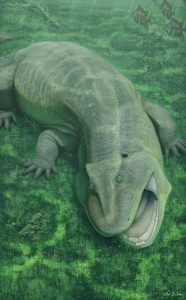
This weirdo is prehistoric to the extreme, belonging to a group that would eventually evolve into reptiles, birds, and mammals alike. Yet, it lived millions of years after all others of its kind had died, being a living fossil of its time.
Yet, its freakiest feature is its sideways jaws. For some reason, T. amnicola’s jaws and teeth were twisted to a seemingly unnatural 90-degree angle.
So, at a time when primitive dinosaur-like creatures were just beginning to appear, this slack-jawed oddity prowled the world as a living reminder of their ancestry. I’m not so sure the dinosaurs appreciated that.
What Little We Know
Frankly, we don’t know much about T. amnicola as it’s only known from a handful of fossils. And most of those consist of its outlandish jawbones.
But let’s still go over the basic facts that we do know. T. amnicola was a stem-tetrapod that lived in the area of modern Brazil some 275 million years ago.
“Stem-tetrapod” means that this creature belongs to the group from which most modern tetrapods draw their lineage. And what are tetrapods?
Well, it’s a huge group of four-limb vertebrate life that includes, among others, reptiles, birds, and mammals – including humans. Although all of these creatures aren’t directly descended from T. amnicola, you could argue it’s something of a great-times-thousand-granddaddy to all of them.
That said, if you’d seen T. amnicola while it lived, you may have thought it’s some kind of funky lizard or salamander. Maybe.
As I said, we really have no clear idea of the creature’s overall body structure, since most of its bones are still missing. Researchers haven’t even determined how big it was since all they have are the jaws, but they guess it grew maybe three feet long.
But who cares about any of that? The jaws that they have are some bizarre jaws, I tell you what.
Most Slack Jaw Ever Made
When researchers dug up the first T. amnicola jawbone from the bottom of a dry Brazilian river in 2015, they thought it was seriously messed up. Their best guess was that either millions of years of being buried had warped the bones or the poor animal had some kind of birth defect.
After all, how else would you describe a jawbone that’s twisted so that its teeth point sideways?
That theory, however, flew out the window once they discovered more jawbones. By now, researchers have dug up nine sets of T. amnicola jaws – and they’re all bent at a 90-degree angle.
“They all have this twist, including the really, really well-preserved ones. So, it’s not a deformation; it’s just the way the animal was made,” Jason Pardo, a research associate at the Field Museum in Chicago, said in a statement.
But how on earth could this critter have lived with its crooked mouthparts? Based on its tooth structure, researchers believe it was an herbivore.
Not just that, but it was likely among the first animals to grind up plant matter for its food.
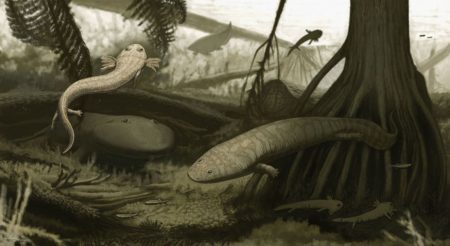
The current theory is that T. amnicola used its bizarre jaws to comb through underwater plants for sustenance. Plants grow straight up, after all, so its weird sideways jaws may have made for surprisingly efficient leaf strippers.
The Platypus of Its Time
Its jaws aren’t the only odd thing about T. amnicola, however. The time when it was alive is also baffling scientists.
As I mentioned, the creature lived around 275 million years ago, meaning it’s so ancient that it predates things like flowers, grass, and dinosaurs. In a way, that seems fitting, as life back then was pretty strange.
But the thing is, as a stem-tetrapod, T. amnicola should’ve been long dead at that point. All others of its kind had been extinct for a long, long time when this weirdo was crawling in muddy rivers.
“In the sense that Tanyka was a remaining member of the stem tetrapod lineage, even after newer, more modern tetrapods evolved, Tanyka is a little like a platypus,” mused Pardo. “It was a living fossil in its time.”
And frankly, a platypus makes an excellent comparison. Much like the little beaked Australian freaks, the Tanyka amnicola bore features completely out of place with anything around it, living millions of years past its time.
Yet, it’s just the way it liked it.
Interested in learning more about the platypus and other creatures that haven’t changed much with the passage of time? Read our list of 10 forms of life that look just like they did millions of years ago.