
- This is probably your one and only chance to own a large piece of the Red Planet.
Ah, Mars — the Red Planet. It has tantalized humankind for thousands of years, either in the role of a deity, the target of future space colonization, or simply as the home of little green men.
Now, you have a chance to own a hefty chunk of it.
Because everything is for sale these days, you’ll soon have a shot at purchasing a bona fide, genuine piece of Mars. The largest known meteorite consisting of Martian stone on Earth is going up for auction.
Known as NWA 16788 (no relation to the ‘80s rap supergroup), will be sold on June 16 by the auction house Sotheby’s. It is one of the rarest objects ever auctioned.
If you’re hankering to have your own piece of Mars, you’d better have deep pockets, though. The selling price of NWA 16788 is expected to reach several million dollars.
As to what you could do with your purchase… Well, we don’t know. Perhaps the buyer will be generous and donate the rock to science instead of keeping it in a glass cabinet in their living room.
It would make for one heck of a conversation starter, though.
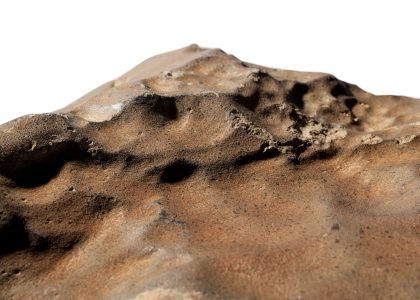
Meet the Meteorite
NWA 16788 is an exceptional specimen in many ways. To begin with, it’s enormous as far as Martian meteorites go.
The hunk of rock, measuring 15 by 11 by 6 inches, weighs 54.4 pounds. It’s more than 70% larger than the next-biggest known Martian stone, so it’s quite the giant.
Considering that all confirmed Mars-originating material on Earth totals 374 pounds, this single meteorite represents just short of 7% of all Martian objects ever recovered.
In addition, NWA 16788 is an incredibly rare object. It’s one of the only 400 known meteorites that have originated on Mars.
To put that further into context, there are 77,000 officially recognized meteorites currently on Earth. So, it’s a rare visitor indeed.
Is It Really Martian?
But how do we know it actually is Martian in origin? And how did it get to Earth?
Well, the meteorite was discovered on November 16, 2023, in a remote region of Nigeria. It shows next to no erosion on its surface, which indicates that it crashed down to Earth relatively recently (although its exact arrival date is unknown).
Speaking of the thing’s surface, that offers our first clue that this thing is not from ‘round these parts. The stone has a strange glassy coating, a result of its melting partially as it screamed through the Earth’s atmosphere.
Additionally, the meteorite consists of — according to Sotheby’s — “olivine-microgabbroic shergottite.” To make things simple, that’s a kind of stone that we know forms when Martian magma cools slowly, thanks to samples collected by NASA’s Mars rovers.
Finally, there were bubbles of gas trapped inside the meteorite. Analyzing the gas’ composition showed that it matches atmospheric samples retrieved from Mars.
There really is no doubt that this rock originated on the Red Planet.
How Did It Get Here?
As to how it got here, we have a series of incredibly unlikely events coming together just right. NWA 16788 must have been launched into space by another, immensely larger meteorite crashing into Mars.
We don’t know its exact point of origin. However, astronomers have identified only 19 impact craters on Mars that are large enough to indicate an asteroid crash of sufficient magnitude to hurl NWA 16788 to Earth.
After it left Mars, the meteorite’s fate was far from certain. After all, it had to travel across 140 million miles of space to reach Earth without crashing into anything else in the middle.
Not only that, the timing of the initial impact that knocked NWA 16788 loose had to be perfect — and it was. Earth was just the right position on its orbit around the sun so that the meteorite could hit our planet in the first place.
Finally, the original chunk of stone had to be big enough not to disintegrate completely before plowing through our atmosphere.
We don’t know the kinds of math to actually calculate the likelihood of the meteor making it here. But we can tell you that it’s very small.
Expensive Rock
Yet, NWA 16788 made it this far. And now, you can buy it — if you have heaping stacks of cash burning a hole in your pocket.
Bidding will start at $1.9 million. However, Sotheby’s states that it expects the final selling price to climb to the region of $4 million.
That’s a lot of money for what is little more than a big stone. Then again, if you want to own a big stone, this is probably the big stone to own.
And hey — when’s the next time you’re going to get a chance to buy a heaping helping of Mars?