
- Imagine being so angry at your (possible) father that you desecrate his tomb and steal it for yourself.
Ancient Egyptians buried their pharaohs in glorious tombs with plenty of pomp and circumstance. It was all done so that the deified ruler could continue his reign in the afterlife.
As such, it seems unthinkable that they would desecrate a pharaoh’s tomb. Yet, grave robbers were surprisingly common in Egypt.
Recently, researchers discovered a very literal case of grave robbing.
The tomb of Pharaoh Shoshenq III was discovered ages ago and is well known. Or, well, at least it’s supposed to be Shoshenq III’s tomb.
The pharaoh himself, however, is nowhere to be found. Instead, many objects in his mausoleum carry the name of his immediate successor, who is potentially his son.
For ages, it was a mystery where Shoshenq III had gone. Now, however, we know.
In the tomb of Shoshenq III’s predecessor, there has been an unmarked coffin that everyone assumed was either empty or belonged to an unimportant sideshow. Yet, recently unearthed figurines have shown that the person in the plain box is not some nobody.
It’s Shoshenq III.
It appears his maybe-son-definitely-successor emptied out his daddy’s tomb, dumped his corpse in an old grave, and took over the place. We can only speculate why he would do such a thing.
Troubled Reign
The drama over the tombs took place nearly 3,000 years ago in Tanis, northern Egypt. At the center of the events is Pharaoh Shoshenq III.
He is believed to have ruled from 841 BC to around 800 BC, so roughly four decades. During Shoshenq III’s reign, Egypt wasn’t united, and his relatively long reign was marred by near-constant warfare.
Yet, he was able to have several monuments built to glorify his name. Look, we’re talking about an Egyptian pharaoh — modesty isn’t the name of the game.
As was customary, he also built a tomb (though not a pyramid) for himself. So, once he died, he was buried in the place prepared for him.
But that’s not where ol’ Sho would stay.
Where’s Sho?
Shoshenq III’s tomb was discovered in the ‘80s. However, it quickly became clear that something was amiss.
The sarcophagus in the tomb bore inscriptions that made it clear that its resident was not Shoshenq III. Instead, the person buried in the tomb was Shoshenq IV, his successor and possibly son, although their exact relation is unclear.
It was also unclear what happened to Shoshenq III. Writings and other artifacts in the tomb showed that it really was supposed to be his tomb, yet his successor had taken over the grave complex.
Well, without Shohenq III’s mummy, all anyone could do was make wild guesses. So, Egyptologists shrugged and filed this under “we’ll probably never know.”
There’s Sho!
A fresh discovery, however, has shed light onto the mystery. To find that light, we must travel to another tomb in Tanis.
This grave belongs to Osorkon II. He was Shoshenq III’s predecessor, and his tomb was found way back in 1939.
At that time, archeologists also noticed that the tomb had an extra, unmarked sarcophagus. They didn’t pay it much mind, probably figuring it belonged to a servant who were sometimes buried with their masters.
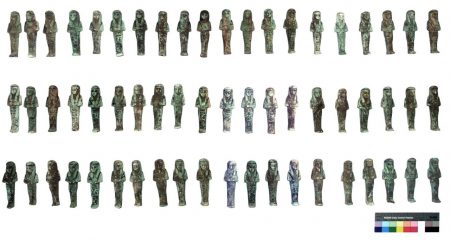
Yet, recently, a French-Egyptian team of researchers took a closer look at the 255 small figurines unearthed around the nondescript coffin. Examining them, they noticed something weird.
The figurines were inscribed with the name Shoshenq III. These were shabtis, representations of servants that were to tend to a deceased pharaoh in the world beyond.
The corpse in the unmarked sarcophagus is Shoshenq III. His body had been removed from his tomb and stuffed in Osorkon II’s grave to make way for Shoshenq IV.
How’s that for power politics?
Family Matters
Of course, you can’t help wondering what happened. Why did Shoshenq IV sweep his (possible) dad’s grave clean just so he could lie there himself?
There are a couple of theories. First, it was not actually uncommon for Egyptian rulers to clear old graves belonging to pharaohs whom nobody remembered anymore.
Hey, if you don’t have the money or workforce to build your own tomb, might as well recycle.
However, Shoshenq IV would have absolutely known who the tomb belonged to. As such, it seems unlikely that this wasn’t a very deliberate act.
So, why would he do something so malicious? Well, that might have something to do with how Shoshenq III became pharaoh in the first place.
When Osorkon II died, he hadn’t appointed a clear heir and the line of succession was twisted at best. Nobody can tell what really went down, but it seems the circumstances around Shoshenq III’s ascension to the throne are a bit questionable.
Perhaps Shoshenq IV felt that his maybe-father hadn’t been a legitimate heir to Osorkon II. The latter, by the way, may have been Shoshenq III’s grandfather and Shoshenq IV’s great-grandfather.
In the end, Sho IV may have felt his daddy was unworthy of a tomb of his own. Perhaps he cleared Sho III’s tomb out and dumped his body in great-grandpappy’s grave, just to add insult to injury.
Talk about family drama.
Want more Egypt-related oddities? Check out these weird facts about King Tut and learn how his curse may help cure cancer.