
- That’s no moon. It’s a… Tiny asteroid, honestly.
A bright full moon shining in the night sky is one of the most beautiful sights in nature. So imagine how much more beautiful it would be if there were two moons.
Soon, you won’t have to imagine that. Earth is just about to get a second moon.
Sort of. For a little while.
An asteroid dubbed 2024 PT5 will enter Earth’s gravitational pull next week. According to astronomers’ calculations, it will spend a couple of months making a slow circle around the planet before it breaks free and heads back to where it came from.
Unfortunately, that doesn’t mean we get to admire a double moon in the sky. Our new cosmic companion will be virtually impossible to see, at least without a professional telescope.
But hey, for a few weeks, we’ll be a little less lonely while floating through the void.
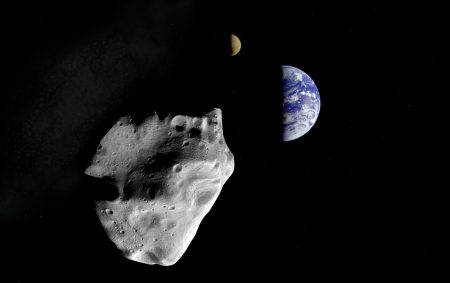
It Came from the Sun
As we mentioned, our new cosmic companion carries the designation 2024 PT5. Astronomers first noticed the hunk of ice and rock careening through space on August 7.
The asteroid is roughly 32 feet in diameter. It hails from the Arjuna asteroid belt, which orbits the sun roughly 93 million miles away from its surface.
We don’t know why 2024 PT5 decided to take off and go on a little trip. Nonetheless, the asteroid was spotted last month — and it was heading for Earth.
Don’t worry, though. It’s not about to collide with the planet and even if it did, a rock this small wouldn’t amount to a whole heck of a lot.
That said, 2024 PT5 will do something unusual with Earth. It’s approaching close enough at such a low speed that our blue planet will trap it for a while.
“Under these conditions, the geocentric energy of the object may grow negative, and the object may become a temporary moon of Earth,” Carlos de la Fuente Marcos from Universidad Complutense de Madrid told Space.com.
And that’s just what 2024 PT5 will be. In the broadest sense of the term, the asteroid will become Earth’s new moon on September 29.
Just… A whole lot smaller than our more familiar orbiter.
A Brief Visit
With all that said, Earth having two moons won’t change much for us on the surface. As mentioned, the 2024 PT5 is just barely over 30 feet in diameter, so you can’t even see it flying by in the night sky.
“The object is too small and dim for typical amateur telescopes and binoculars,” said Marcos. Those lucky enough to (somehow) own an astronomer-grade telescope with a lens of at least 30 inches and a CCD or CMOS detector will be able to catch a glimpse of it, though.
Even if you were to own such high-grade equipment, you’d have a relatively short window to see the asteroid. After all, it won’t stick around forever.
“If a true satellite is like a customer buying goods inside a store, objects like 2024 PT5 are window shoppers,” mused Marcos.
Indeed, the 2024 PT5 won’t spend more than a couple of months around Earth. According to astronomers’ estimates, it will shoot out of the planet’s orbit on November 25.
After that, it will likely head back in the direction of the Arjuna asteroids. Where it will ultimately end up, though, nobody knows.
Types of Mini-Moons
Strange as it might seem, these kinds of mini-moon events aren’t all that rare. They happen relatively frequently, but most are so short that they don’t really break the news threshold.
Mini-moon events fall into two categories — long-term and short-term. They are pretty much exactly what it says on the label.
Long-term mini-moons get trapped in a planet’s orbit for long enough that they can complete at least one full revolution around it. They can last for years, decades, or even centuries until the orbiting asteroid finally flings itself back into the void.
In short-term mini-moon events — like the 2024 PT5 one — the asteroid doesn’t complete even one full revolution before leaving orbit. However, they can still last several months, depending on the size, speed, and distance of the visiting rock.
Earth experiences multiple short-term mini-moon events every decade. Even long-term events aren’t that uncommon, with one occurring every 10-20 years.